
Modified Polypropylene (PP) · Full Category Range
Modified Polypropylene PP Granules — GF30, Impact Copolymer, Mineral Filled & FDA Food Contact Grades
Low Density + Food Contact Compliance = Cost-Saving Workhorse
Juhai manufactures a complete range of modified polypropylene (PP) compounds tailored for appliances, automotive, food packaging and electrical industries. With densities from only 1.05 to 1.13 g/cm³, our PP grades deliver up to 20% lower per-part weight cost vs equivalent glass-filled nylon alternatives while offering FDA and EU food-contact compliance on select formulations.
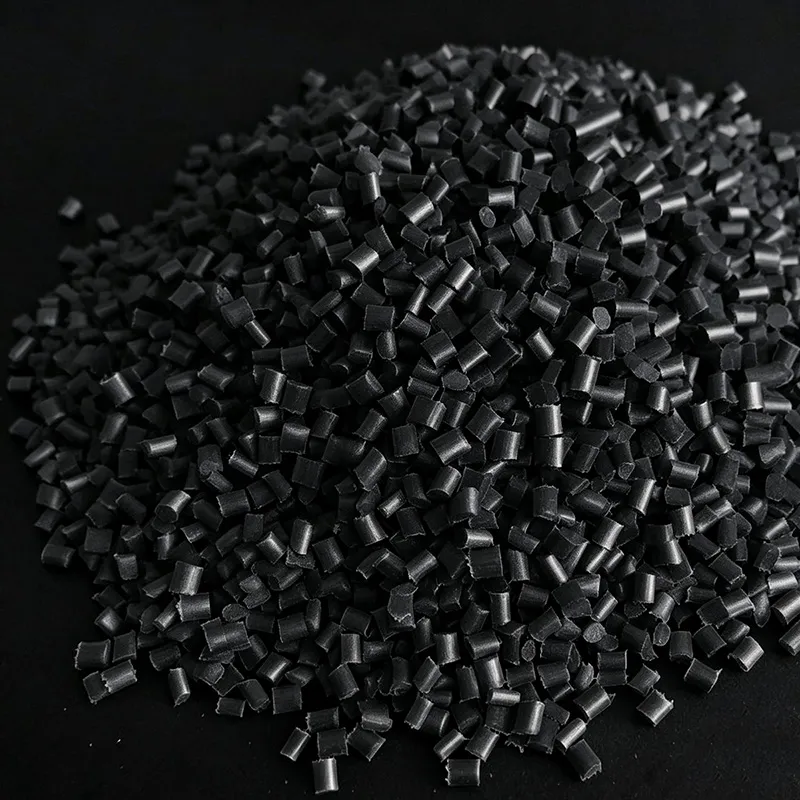
Full PP Grade Lineup
Five standard modified PP families covering structural reinforcement, low-temperature toughness, dimensional stability, fire safety and food compliance. All grades customizable for GF% / filler%, color, UV stabilization and processing flow.
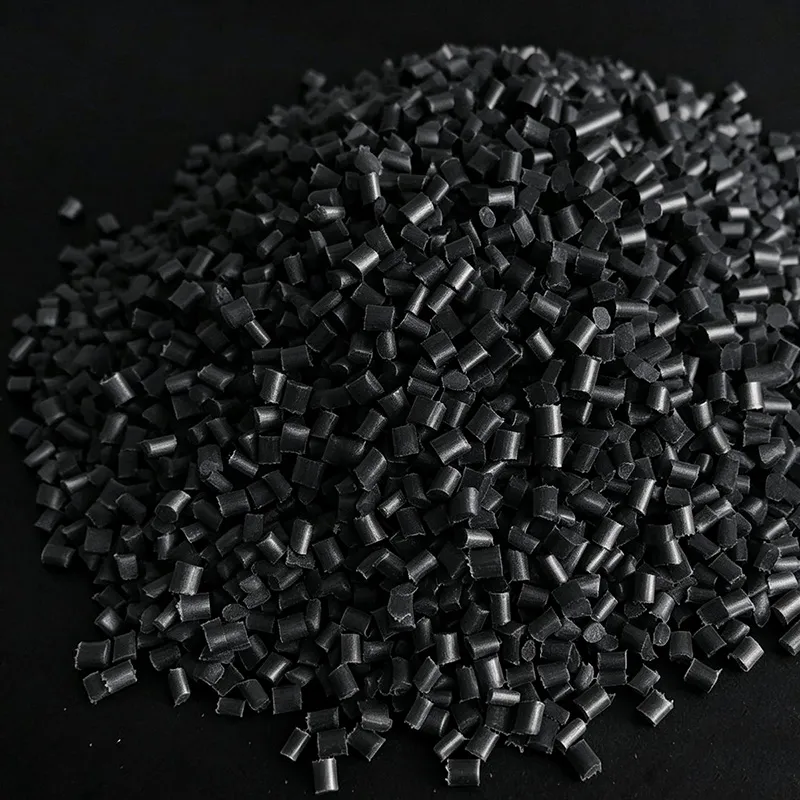
PP GF30 · Glass Fiber Reinforced 30%
Homopolymer PP reinforced with 30% chopped E-glass fiber. Tensile strength 90+ MPa, flex modulus 4.5 GPa. Excellent stiffness-to-weight ratio for appliance structural frames and furniture components.
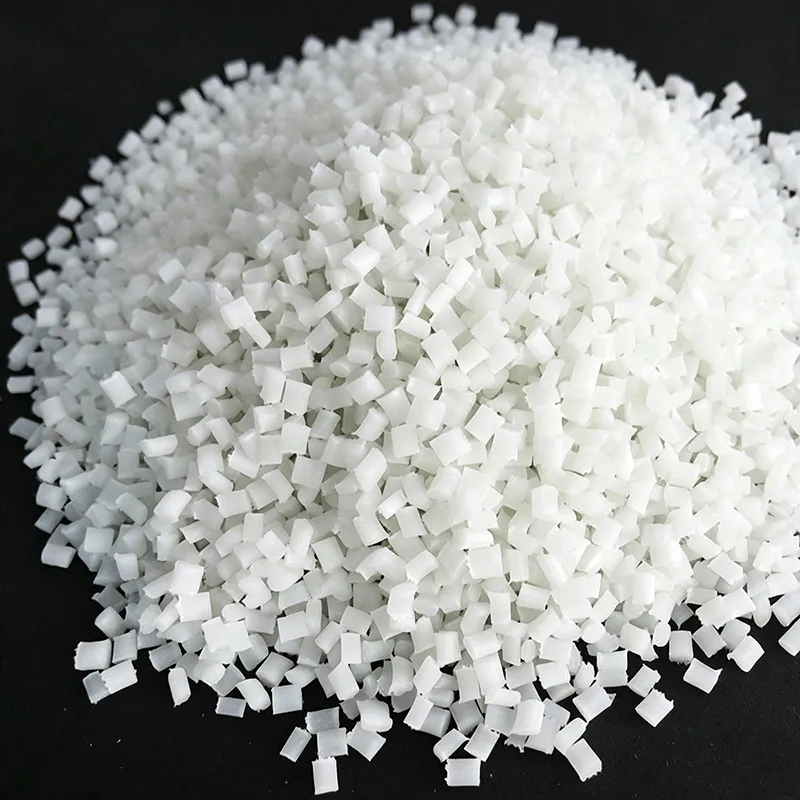
PP IM20 · Impact Copolymer (TPO)
Ethylene-propylene block copolymer with 20% EPR/EPDM elastomer. Superior room-temperature and -20°C low-temperature impact. Widely specified for automotive bumpers, instrument panels and exterior trim.
Why Choose Our Modified PP Compounds
Four core advantages that make Juhai modified PP the preferred drop-in replacement for higher-cost engineering plastics across appliance, automotive and food-contact industries.
-20% Lighter vs. Equivalent Nylon
Density range of only 1.05–1.13 g/cm³ vs 1.30–1.45 for PA6 GF30. On a 100g part this saves ~20g of material per piece — at 1 million parts/year that is 20 tons of resin cost eliminated without loss of stiffness for non-extreme temperature applications.
FDA Food Contact Compliant
Food-grade homopolymer and copolymer grades meet FDA 21 CFR 177.1520 (USA) and EU Commission Regulation 10/2011 with full third-party migration test data and Declaration of Compliance (DoC) available for every shipment. Natural and food-safe color masterbatch options.
Low Water Absorption < 0.02%
Unlike nylon (PA6/PA66) which absorbs 1.0–1.8% water leading to dimensional drift and property drop over time, polypropylene absorbs less than 0.02% by weight after 24h immersion. Mechanical properties and part dimensions remain stable regardless of ambient humidity.
Excellent Chemical Resistance
Superior resistance to dilute acids, alkalis, aqueous detergents, alcohols and polar solvents compared to nylon and ABS. Ideal for washing machine tubs (detergent exposure), battery housings (electrolyte resistance) and food containers (oil/vinegar contact).
PP Three Base Polymer Types Compared
Understand the structural and property differences between the three fundamental polypropylene polymer architectures — Homopolymer, Random Copolymer and Impact (Block) Copolymer — so you can select the correct PP base for your application.
| Property / Characteristic | Homopolymer PP (hPP) | Random Copolymer PP (rPP) | Impact Copolymer PP (ICP / Block) |
|---|---|---|---|
| Molecular Structure | 100% propylene monomer, semi-crystalline linear chains, isotactic configuration | Propylene + 2-5% ethylene randomly distributed along the polymer backbone | Propylene homopolymer matrix + discrete 10-25% ethylene-propylene rubber (EPR) domains |
| Notched Izod Impact @ -20°C | 2 – 4 kJ/m² (Brittle; tends to shatter) | 3 – 6 kJ/m² (Slightly improved; still brittle below 0°C) | 12 – 30 kJ/m² (Tough; rubber phase absorbs impact energy) |
| HDT @ 1.8 MPa (Heat Deflection) | 95 – 110 °C (Highest crystallinity) | 75 – 90 °C (Reduced crystallinity from ethylene comonomer) | 80 – 95 °C (Moderate; rubber phase reduces HDT slightly vs hPP) |
| Transparency / Clarity | Opaque / Semi-transparent (High crystallinity causes light scattering) | Transparent / Glossy (Low crystallinity; used in food packaging & lids) | Opaque (Rubber domains scatter light; not for see-through parts) |
| Typical Applications | Appliance structural frames, thin-wall food containers, fibers, monofilaments, household goods | Food storage containers (transparent lids), squeeze bottles, syringe plungers, blow-molded jars, hot-fill packaging | Automotive bumpers & interior trim, appliance housings, luggage, crates, power tool bodies, furniture |
Mineral (Talc) Filled vs. Glass Fiber Filled PP — Stiffness vs. Cost Tradeoff
Both 20% talc (mineral) and 20% glass fiber loading increase PP stiffness — but they do so through very different mechanisms with dramatically different effects on surface quality, weight and material cost. The comparison below helps you choose the right filler system.
| Performance Dimension | PP + Talc 20% (Mineral Filled) | PP + Glass Fiber 20% (GF Filled) |
|---|---|---|
| Compound Density | ~1.04 g/cm³ · Lightest weight option | ~1.08 g/cm³ · ~4% heavier than talc at equal loading |
| Flexural Modulus (Stiffness) | 2,200 – 2,600 MPa · Good stiffness from platelet-like talc reinforcement | 3,200 – 3,800 MPa · ~45% higher stiffness; high-aspect-ratio glass fibers carry load effectively |
| Surface Appearance & Warpage | Excellent — smooth, glossy, Class-A paintable surface possible. Isotropic shrinkage = very low warpage on large flat panels. | Fair/Moderate — glass fiber read-through and sink marks on thin walls. Highly anisotropic shrinkage (flow vs cross) = higher warpage risk. |
| Material Cost $/kg (EXW) | ~$1.18 / kg · Lowest cost reinforced PP (talc ≈ $0.25/kg filler) | ~$1.48 / kg · ~25% more expensive (chopped E-glass ≈ $0.90/kg filler) |
Food Contact Compliance — FDA & EU Certified PP Grades
All Juhai food-contact PP grades are compounded using virgin FDA-grade base resin + regulated additives only. Below is the quick reference of food-contact grades available with Declaration of Compliance (DoC) and migration test reports.
FDA 21 CFR 177.1520
United States Food and Drug Administration regulation for polypropylene olefin polymers intended for food contact — covers repeat-use and single-use articles.
EU Commission 10/2011
European Union plastic materials and articles intended to come into contact with foodstuffs — overall and specific migration limits in olive oil, acetic acid and ethanol simulants.
Food Contact Compliance Grade Matrix
| Compliance Grade Name | Internal SKU | Test Standard / Simulants | DoC Available |
|---|---|---|---|
| PP-FOOD-HM · Homopolymer Natural | PP-FD-HM-NAT | FDA 21 CFR 177.1520 · EU 10/2011 (Sim A: 10% ethanol · Sim B: 3% acetic acid · Sim D1: olive oil, 40°C/10d) | ✓ Yes (CoC + Migration Report) |
| PP-FOOD-RC · Random Copolymer | PP-FD-RC-CLR | FDA 21 CFR 177.1520 · EU 10/2011 (Hot-fill simulants up to 80°C) | ✓ Yes (CoC + Migration Report) |
| PP-FOOD-GF20 · Glass Fiber 20% | PP-FD-GF20-NAT | FDA 21 CFR 177.1520 · EU 10/2011 (100°C / 1h simulants for food-processing equipment) | ✓ Yes (MOQ 3MT required) |
| PP-FOOD-MF20 · Talc 20% | PP-FD-MF20-NAT | FDA 21 CFR 177.1520 · EU 10/2011 (Microwave-safe grade up to 121°C retort) | ✓ Yes (MOQ 3MT required) |
Typical Property Datasheets (Reference Range)
Below are representative mechanical, thermal and physical-property ranges across our standard modified PP portfolio. Download individual grade datasheets via the inquiry form at the bottom of this page for exact ISO-tested values per SKU.
Mechanical Properties (ISO Standards, 23°C Dry-as-Molded)
| Mechanical Property | Test Standard | PP GF30 | PP IM20 (Impact) | PP MF40 (Talc) |
|---|---|---|---|---|
| Tensile Strength (Yield / Break) | ISO 527 | 90 – 98 MPa | 22 – 26 MPa | 32 – 36 MPa |
| Tensile Modulus of Elasticity | ISO 527 | 4,500 – 5,000 MPa | 900 – 1,100 MPa | 2,600 – 2,900 MPa |
| Elongation at Break | ISO 527 | 2.5 – 3.5 % | 60 – 120 % | 8 – 12 % |
| Flexural Strength | ISO 178 | 120 – 130 MPa | 30 – 34 MPa | 50 – 55 MPa |
| Flexural Modulus | ISO 178 | 4,200 – 4,700 MPa | 800 – 1,000 MPa | 2,400 – 2,700 MPa |
| Notched Izod Impact, 23°C (1A) | ISO 180 | 8 – 10 kJ/m² | NB (No Break) · 55+ kJ/m² | 6 – 8 kJ/m² |
| Notched Izod Impact, -20°C (1A) | ISO 180 | 4 – 6 kJ/m² | 14 – 20 kJ/m² | 3 – 4 kJ/m² |
| Rockwell Hardness (R-Scale) | ISO 2039-2 | R 100 – 105 | R 60 – 68 | R 90 – 95 |
Thermal Properties
| Thermal Property | Test Standard | PP GF30 | PP IM20 (Impact) | PP MF40 (Talc) |
|---|---|---|---|---|
| Heat Deflection Temp @ 1.82 MPa (HDT/A) | ISO 75/Af | 145 – 155 °C | 75 – 85 °C | 110 – 120 °C |
| Heat Deflection Temp @ 0.45 MPa (HDT/B) | ISO 75/Bf | 160 – 170 °C | 105 – 115 °C | 135 – 145 °C |
| Vicat Softening Temp (B/50) | ISO 306 | 155 – 165 °C | 95 – 105 °C | 130 – 140 °C |
| Melting Peak (DSC, 10°C/min) | ISO 11357 | 165 – 168 °C (hPP) | 163 – 166 °C | 162 – 166 °C |
| Coefficient of Linear Thermal Expansion (Flow) | ISO 11359-2 | 4.0 × 10⁻⁵ °C⁻¹ | 11 × 10⁻⁵ °C⁻¹ | 5.5 × 10⁻⁵ °C⁻¹ |
| Continuous Use Temperature (Long-Term Air) | Internal Method | 100 – 110 °C | 80 – 90 °C | 90 – 100 °C |
Physical & Electrical Properties
| Physical / Electrical Property | Test Standard | PP GF30 | PP IM20 (Impact) | PP MF40 (Talc) |
|---|---|---|---|---|
| Density | ISO 1183 | 1.12 – 1.14 g/cm³ | 0.90 – 0.92 g/cm³ | 1.22 – 1.25 g/cm³ |
| Melt Flow Rate MFR (230°C / 2.16 kg) | ISO 1133 | 6 – 12 g/10 min | 8 – 15 g/10 min | 4 – 10 g/10 min |
| Water Absorption (24h / 23°C Immersion) | ISO 62 | < 0.02 % | < 0.01 % | < 0.02 % |
| Mold Shrinkage — Flow Direction | ISO 294-4 | 0.40 – 0.60 % | 1.20 – 1.60 % | 0.80 – 1.10 % |
| Mold Shrinkage — Cross Direction | ISO 294-4 | 0.90 – 1.20 % | 1.30 – 1.70 % | 0.85 – 1.15 % |
| Volume Resistivity | IEC 60093 | > 1 × 10¹⁶ Ω·cm | > 1 × 10¹⁶ Ω·cm | > 1 × 10¹⁶ Ω·cm |
| Dielectric Strength (2 mm, Short-Time) | IEC 60243-1 | 22 – 26 kV/mm | 26 – 30 kV/mm | 22 – 25 kV/mm |
| Comparative Tracking Index (CTI, Solution A) | IEC 60112 | CTI 2 · 250 – 300 V | CTI 1 · 600 V | CTI 1 · 600 V |
Processing Guidelines for Modified PP Compounds
Polypropylene is one of the most forgiving engineering plastics to injection mold. Follow the parameter windows below for optimal part surface, filler retention and cycle efficiency. Unlike nylon, PP does not require predrying under normal ambient conditions (moisture uptake < 0.02%).
Recommended Injection Molding Parameters — All PP Grades
| Process Parameter | Recommended Value / Range | Notes |
|---|---|---|
| Pre-Drying | Usually not required. Optional: 80°C × 2h only if bags were opened > 4 weeks in > 80% RH | PP absorbs virtually no water; drying saves 0.2-0.5% cycle energy only. |
| Barrel Temp — Rear / Middle / Front | 180 °C / 200 °C / 215 °C (Unfilled) · 190 °C / 210 °C / 225 °C (GF30 / MF40) | Glass/mineral filled grades need 10-15°C hotter front zone for good wet-out. |
| Nozzle Temperature | 210 – 225 °C | Ensure nozzle is hotter than front zone +5°C to prevent freeze-off. |
| Mold Temperature | 30 – 50 °C (General) · 50 – 70 °C (GF filled / High surface) | Higher mold temp improves GF wet-out and visual surface; higher temp marginally reduces shrinkage. |
| Injection Pressure | 60 – 100 MPa (Unfilled) · 80 – 120 MPa (GF30 / MF40) | Fill speed medium-fast for thin walls; slower for thick sections to avoid voids. |
| Holding / Packing Pressure | 40 – 70% of injection pressure; hold time = 1-2 s per mm wall thickness | Sufficient hold pressure is critical for dimensional accuracy and sink marks on ribbed parts. |
| Screw Back-Pressure | 3 – 8 bar (Unfilled) · 8 – 15 bar (GF30) | Higher back-pressure on GF grades improves fiber dispersion; avoid >20 bar to prevent fiber breakage. |
| Screw Speed (RPM) | 80 – 150 rpm; linear tip velocity < 0.5 m/s for GF grades | Excessive screw speed causes shear heating + polymer degradation + glass fiber breakage. |
Storage & Shelf Life
- Store in original sealed bags below 35°C and below 75% relative humidity.
- PP is inherently moisture-insensitive but avoid prolonged direct sunlight on UV-unstabilized grades.
- Shelf life under proper conditions: 36 months from manufacturing date (12 months extra vs. nylon due to no hydrolysis risk).
- Once opened, re-seal bags; use within 8 weeks. No predrying needed even after long storage.
- Keep away from open flame and sources of continuous heat above 50°C.
Typical Applications — 8 Key Industries Using Juhai Modified PP
From washing machine tubs to automotive bumpers and FDA food containers, our modified PP compounds are engineered to fit each of these industry applications with the right balance of properties and cost.
Home Appliance Tubs & Housings
Washing machine outer drums (PP-MF40 talc-filled for low warpage + vibration damping), dryer lint housings, dishwasher racks, refrigerator drawer liners, and microwave cavity frames.
Food Containers & Packaging
FDA/EU compliant thin-wall lunch boxes, microwaveable food trays, disposable cutlery, sauce cups, food storage lids, squeeze bottles, and cap/closure systems.
Automotive Bumpers & Interior
PP-IM20 TPO impact copolymer for front/rear bumper fascias, instrument panel carriers, door trim substrates, pillar covers, wheel arch liners, and battery tray upper covers.
Furniture Components
Office chair five-star bases and backrest frames (PP-GF30 structural grade), armrests, table legs, outdoor garden furniture housings, cabinet hinges and drawer slides.
Medical Disposables
Syringe plungers and gaskets, IV connector housings, surgical instrument trays, disposable cuvettes, and specimen containers using gamma-sterilizable random copolymer PP.
Battery Housings & EV Parts
PP-FR-V0 halogen-free flame retardant grade for EV battery module end plates, cell retainers, relay housings, and on-board charger (OBC) plastic enclosures requiring UL94 V0.
Cosmetic & Personal Care Packaging
Plastic Pallets & Logistics
Heavy-duty structural PP-GF30 or impact copolymer for hygiene-sensitive plastic pallets, reusable transport crates, tote boxes, collapsible bins and warehouse dollies.
Packaging, MOQ, Lead Time & Shipping
Standard commercial terms for all Juhai modified PP compounds. All terms below are default; custom packaging, trial batches and partial-pallet shipments can be arranged on request.
| Standard Export Packaging | 25 kg heat-sealed kraft + PE composite bag with inner moisture barrier; label shows SKU, lot, net weight, date, grade |
|---|---|
| Pallet Configuration | 40 bags × 25 kg = 1,000 kg (1 MT) per standard fumigated plywood export pallet; stretch-wrapped + 4 corner protectors |
| Minimum Order Quantity (MOQ) | 1,000 kg = 1 full pallet (40 bags × 25 kg). Small 100-500 kg trial batches available with 12-15% price premium on stock grades |
| Stock Lead Time (Standard Grades) | 3-5 working days EXW Ningbo after T/T payment receipt. Most PP-GF30, PP-MF40 and PP-IM20 held in stock ≥ 8 MT each |
| Custom Color MOQ & Lead Time | 5,000 kg (5 pallets) for custom RAL / Pantone color masterbatch compounded-in. Lead time 7-10 working days |
| Custom Formulation MOQ & Lead Time | 3,000 kg for new formulation development (custom GF% / mineral% / FR / UV / additive package). Lead time 10-15 working days |
| Container Loading — 20 ft FCL / 40 ft HC | 20 ft FCL: ~20 pallets = 20,000 kg (20 MT) net · 40 ft HC: ~27 pallets = 27,000 kg (27 MT) net |
Frequently Asked Questions (FAQ) — Modified PP Selection
Answers to the most common technical and commercial questions our engineers receive from customers switching from ABS/nylon to modified PP compounds.
Use Random Copolymer PP (rPP) for food containers that require: (1) see-through transparency/clarity or (2) hot-fill above 80°C or (3) microwave reheating. rPP has lower crystallinity giving better clarity and higher impact resistance at hot-fill temperatures. Use Homopolymer PP (hPP) only for opaque containers or when you need maximum stiffness, top-load stack strength, and lowest cost for room-temperature dry-food packaging. For thin-wall wall thickness below 0.4 mm, specify our thin-wall MFR 35-50 g/10min grade in either polymer base. Contact us for the exact food-grade SKU recommendation.
Absolutely. Our PP-FOOD-HM, PP-FOOD-RC, PP-FOOD-GF20 and PP-FOOD-MF20 food-contact grades use only FDA-listed virgin base resin + regulated additives under 21 CFR 177.1520. Every food-grade production lot is logged and retains full traceability from raw material batch to finished pellet shipment. A Declaration of Compliance (DoC / CoC) letter referencing FDA 21 CFR 177.1520 and EU 10/2011 is provided with every food-grade commercial invoice proactively. Full third-party overall migration reports (in Simulants A, B, D1 per EU 10/2011) are available on request with 5 working days lead time.
Use Mineral Talc Filled PP (PP-MF20 / PP-MF40) for any large, flat panel, housing or tub where dimensional flatness and Class-A paintability/surface quality are critical. Talc-filled PP has near-isotropic shrinkage, giving ultra-low warpage on 500 mm × 500 mm+ panels — something GF-filled PP cannot match. Use Glass Fiber PP (PP-GF20 / PP-GF30) only when you genuinely need the extra 40-50% flexural modulus and 30-40°C higher HDT for structural load or high-heat conditions, and you can tolerate the higher warpage risk and higher cost. A simple rule: "Flat parts → talc; structural parts → GF". Hybrid grades with 10% talc + 10% GF are also available for balanced properties.
Standard FDA homopolymer and random copolymer PP are not inherently UV-stable; unmodified PP will chain-scission and become brittle after 300-500 hours of direct sunlight (Xenon Weather-Ometer exposure). For reusable outdoor food-storage applications, you must specify our FDA-compliant UV-stabilized PP grade using only food-contact-allowed HALS (hindered amine light stabilizer) + benzotriazole UV absorber additives per 21 CFR 177.1520 permitted additives list. This UV-stabilized food-grade PP passes 2,000+ hours Xenon arc exposure with ≥ 70% impact retention. Specify "UV-stabilized food grade" in your RFQ and we will recommend the correct SKU (MOQ 3 MT for this UV FDA compound).
Request Modified PP Datasheets, Pricing & Free Samples
Select your target PP grade(s) of interest below. Our technical sales engineer will respond within 24 hours with complete ISO-tested datasheets, per-grade pricing, shipment lead-time and free 2 kg sample availability (freight collect for international orders).
Need 2× Higher Tensile Modulus & Stiffness?
For applications requiring tensile modulus above 7 GPa and HDT above 190°C that exceed the limits of even PP-GF40, explore our glass-fiber reinforced PA6 nylon series. Stiffness doubles, heat resistance jumps 50°C+ — and we still offer FDA food-contact nylon grades too. 👉