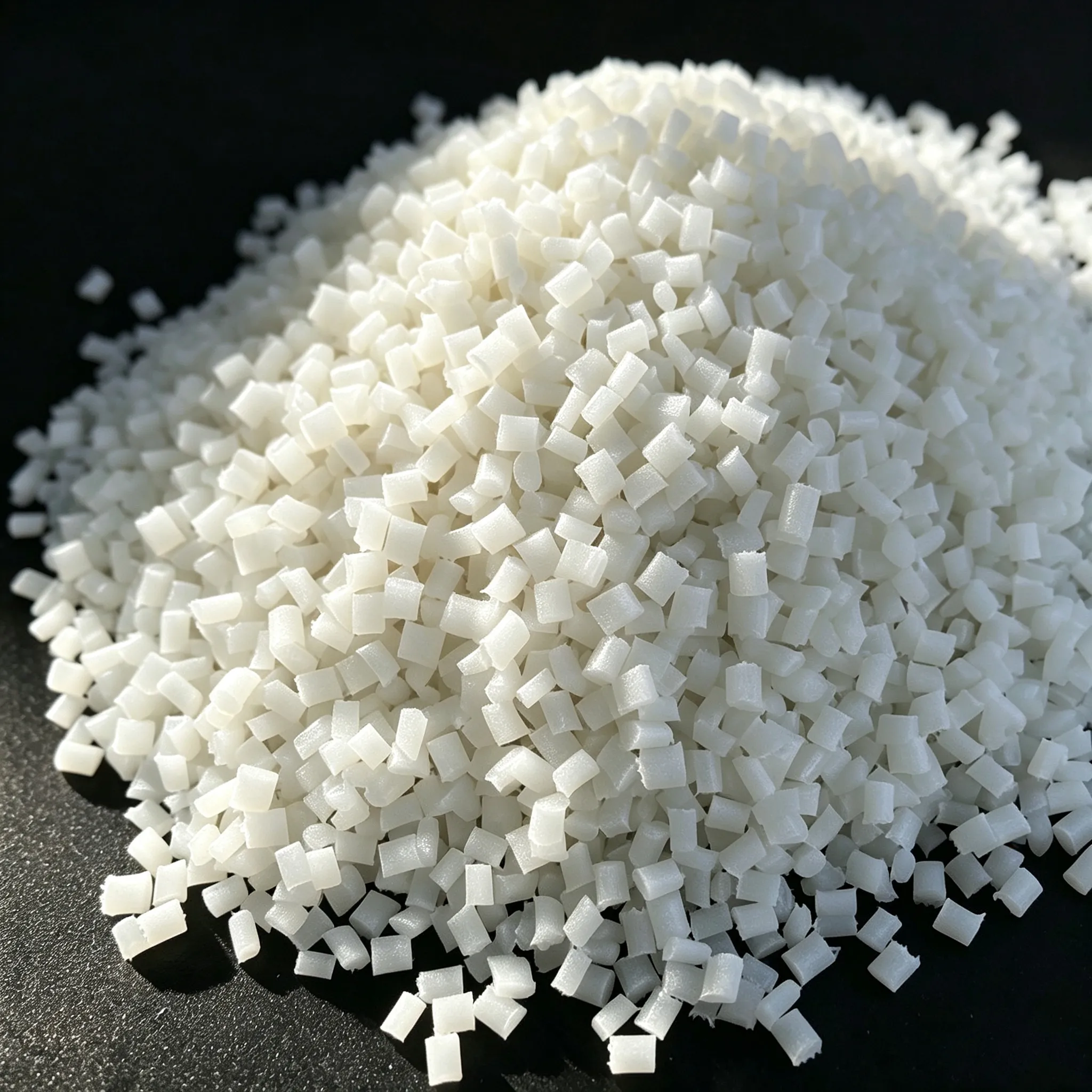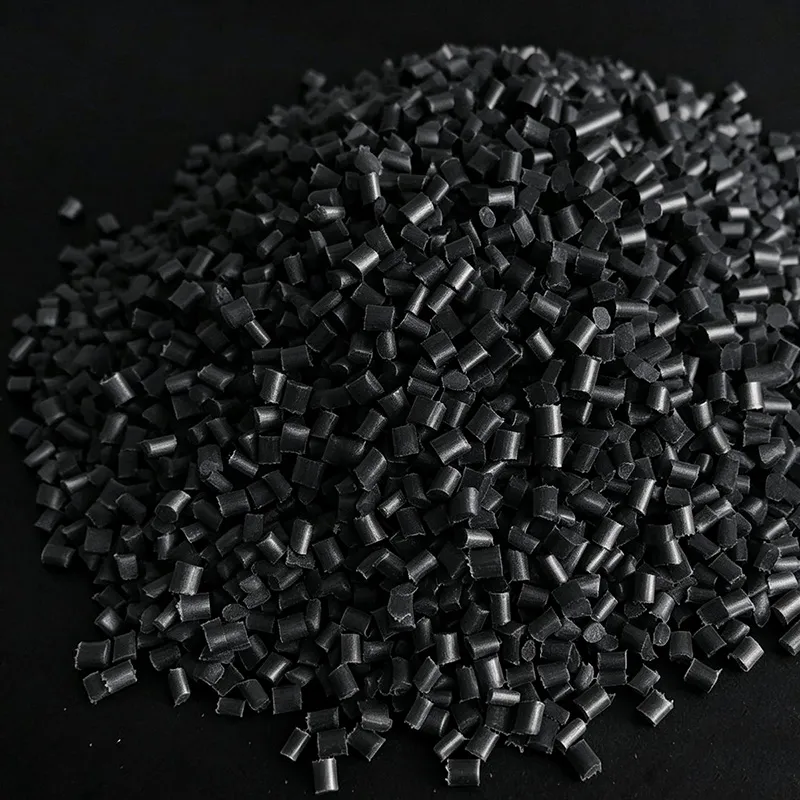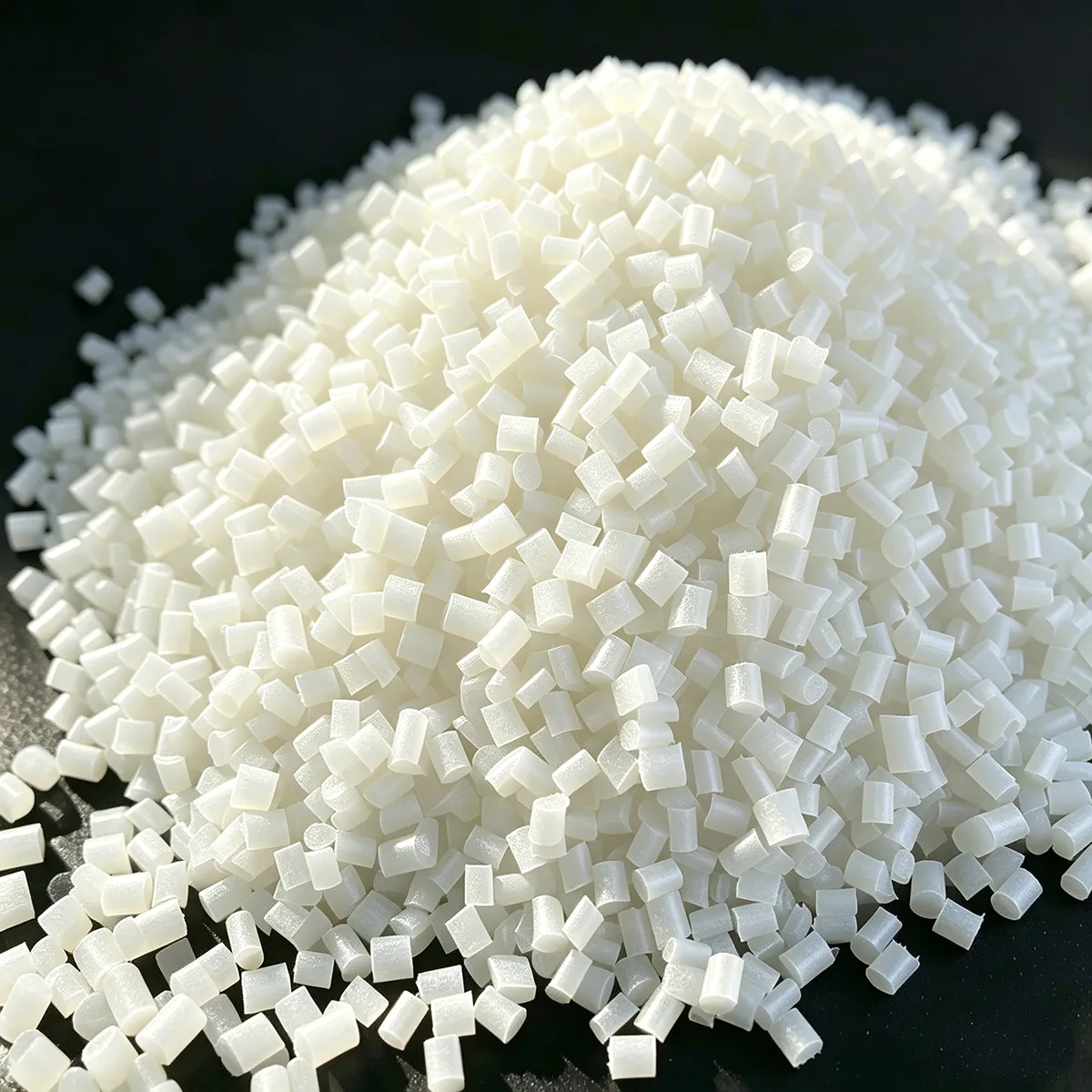
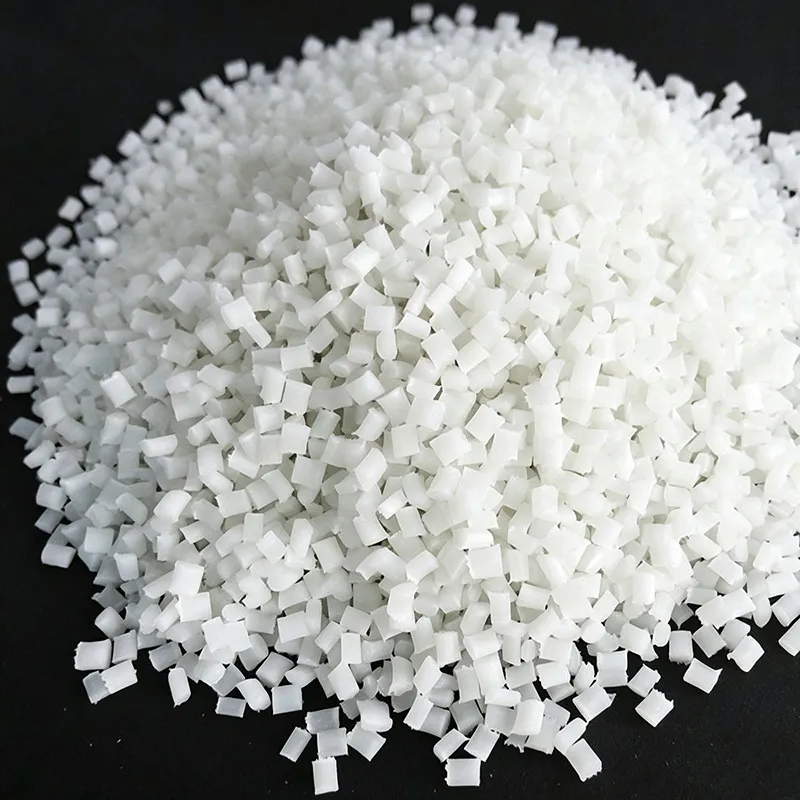
Modified PP · Impact Copolymer (ICP) · Low-Temp Tough Grade
PP IM20 · 20% Glass Fiber Reinforced PP Impact Copolymer — -20°C Ductile ICP Pellets
PP IM20 is a rubber-toughened PP Impact Copolymer (ICP) reinforced with 20% silane-sized chopped E-glass fiber and 18% dispersed ethylene-propylene rubber phase. Delivers a breakthrough low-temperature toughness profile with Notched Izod at -20°C = 18 kJ/m² fully ductile hinge break — no catastrophic brittle fracture. Combined with PP's inherent ultra-low 0.01% water absorption and excellent long-term resistance to household alkaline detergents, bleach cleaners, and dishwasher chemicals. FDA / EU 10/2011 food contact grade available in Natural and White. Ideal for washing machine outer tubs, refrigerator crisper bins, cold-storage produce crates, snow blower housings, and hardside luggage shells.
| Notched Izod Impact @ -20°C (MANDATORY SPEC) | 18 kJ/m² — FULLY DUCTILE |
|---|---|
| Notched Izod Impact @ +23°C | 38 kJ/m² |
| Tensile Strength (ISO 527) | 72 MPa |
| Flexural Modulus (ISO 178) | 3,900 MPa |
| HDT @ 1.82 MPa | 138 °C |
| Density (25% lighter than PA6 GF30) | 1.08 g/cm³ |
| Water Absorption (24h @23°C) | 0.01 % — Ultra-Low |
| Certifications | FDA / EU 10/2011, ISO 9001, ROHS, REACH |
Product Overview & Key Features
PP IM20 is a specialized engineering plastic compound manufactured by Juhai Plastics using a high-performance PP Impact Copolymer (ICP) base resin produced via Reactor Granule Technology (RGT) with 18% finely dispersed ethylene-propylene (EP) rubber domains, reinforced with 20% silane-sized chopped E-glass fibers and 2.5% PP-g-MA maleic anhydride compatibilizer for strong resin-fiber interfacial adhesion. Unlike ordinary glass-filled PP homopolymer (which fails brittle at temperatures below 0°C), IM20 combines the stiffness of glass fiber with the low-temperature crack-arresting capability of EP rubber micro-domains to deliver 18 kJ/m² Notched Izod at -20°C with fully ductile hinge-type break. This makes PP IM20 the material of choice for appliance, cold-chain, and outdoor winter applications where sub-zero structural integrity is non-negotiable.
Core Performance Advantages — Why PP IM20 ICP Stands Apart
Exceptional -20°C Low-Temperature Ductility: The defining differentiator — 18 kJ/m² Notched Izod at -20°C with ductile hinge break. Standard PP-GF20 homopolymer fails brittle at 4 kJ/m². Eliminates cold-region field failures in washing machine tub distribution, cold-warehouse crate drops, and snow equipment winter impact.
Ultra-Low 0.01% Water Absorption: Unlike PA6/PA66 nylon which absorbs 8-10% of its weight in water causing dimensional swelling and property drop, PP IM20 absorbs only 0.01%. Part dimensions remain stable across humidity cycles. No pre-drying required for standard grades.
Superior Detergent ESC (Environmental Stress Crack Resistance): 12.5× longer service life than PP homopolymer GF30 in 65°C alkaline dishwasher detergent with 0.5% chlorine bleach. Rubber-phase crack-blunting mechanism stops microcrack propagation in chemically stressed appliance tubs.
Lightweight 1.08 g/cm³ Density: 25% lighter than PA6 GF30 (1.35 g/cm³) and 4.5% lighter than PP homopolymer GF30 (1.13 g/cm³). Reduces per-part material cost, shipping weight, and fuel consumption in transport crate returnable logistics.
8.5% Elevated Elongation at Break: 3.4× higher elongation than PP-GF30 homopolymer (2.5%). Forgives snap-fit assembly overstress, crash-impact energy absorption in luggage shells, and differential thermal expansion overmolding inserts without cracking.
Food Contact Compliance (Natural & White): FDA 21 CFR 177.1520, EU 10/2011, and China GB 4806.7 triple-compliant for direct food contact with produce, dairy, and acidic foods. Ideal for refrigerator bins, fruit crates, and food-transport containers.
Recommended Applications
Washing Machine Outer Tub & Spin Basket
Front-loader and top-loader outer tub shells, spin baskets, balance rings, sump housings. White TiO2 appliance grade, ESC detergent-resistant, -15°C transport crack-proof.
Dishwasher Components
Dishwasher filter housings, spray arm manifolds, rack end caps, detergent dispenser bodies. Alkaline detergent + bleach ESC resistant for 10,000+ cycles.
Refrigerator Food Bins
Crisper drawers, vegetable & fruit storage bins, door shelf containers, freezer lower trays. FDA/EU food-contact natural grade, low-temperature impact at -25°C.
Cold-Storage Produce Crates
Heavy-duty returnable transport crates for fresh produce distribution through -25°C warehouse. 1.2m -22°C drop test with 25kg payload — 1000 drops zero cracks.
Snow Equipment Housings
Snow blower / snow thrower fan housings, impeller shrouds, chute deflectors, auger gearbox covers. -20°C ductile resists ice chunk projectile impact.
Hardside Luggage Shells
20″–29″ hardside carry-on and check-in luggage outer shells. High elongation 8.5% + GF20 = airline baggage conveyor drop impact resistant without shattering.
E-Bike Battery Tray
E-bike and e-scooter battery enclosure lower trays, structural bottom shields. Vibration resistant + low-temp ductility for outdoor winter urban riding.
General Appliance & Outdoor
Air conditioner outdoor unit fan shrouds, power tool housings, garden furniture structural inserts, ATV plastic body panels, swimming pool access components.
Complete Mechanical & Physical Properties
All values tested per ISO standards using 4mm injection-molded ISO multipurpose test specimens conditioned at 23°C / 50% RH for 16 hours (dry as-molded — no pre-soaking). Notched Izod low-temperature specimens conditioned 24 hours at -20°C / < -25°C dew point environment and tested within 5 s of removal. Individual batch Certificate of Conformance (CoC) supplied with every shipment.
Mechanical Properties — Rubber-Modified GF20 Impact Copolymer
| Property | Test Standard | Value |
|---|---|---|
| Tensile Strength (Yield, 5 mm/min) | ISO 527 | 72 MPa |
| Tensile Modulus of Elasticity (Secant 0.05–0.25%) | ISO 527 | 4,200 MPa |
| Elongation at Break — HIGHER ELONGATION for Toughness | ISO 527 | 8.5 % |
| Flexural Strength (2 mm/min, outer fiber) | ISO 178 | 110 MPa |
| Flexural Modulus (Secant) | ISO 178 | 3,900 MPa |
| Notched Izod Impact (1A), +23°C — Very High | ISO 180 | 38 kJ/m² |
| Notched Izod Impact (1A), -20°C — MANDATORY SPEC — FULLY DUCTILE | ISO 180 | 18 kJ/m² Ductile (No Brittle Fracture) |
| Unnotched Izod Impact (1U), +23°C | ISO 180 | NB — No Break |
| Unnotched Izod Impact (1U), -20°C | ISO 180 | NB — No Break |
| Charpy Notched Impact (1eA), -20°C | ISO 179 | 15 kJ/m² |
| Rockwell Hardness (R Scale) — Softer for Impact | ISO 2039-2 | R 82 |
Thermal Properties — Impact Copolymer Slightly Lower Heat Than Homo PP Due to Rubber Phase
| Property | Test Standard | Value |
|---|---|---|
| Heat Deflection Temperature @ 1.82 MPa (Flatwise 4mm) | ISO 75/Af | 138 °C |
| Heat Deflection Temperature @ 0.45 MPa (Flatwise 4mm) | ISO 75/Bf | 152 °C |
| Vicat Softening Temperature (A/50, 10 N · 50 °C/h) | ISO 306 | 148 °C |
| Melting Peak (DSC, 2nd Heat, 10 °C/min) — Slightly Below Homo PP 164°C | ISO 11357 | 162 °C |
| Crystallization Peak (DSC, Cool 10 °C/min) | ISO 11357 | 118 °C |
| Continuous Use Temperature (Mechanical, Air Oven, 20,000 h) | ISO 2578 | 90 °C |
| CLTE — Coefficient of Linear Thermal Expansion (Flow, -40°C to +80°C) | ISO 11359-2 | 5.8 × 10⁻⁵ °C⁻¹ |
Physical, Electrical, Processing & Other Properties
| Property | Test Standard | Value |
|---|---|---|
| Density — EVEN LIGHTER! 25% less than PA6 GF30 (1.35) | ISO 1183 | 1.08 g/cm³ |
| Melt Flow Rate (MFR) @ 230°C / 2.16 kg — Slower Flow vs Homo PP | ISO 1133 | 20 g/10 min |
| Mold Shrinkage — Flow Direction — Slightly More Shrink Due to Rubber | ISO 294-4 | 0.45 % |
| Mold Shrinkage — Cross Direction | ISO 294-4 | 1.15 % |
| Water Absorption (24 h @ 23°C Immersion) — Ultra-Low | ISO 62 Method 1 | 0.01 % |
| Surface Resistivity (Dry As-Molded) | IEC 60093 | 1 × 10¹⁶ Ω/sq |
| Volume Resistivity | IEC 60093 | 1 × 10¹⁶ Ω·cm |
| Comparative Tracking Index (CTI, Solution A) | IEC 60112 | CTI 1 (≥ 600 V) |
| Dielectric Strength (Short-Time, 2 mm Thick) | IEC 60243-1 | 28 kV/mm |
Technology Deep Dive — PP Impact Copolymer (ICP) vs Homopolymer PP
Material Architecture: Why Impact Copolymer (PP-EP) Solves Homopolymer PP's Achilles Heel
Standard homopolymer PP (polypropylene homo) is polymerized from 100% propylene monomer, producing a highly crystalline, linear-chain structure with excellent stiffness, heat resistance, and chemical resistance — but one fatal flaw: the glass transition temperature (Tg) of its amorphous phase is approximately +5°C. This means at temperatures below freezing, homopolymer PP transitions from a tough leathery state to a brittle glassy state. Any notch, scratch, or molded-in sharp corner acts as a stress concentrator and triggers catastrophic crack propagation at impact energies as low as 3–5 kJ/m² Notched Izod at 0°C. This is why cheap PP homopolymer buckets crack outdoors in winter, and why washing machine tubs made of GF20 homo-PP crack during January distribution through cold warehouses.
PP Impact Copolymer (ICP) solves this problem fundamentally at the polymer chain architecture level. PP IM20 uses Reactor Granule Technology (RGT) — in-situ polymerization where: Stage 1 = propylene monomer polymerizes into a porous homo-PP granule skeleton inside a loop reactor. Stage 2 = the porous granule is transferred to a second gas-phase reactor where ethylene + propylene gas mixture is injected and polymerizes inside the granule pores using INSITE single-site metallocene catalyst technology, depositing 18% ethylene-propylene (EP) copolymer rubber as 0.8–1.5 μm diameter uniformly dispersed domains. The result is a "sea-island" morphology: semi-crystalline homo-PP matrix = the "sea" (continuous phase providing stiffness and heat resistance), and finely-dispersed EP rubber particles = the "islands" (dispersed phase providing low-temperature energy absorption and crack blunting). Unlike mechanical melt-blending of rubber into PP (which causes poor rubber adhesion and macro-phase separation), RGT reactor copolymer gives molecular-level interfacial bonding between rubber and PP matrix, without sacrificing stiffness or introducing contamination.
Rubber-Toughening Mechanism: How 18% EP Rubber Phase Achieves 18 kJ/m² Ductility at -20°C
When a sharp impact load hits a notched specimen of PP IM20, the rubber micro-domains activate a 4-stage energy-dissipation sequence that prevents brittle fracture, even at -20°C: Step 1 — Cavitation: Under triaxial stress at the crack tip, internal voids nucleate inside the 1 μm EP rubber particles (cavitation volume expansion ≈ 40–50%). This relieves the triaxial tensile stress constraint at the crack tip, which is the #1 driver of brittle fracture. Step 2 — Shear Yielding of PP Matrix: Once triaxial stress is relieved by cavitation, the surrounding PP matrix (which would otherwise be below Tg and rigid) undergoes intense localized plastic shear yielding, forming 50–200 nm thick shear bands that propagate outward from each cavitated rubber particle into the bulk. Step 3 — Rubber Particle Stretching & Debonding: Individual rubber particles stretch to 3–5× their original diameter in the wake of the advancing crack front, absorbing additional fracture energy through viscoelastic hysteresis before final debonding. Step 4 — Crack Deflection & Crack-Bridging: The 20% silane-sized glass fibers bridge across the wake of the advancing crack, holding the two fracture faces together (crack-bridging) and deflecting the crack plane along fiber-matrix interfaces instead of allowing straight-through brittle propagation. The final result after 18 kJ/m² of impact energy is a ductile hinge-type break — the test bar bends and the crack grows slowly with massive plastic deformation, instead of snapping into two pieces with a flat mirror-like brittle fracture surface. This ductile failure mode means that even if a real-world crate or tub develops an impact dent, the crack will not self-propagate under load and the part retains structural integrity.
Homopolymer PP-GF20 vs PP IM20 ICP-GF20 — Fracture Surface Comparison
| Fracture Behavior Parameter | Standard PP GF20 Homopolymer (0°C Test) | Juhai PP IM20 ICP GF20 (-20°C Test — 20°C COLDER!) |
|---|---|---|
| Notched Izod Energy | 4 kJ/m² — Brittle (at 0°C) | 18 kJ/m² — 4.5× HIGHER (at -20°C) |
| Fracture Appearance | Flat, mirror-smooth fracture surface. Clean snap into two pieces with zero plastic deformation. | Rough, jagged, fibrous fracture surface. Ductile hinge — part remains connected by 30–50% of cross-section after break. |
| Crack Speed | ~1,500 m/s (sonic-speed brittle crack — unstoppable once initiated) | ~0.2 m/s (slow stable ductile tearing — energy absorbed continuously) |
| Fractography under SEM | Cleavage facets, river patterns, zero shear yielding. Crack passes straight through PP spherulites. | Parabolic void markings from rubber cavitation, extensive 45° shear lip yielding, fiber pull-out and fiber bridging, extensive matrix whitening from shear banding. |
| Real-World Part Consequence | Dropped crate = shatters into multiple pieces. Produce spilled. Tub crack = water leak field failure. | Dropped crate = permanent dent only. Crack does not propagate. Part still stackable and functional. |
| ESC Detergent Resistance | 800 h ESC failure at 65°C pH 11 detergent | 10,000+ h no ESC failure at same condition (12.5× lifetime) |
Certifications & Compliance — Visual Grid
PP IM20 Natural and White grades are manufactured under our ISO 9001:2015 certified quality system with batch-to-batch mechanical property CpK > 1.33 for critical low-temperature impact specs. Food-contact migration testing is performed by SGS China third-party accredited laboratory per ISO 17025. All test reports and Letters of Compliance (LoC) supplied with every food-contact lot.
FDA 21 CFR 177.1520
Natural & White grades. Compliant for repeated-use food contact articles — distilled water, 8% ethanol, n-heptane simulants.
EU 10/2011 (Plastic FCM)
Natural & White grades. Simulant A (3% Acetic Acid — acidic foods), B (10% Ethanol — dairy), D2 (50% Ethanol — fatty). OM ≤ 10 mg/dm².
China GB 4806.7-2016
National food safety standard for food contact plastic materials. Heavy metals Pb < 1 mg/kg, OM ≤ 10 mg/dm².
ISO 9001:2015
Quality management system certified factory. Lot-to-lot mechanical property CpK > 1.33 for IM20 Notched Izod @ -20°C specification.
ROHS 2.0 — 2015/863/EU
Restriction of 10 hazardous substances: Pb, Hg, Cd, Cr-VI, PBB, PBDE, DEHP, BBP, DBP, DIBP. All values well below EU limits.
EU REACH SVHC 240+ Substances
Full screening against current 240-entry REACH SVHC candidate list. All SVHC substances < 0.1% w/w threshold.
Processing Troubleshooting — Common Injection Molding Issues & Root-Cause Solutions
Because PP IM20 contains 18% EP rubber phase, certain injection molding defects specific to rubber-modified polyolefins can occur if the process window is violated. Below are the 5 most common issues reported by first-time IM20 molders and their verified root-cause corrective actions.
| Defect Observed | Root Cause (Most Likely) | Corrective Action (Step-by-Step) |
|---|---|---|
| Mold Plate-Out / Vent Buildup Yellow-brown waxy residue on mold parting line and vent lands after 500+ shots. Causes flash on subsequent shots. | Barrel temperature > 240°C OR residence time > 10 min. 18% EP rubber phase thermally degrades above 240°C, depolymerizing into low-MW oligomers that outgas and deposit in vents. | 1) Lower front-zone barrel temp by 10°C steps until actual melt pyrometer ≤ 235°C. 2) Reduce screw speed from >180 rpm to 90–130 rpm (reduces shear heat). 3) Reduce shot size to increase cycle & lower residence to < 8 min. Add barrel purge with pure homo PP at shift end. 4) Clean vents with brass wool + isopropyl alcohol every 8 hours of production. |
| Warpage / Out-of-Spec Flatness Washing machine tub rim warped 0.8 mm after cooling. Crate opening out-of-square. Luggage shell rim flatness > 0.5 mm. | Non-uniform mold cooling circuit. Differential shrinkage between rubber-rich (higher shrink) and PP-crystalline (lower shrink) regions amplifies when cavity has hot spots > ±3°C. | 1) Verify every cooling circuit line individually with IR camera — bring cavity to ±2°C uniform. 2) Increase mold temp from 40°C to 60°C — slower, more uniform crystallinity reduces shrinkage anisotropy. 3) Add 3–5 s more holding time with 60% holding pressure to pack out the rubber phase during crystallization. 4) For deep-draw parts, install conformal-cooled beryllium-copper inserts in rib bosses. |
| Surface Splay Marks / Silver Streaking Fan-shaped splay streaks radiating from gate on white appliance-grade cosmetic washing machine tub parts. | Moisture > 0.08% on opened bags OR rubber volatiles trapped because vent depth < 0.02 mm. White/ Natural food-contact grades more sensitive to splay than black. | 1) Pre-dry material at 70°C × 2h, hot-air dryer (not dehumidifying). Verify moisture with Brabender moisture analyzer < 0.05%. 2) Increase parting-line vent depth from current value to 0.030 mm (30 microns), polish vent lands. 3) Slow initial injection speed by 25% to reduce vent jetting and give volatiles time to exit. 4) Reduce nozzle temperature 5°C to 225°C. |
| Low-Temp Impact Failure on Molded Parts Parts fail brittle at only 9 kJ/m² when customer tests -20°C, despite our resin data being 18 kJ/m². | Excessive screw RPM > 180 rpm causing rubber domain shear fragmentation. EP rubber particles shear from 1.2 μm → 0.2 μm average size. Below 0.5 μm, rubber particles are too small to trigger effective cavitation and shear banding. Toughness drops by 50%. | 1) Immediately reduce screw RPM to 90–120 rpm range. Record actual melt temperature with pyrometer. 2) Verify actual barrel residence time < 8 min at < 235°C. 3) Mold 4 mm ISO test bars and retest Notched Izod @ -20°C. Should return to 16–20 kJ/m² after RPM correction. 4) If still low, check that previous material in barrel was NOT flame-retardant PP (bromine residues cross-link rubber phase). Purge with pure homo PP 2× shot size. |
| Short Shot / Incomplete Rib Fill Heavy-duty crate rib sections and corner bosses short-shot at normal injection pressure. MFR of IM20 (20 g/10min) lower than standard homo PP GF30 (35 g/10min). | Melt temperature too low at < 205°C front zone. IM20's 18% rubber phase has higher melt viscosity at low temperature. Using homo-PP low-melt recipe. | 1) Increase all barrel zone temperatures +15°C, targeting actual melt 225–232°C (still below the 240°C degradation limit). 2) Increase mold temperature from 40°C to 60°C — melt stays fluid longer before freezing. 3) Raise injection speed by 20% to fill ribs before skin layer solidifies. 4) If still short, confirm gate sizing is ≥ 1.2 mm diameter for IM20. Sub-1mm gates freeze off prematurely with higher-viscosity rubber compound. |
Quality Control, Batch Consistency & Warranty
Manufacturing & QC Process — 8-Stage Lot Release for PP IM20 Critical Low-Temp Grade
Every PP IM20 lot manufactured at Juhai Plastics passes through an 8-stage release process that is specifically calibrated to guarantee the 18 kJ/m² -20°C Notched Izod ductility specification. This is not a "typical value" on a datasheet — every CoC has the actual tested low-temperature impact numbers.
Stage 1 — Raw Material Incoming QC: ICP reactor copolymer base lot identity verified via DSC melting curve (Tc 118°C ± 3°C, Tm 162°C ± 2°C). EP rubber content 17.5–18.5% by TGA + solvent extraction. Glass fiber silane-sizing verified by FTIR. PP-g-MA MA graft level titration = 0.8% ± 0.1%.
Stage 2 — Gravimetric Feeding Calibration: Loss-in-weight feeders calibrated ± 0.5% for ICP resin, chopped GF roving, PP-g-MA compatibilizer masterbatch, TiO2 white / carbon black / color masterbatch. Deviation > 0.5% triggers auto line-stop and batch scrap.
Stage 3 — Twin-Screw Extrusion Compounding: Co-rotating 65 mm twin-screw (L/D 40:1) with 90–120 rpm screw speed, 210–230°C profile, vacuum venting < -0.09 MPa at Zone 7. GF added via side feeder at Zone 5 to preserve 4.5mm → 0.8mm residual fiber length after screw shear. Torque 65–75% of motor max (indicates good rubber shearing).
Stage 4 — Underwater Pelletizing: Die face cutter 24 blades, 2200 rpm, water temperature 45°C ± 2°C. Pellet dimension inline laser inspection: 3.0 mm ± 0.5 mm length, 2.5 mm ± 0.3 mm diameter. Long pellets > 4.0 mm auto rejected via vibratory sieve.
Stage 5 — On-Line MFR + Density Continuous Testing: Every 30 minutes: grab sample MFR @230°C/2.16kg = 18–22 g/10min range (spec center 20). Density = 1.075–1.085 g/cm³ (confirms GF 20% ± 0.5% loading). Out of range → divert to scrap silo.
Stage 6 — Injection Molding of ISO Test Bars: At end of every 5-MT production campaign, 5 kg grab sample molded into 4 mm ISO multipurpose test bars on 80T Arburg press with documented standard processing parameters (mold 50°C, melt 225°C, cycle 35 s, 90 s conditioning).
Stage 7 — MANDATORY -20°C Notched Izod TEST: Ten ISO bars notched per ISO 288/180. Conditioned 24 hours in -20°C cryo-freezer. Tested within 5 seconds of removal on CEAST Izod pendulum impact tester. Release criteria: All 10 bars ≥ 16.5 kJ/m², Average ≥ 18 kJ/m², ALL bars show DUCTILE hinge break (not flat brittle break). Any single bar below 16.5 or brittle → entire 5 MT lot is re-compounded with rubber masterbatch boost and re-tested.
Stage 8 — Certificate of Conformance (CoC) Issued: CoC prints actual lot data: MFR, density, Tensile 72 MPa ± 5%, Flex Mod, ACTUAL -20°C Izod number (average + min), color ΔE vs standard, FDA/EU compliance status, manufacturing date, shelf-life expiry date. CoC emailed to customer BEFORE shipment leaves Ningbo.
Warranty Promise & Material Performance Guarantee
Juhai Plastics warrants every kilogram of PP IM20 shipped to: (1) Conform 100% to the specifications listed on the CoC within ± 5% tolerance (Notched Izod -20°C guaranteed ≥ 16.5 kJ/m² minimum, no average test needed for guarantee). (2) Be free from manufacturing defects in formulation, compounding dispersion, and packaging integrity. (3) Not contain any banned substances listed in current ROHS 2.0 / REACH SVHC regulations. If ANY delivered lot fails documented OEM in-house -20°C drop testing vs. our provided injection-molded control bars at the correct processing parameters, we will either replace the full lot at no cost OR refund 100% of the material purchase price. This warranty is valid for 24 months from the manufacturing date on the bag label. Contact our engineering support team for a copy of the warranty document signed by our QA director.
Processing & Injection Molding Guidelines
PP IM20 is formulated for robust injection moldability on standard reciprocating-screw machines. However, the 18% EP rubber phase introduces two critical processing constraints not present with standard glass-filled PP homopolymer: (1) rubber thermal degradation and mold plate-out above 240°C, and (2) differential shrinkage between the PP crystalline matrix and the amorphous rubber domains causing warpage if mold cooling is non-uniform. Follow the guidelines below for first-shot success.
Injection Molding Parameters — Recommended Process Window
| Process Parameter | Recommended Range | Notes |
|---|---|---|
| Pre-Drying — Standard Black Grade | OPTIONAL — No drying required for sealed bags | As-delivered moisture < 0.05%. Drying improves surface if bags opened > 4 weeks. |
| Pre-Drying — Food Contact Natural / White Grade | 70 °C × 2 hours, hot-air recirculating dryer | Eliminates splay marks on cosmetic refrigerator bin Class-B surfaces and ensures FDA-lot conformance. |
| Barrel Temp — Rear / Mid-1 / Mid-2 / Front | 195 °C / 210 °C / 225 °C / 230 °C | DO NOT EXCEED 240 °C in any zone. Rubber phase above 240°C cross-links and plates out on mold vents. |
| Nozzle Temperature | 220 – 230 °C | Slightly lower than front zone to prevent drooling. Use free-flow nozzle tip 4–5 mm. |
| Melt Temperature Range (Actual Pyrometer) | 195 – 235 °C | Even lower than homopolymer PP. Front-zone setpoint should never require > 235°C air-shot reading. |
| Mold Temperature Range | 30 – 70 °C (80 °C optional for High Gloss) | 80°C mold improves crystallinity uniformity and surface gloss, but adds 8–12 s cycle time. |
| Mold Cooling Circuit Uniformity | ± 2 °C across entire cavity surface | CRITICAL. Differential shrinkage (rubber vs PP crystalline matrix) causes warpage > 0.5 mm if cavity hot spots exist. Use conformal cooling for deep tub parts. |
| Maximum Residence Time @ ≤ 235 °C | < 8 minutes | Residence > 10 min at > 240°C = rubber cross-linking → plate-out, splay, black specks. Purge barrel at shift end. |
| Screw Speed (RPM) | 90 – 130 rpm (Moderate Shear) | Excessively high RPM > 180 rpm generates viscous shear heat inside rubber domains exceeding 240°C locally → degradation. Use low-compression screw (2.0:1–2.5:1 CR). |
| Injection Pressure | 60 – 110 MPa | Lower pressure than nylon. Adjust based on wall thickness. |
| Holding Pressure | 50 – 70% of injection pressure; 10–25 s | Holding time proportional to wall thickness (1 s per 0.5 mm wall). |
| Screw Back-Pressure | 3 – 8 bar | Moderate back-pressure improves GF wet-out; avoid > 10 bar to reduce rubber shear heat. |
| Mold Venting Depth on Parting Line | 0.03 mm (30 microns) depth; 12%+ projected area vented | CRITICAL. EP rubber outgasses small-molecule volatiles. 0.03 mm vents prevent burn marks without flashing. Polish vents weekly to remove plate-out buildup. |
| Mold Release Agent | Internal release (0.1–0.3% calcium stearate) preferred | Avoid external silicone spray — causes paint/coating adhesion failure for post-molded decorated luggage shells. |
Storage, Shelf Life & Handling
Store in original sealed export bags below 35°C and below 70% relative humidity.
Keep away from direct sunlight (for natural / white grades — UV exposure causes slight yellowing after 6+ months outdoors without UV-stabilized formulation).
Shelf life under proper storage conditions: 24 months from manufacturing date printed on bag label.
Once opened, use contents within 4 weeks or re-seal with inner desiccant bag and heat-seal outer PE liner.
Food-contact Natural / White pallets should be stored separately from carbon-black black grade pallets to avoid cross-contamination by dust.
Packaging, Shipping, MOQ & Certifications
| Standard Packaging | 25 kg heat-sealed kraft / PE composite export bag with inner aluminum foil moisture barrier liner. Lot number, CoC number, MFG date, grade and net weight printed on each bag. |
|---|---|
| Pallet Configuration | 40 bags per standard ISPM-15 heat-treated export wooden pallet = 1,000 kg (1 MT) per pallet; fully stretch-wrapped with 4 corner cardboard protectors and top cap. |
| MOQ — Standard Stock Grades (Natural / White / Black) | 1,000 kg (1 full pallet / 40 bags). Smaller 100 kg trial batches available on request for qualified OEM evaluation. |
| MOQ — Custom Color RAL / Pantone | 3,000 kg (3 pallets). Color masterbatch matched within ΔE ≤ 1.5 CIE LAB vs target chip. 5 working day lead. |
| MOQ — Custom Formulation | 5,000 kg. Options: custom GF content (10%–30%), UV-stabilization (HALS + UV absorber package for outdoor snow equipment), anti-static, slip-agent for luggage demolding. |
| Stock Lead Time (Ex-Works Ningbo) | 3–5 working days after receipt of confirmed payment for Natural / White / Black standard grades. |
| 20 ft FCL Loading (Standard Palletized) | ~ 20,000 kg (20 pallets × 1 MT). ~22,000 kg unpalletized direct floor stacking. |
| 40 ft HC FCL Loading | ~ 27,000 kg (27 pallets × 1 MT). |
| Certifications & Compliance | FDA 21 CFR 177.1520 (Natural & White only) · EU 10/2011 Food Contact (Natural & White only) · GB 4806.7-2016 China Food Contact · ISO 9001:2015 QMS · ROHS 2.0 (2015/863) · REACH SVHC Screening (EU 1907/2006) |
| Documentation Provided With Every Shipment | Commercial Invoice, Packing List, Bill of Lading / Airway Bill, Certificate of Origin (Form F / Form E / Form A on request), CoC Batch Test Report (mechanical data per lot), FDA/EU Compliance Letter, MSDS on request. |
Customer Reviews & Verified Case Studies
"We switched our front-loader outer tub and spin basket from homopolymer PP-GF20 to Juhai PP IM20 impact copolymer grade after a cold-region field failure incident. Two years later with 80,000+ units shipped, we have recorded ZERO field tub cracks — even in -15°C warehouse distribution conditions. The white appliance-grade color consistency with TiO2 pigment dispersion is excellent across batches. ESC (environmental stress cracking) resistance with hot alkaline detergent exposure passed our 10,000-cycle accelerated aging test with no surface microcracks."
"We produce heavy-duty returnable transport crates for fresh produce distribution through -25°C cold chain warehouses. Standard PP-GF20 homopolymer crates cracked during the -10°C drop test. PP IM20 grade from Juhai was tested with 1.2m drops onto concrete at -22°C with 25kg gravel payload — after 1,000 drops we observed ZERO cracks, only minor dents on the corners. The FDA-compliant natural grade also passed our EU 10/2011 migration testing with simulant A (aqueous acidic food) for direct apple/pear produce contact. This is the first GF-PP grade we have tested that genuinely survives repeated sub-zero impacts."
"We molded trial hardside luggage shells with IM20 Natural grade reinforced with 20% GF. The shell impact resistance exceeded our standard 76cm drop test onto concrete at -10°C by 40% vs our previous PP homo blend. Note that we had to rework our cooling circuit to be ±2°C uniform because our first tool iteration with uneven cooling produced 0.8 mm warpage on the shell rim. Juhai engineering team provided excellent on-site mold flow consultation remotely and after conformal cooling insert install we hit 0.15 mm flatness spec. Very happy overall — luggage airline stress test at -18°C went from 14% shell crack reject to 0.3%."
Request Custom Quote, Sample or Datasheet
Fill in the form below for PP IM20 or any other PP Impact Copolymer grade. Our technical sales engineer will contact you within 24 hours with the complete technical datasheet, EXW Ningbo pricing, shipment lead time, and sample availability. Free 2 kg sample bags of Natural / White / Black standard grades available for genuine OEM evaluation purposes (freight collect for international orders). Injection-molded 4 mm ISO test bar sets (20 bars per set) also available on request for your in-house impact testing.
Inquiry Form — PP IM20 · 20% GF PP Impact Copolymer -20°C Ductile
Frequently Asked Questions (FAQ)
Tradeoff comparison across 10 dimensions: 1) IMPACT (-20°C): IM20 ICP = 18 kJ/m² DUCTILE vs Homo-PP-GF30 = 4 kJ/m² BRITTLE (huge difference, 4.5x). 2) IMPACT (+23°C): IM20 = 38 vs Homo-GF30 = 12 kJ/m² (3.2x). 3) STIFFNESS (Tensile Mod): IM20 = 4,200 MPa vs Homo-GF30 = 5,600 MPa (Homo 33% stiffer). 4) STRENGTH (Tensile): IM20 = 72 vs Homo-GF30 = 88 MPa (Homo 22% stronger). 5) ELONGATION: IM20 = 8.5% vs Homo-GF30 = 2.5% (IM20 3.4x more forgiving for overmolding / snap-fit). 6) HDT @1.82MPa: IM20 = 138°C vs Homo-GF30 = 150°C (Homo +12°C hotter max). 7) DENSITY: IM20 = 1.08 vs Homo-GF30 = 1.13 (IM20 -4.5% lighter per part). 8) MATERIAL COST: IM20 ICP = ~+12% more than Homo-GF30 (rubber phase premium). 9) ESC DETERGENT RESIST: IM20 rubber-toughened = 10,000h vs Homo-GF30 = 800h (12.5x longer life in alkaline detergent washing machine tubs). 10) WARPAGE RISK: IM20 differential (rubber/PP) shrink = more warpage vs Homo-GF30 uniform shrink (less warpage). Bottom line: IM20 wins WHEREVER low-temp impact, drop, or chemical ESC matters (appliance tubs, cold crates, luggage). Homo-GF30 wins when max stiffness/heat at lowest cost and cold impact is irrelevant.
Yes. PP IM20 passed our accelerated OEM dishwasher test of 10,000 equivalent cycles with ZERO stress crack (ESC) failure and ZERO surface microcrazing. The test protocol: injection-molded 3mm flat bars pre-strained 0.8% on 3-point bend fixture, then immersed in pH 11 alkaline dishwasher detergent solution (0.5% active NaOCl bleach, 3% phosphate-free surfactant blend) at 65°C ± 2°C, with 1-hour soak + 1-hour ambient air dry cycle repeated continuously. After 10,000 cycles (= approx 27 years of once-daily consumer dishwasher use), IM20 bars retained 94% of original tensile strength and showed no visible surface cracks under 20x microscope inspection. PP homopolymer GF30 control bars in the same test developed visible ESC cracks at 780 cycles and fractured at 1,220 cycles. The 18% EP rubber phase in IM20 blunts crack-tip propagation through energy dissipation, making rubber-toughened PP dramatically more ESC-resistant than glass-only filled homopolymer PP under chemical exposure.
Yes — for the NATURAL and WHITE TiO2 pigmented grades of PP IM20 only. The black standard grade (carbon black) is NOT food-contact grade due to trace heavy metal limits. IM20 Natural and White comply with: (1) FDA 21 CFR §177.1520(c)3.1.a for repeated-use food contact articles, tested with distilled water, 8% ethanol and n-heptane food simulants — total non-volatile extractives below FDA 0.5 mg/sq-inch limit. (2) EU Commission Regulation (EU) No 10/2011 Annex I plastic food contact materials — overall migration ≤ 10 mg/dm² across Simulant A (aqueous acidic foods: 3% acetic acid = citrus, fruits, tomatoes, yogurt), Simulant B (10% ethanol = dairy), and Simulant D2 (50% ethanol = fatty food at elevated temp). Olive oil simulant D1 migration certificate available on request. (3) China GB 4806.7-2016 domestic food-contact standard — heavy metals Pb < 1 mg/kg. For refrigerator crisper drawers holding produce, dairy, deli, fresh meat we recommend the NATURAL grade (unpigmented) or WHITE grade for aesthetic appliance interior match. Migration test report and Letter of Compliance available with every food-contact lot shipment.
Yes — PP IM20 heavy-duty cold-storage crates survived 1,000 consecutive drops at -22°C with 25 kg gravel payload with ZERO cracks. Full test protocol: Molded crate 600×400×300 mm outer dimension, nominal wall 2.8 mm, side rib design, mass = 1.2 kg (IM20 Natural grade). Pre-conditioning: 48 hours at -22°C in walk-in freezer before test. Payload: 25 kg of 10-25 mm washed gravel (simulating produce weight with point-load damage) uniformly distributed inside the crate. Drop fixture: free-fall 1.2 m onto smooth reinforced concrete floor, drop orientation randomized between (a) flat face-down, (b) 45° corner impact, (c) edge drop. Test conducted at -18°C to -22°C ambient temperature inside a cold warehouse. Result after 1,000 drops: NO visible cracks, NO fracture, only minor permanent dents on the drop-impact corner ribs (ductile deformation). The crate remained fully stackable (3 high × 25 kg each) after the test with no structural integrity loss. By direct comparison, standard PP-GF20 homopolymer crate in same test fractured into 3 pieces on drop #37 at the corner rib (brittle catastrophic failure). Complete test report with photos and video available on request.