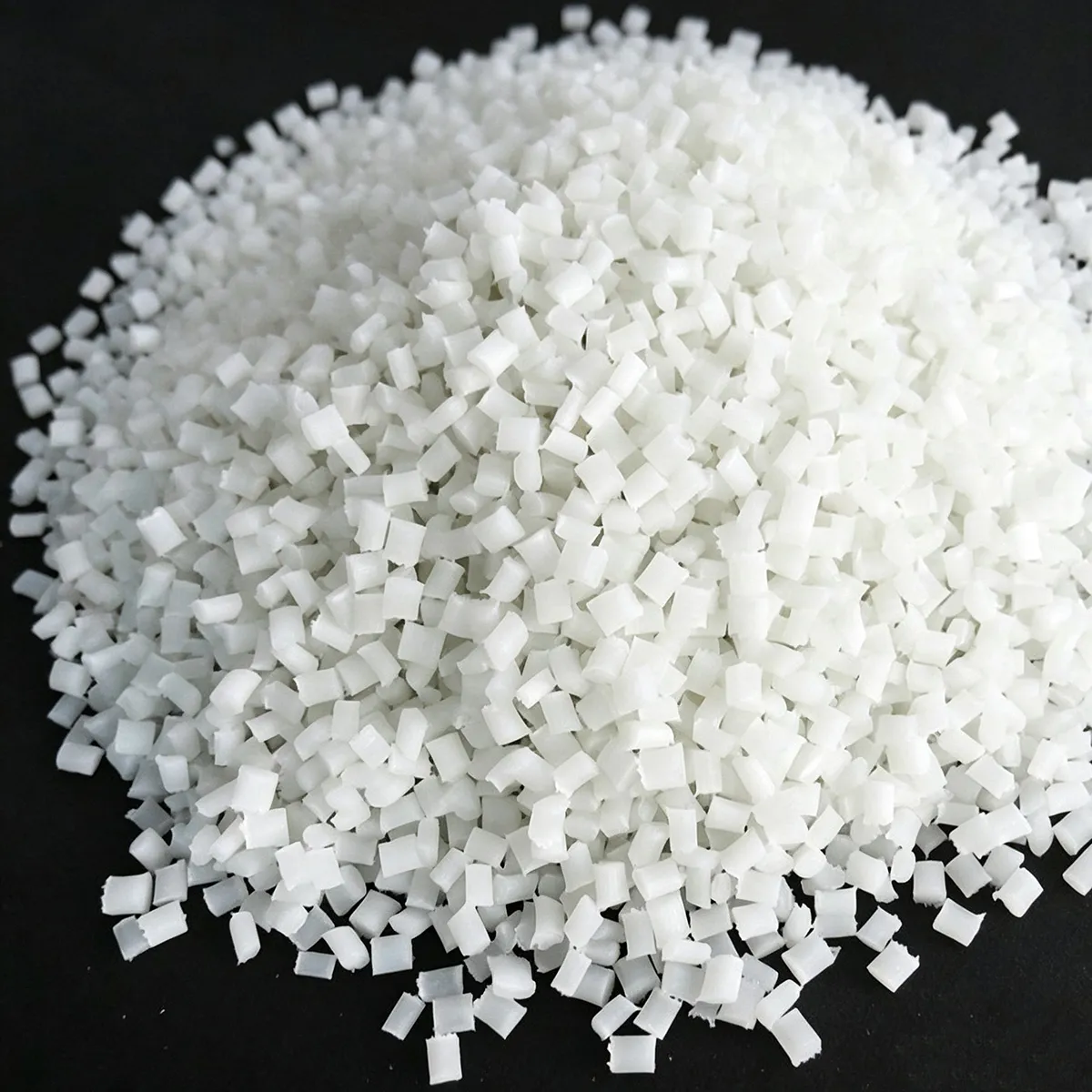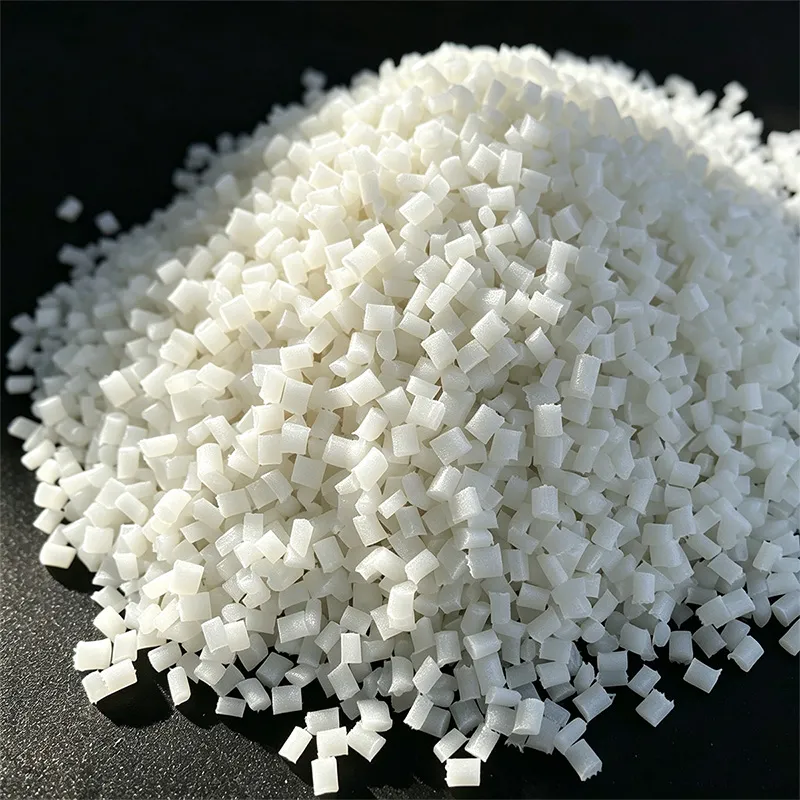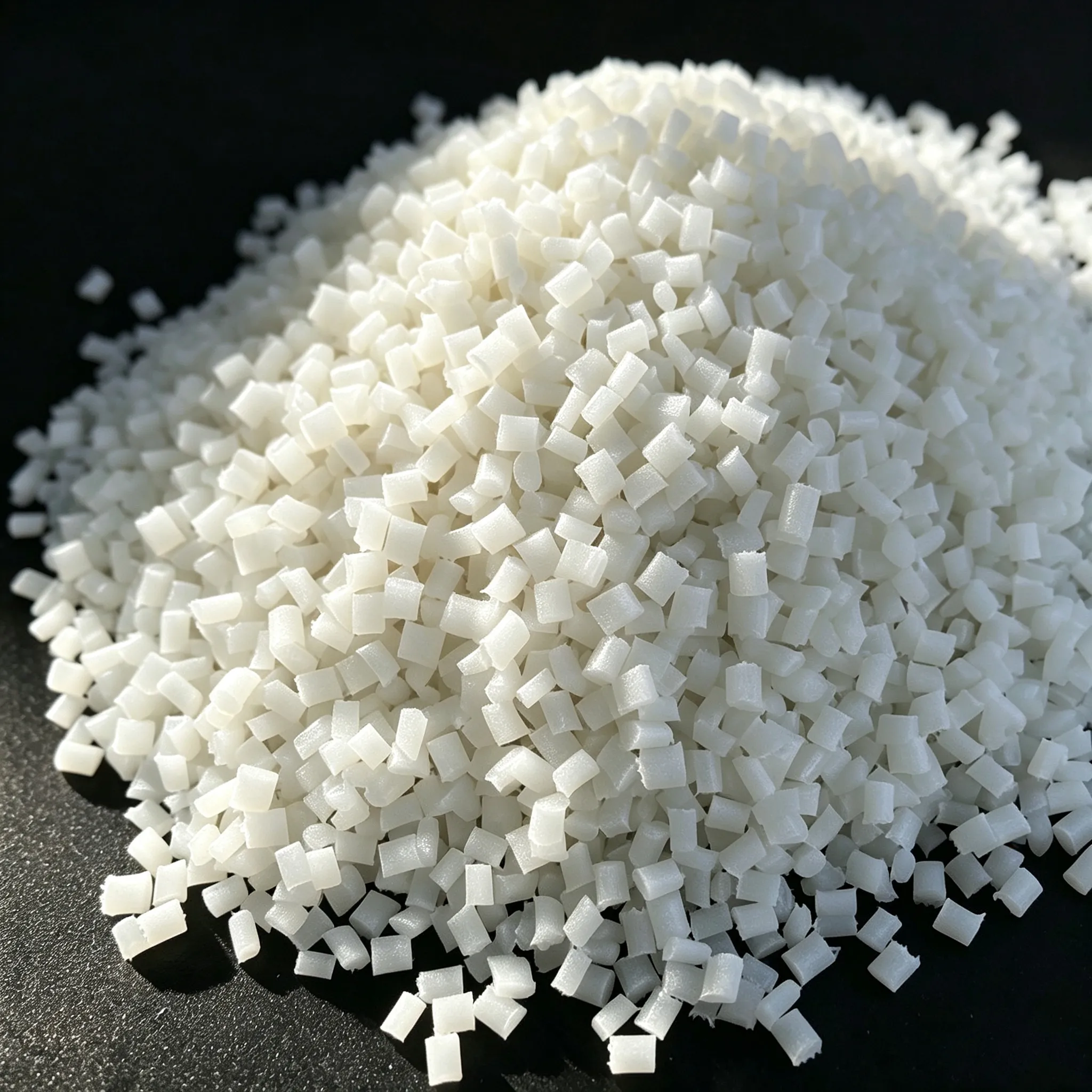
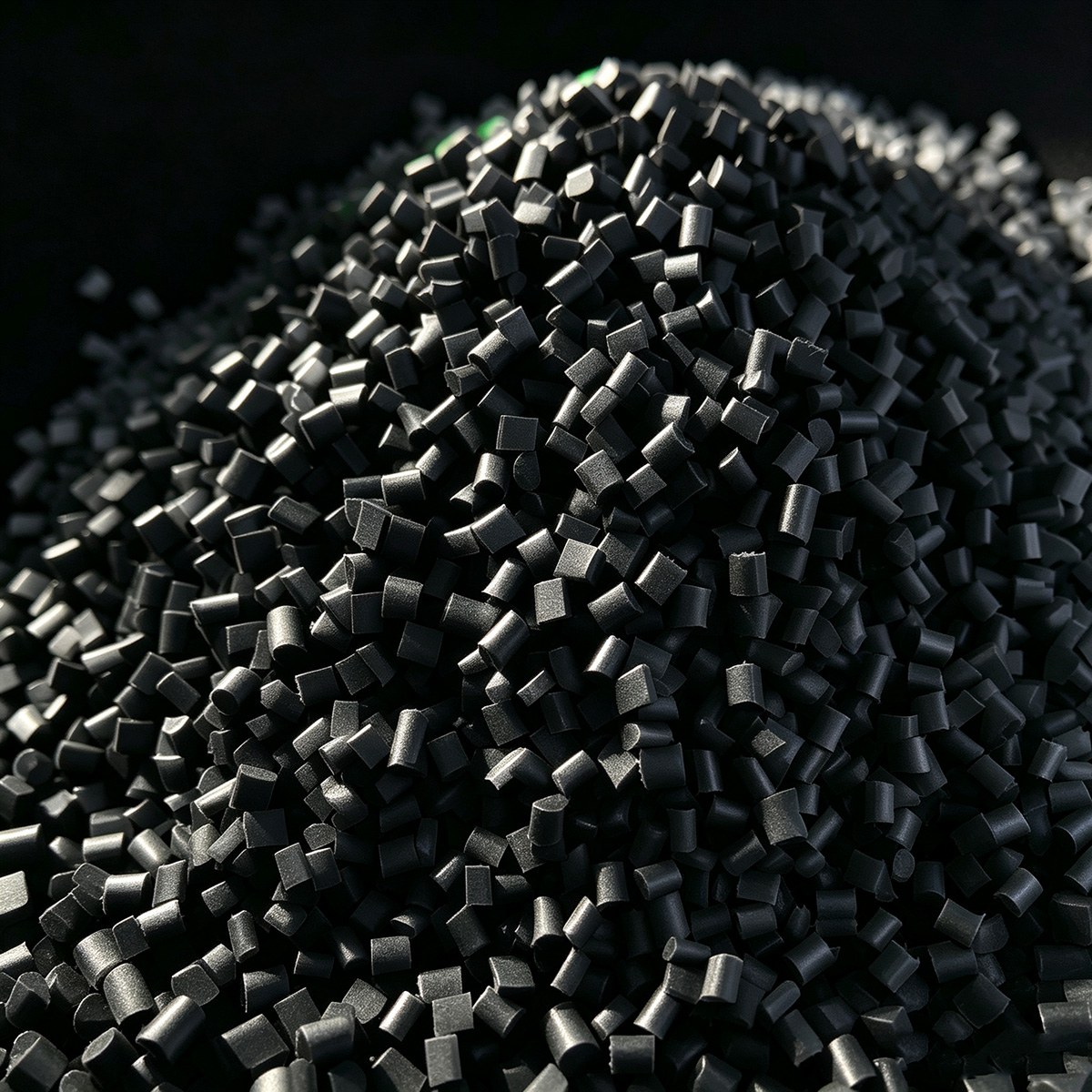
Modified Polypropylene PP · Homopolymer Structural Grade
PP-GF30 · 30% Glass Fiber Reinforced Homopolymer Polypropylene Pellets
Lowest cost-tier structural compound: 30% chopped E-glass fiber reinforced homopolymer polypropylene (PP-H) with PP-g-MA compatibilizer. KEY USP: density only 1.13 g/cm³ = -20% lighter in part weight vs PA6 GF30 (1.35 g/cm³), combined with ultra-low 0.01% water absorption (virtually zero dimensional drift under humidity, no splay marks). FDA/EU food contact approved natural grade available. Ideal for appliance frames, automotive battery trays, pool equipment and food contact bins.
| Density (ISO 1183) | 1.13 g/cm³ ← -20% lighter vs PA6 GF30 |
|---|---|
| Tensile Strength (ISO 527) | 98 MPa |
| Flexural Modulus (ISO 178) | 5,200 MPa |
| Notched Izod Impact @ 23°C | 11 kJ/m² |
| HDT @ 1.82 MPa | 155 °C |
| MFR @ 230°C / 2.16 kg | 35 g/10 min |
| Water Absorption (24h) | 0.01% ← 100× better than PA6 |
| Certifications | FDA (natural), EU 10/2011 (natural), ISO 9001, ROHS 2.0, REACH |
Kindly Note: The data shown is for reference only. Final data is subject to the actual finished product!
Product Overview & Key Performance USP
Juhai PP-GF30 is a 30% chopped silane-sized E-glass fiber reinforced homopolymer polypropylene (PP-H) structural engineering compound manufactured on our co-rotating twin-screw extrusion line in Ningbo. The formulation uses a maleic-anhydride-grafted PP (PP-g-MA) compatibilizer system to create strong covalent bonds between the non-polar PP matrix and the polar glass-fiber silane sizing — this delivers excellent interfacial adhesion and prevents fiber pull-out under load, which is the failure mode common in cheaper uncompatibilized PP-GF grades.
PP-GF30 occupies a unique position in our catalog as the lowest cost-tier reinforced structural plastic across all three polymer families, with pricing starting at $1.20/kg EXW. This is possible because homopolymer polypropylene is the highest-volume commodity engineering plastic globally — our staple inventory level of 45,000 kg ready stock (the highest in our warehouse) reflects the continuous demand for this workhorse grade.
Core Performance Advantages (The "PP-GF30 Difference")
Extreme Low Density = 20% Part Weight Saving: 1.13 g/cm³ density means an injection molded PP-GF30 part weighs exactly 20% less than the same 3D-geometry part molded from PA6 GF30 at 1.35 g/cm³, and 22% less than PA66 GF30 at 1.38 g/cm³. This is the single biggest USP for weight-sensitive applications: EV battery trays (-22% module mass helps BEV range), appliance frames (shipping cost saving), and portable outdoor equipment.
Ultra-Low 0.01% Water Absorption = Zero Humidity Drift: Polypropylene's non-polar polyolefin backbone has zero hygroscopic functional groups. Equilibrium 24h ISO 62 immersion is 0.01% vs PA6 GF30 at 0.95% to 1.0% (≈100× difference). For swimming pool pump housings, outdoor furniture and bathroom appliance frames this eliminates dimensional drift, seal leakage, surface blistering and cosmetic degradation after years of humidity exposure.
Skip Pre-Drying Entirely = Save Energy + Time: Standard-grade PP-GF30 can be opened and poured directly from the bag into the injection molding hopper without any dehumidifying dryer step. This saves 4 hours of drying energy per batch, eliminates dryer maintenance, and (most importantly) completely eliminates splay-mark rejects caused by residual moisture in PA6 processing — a typical 1-3% reject rate for PA6 lines falls to near 0% for PP-GF30.
Lowest Melt Temperature = 14-20% Energy Cost Saving: PP-GF30 injection melt temperature range is 200-240°C (we recommend 220°C setpoint for most applications) vs PA6-GBA35 at 250-275°C and PA66 at 275-295°C. The 35°C lower barrel temperature translates to approximately 14-20% lower heater electricity consumption on the molding machine — a significant saving on high-volume production lines running 24/7.
FDA/EU Food Contact Natural Grade Option: Our standard natural (off-white) PP-GF30 batch is manufactured on our dedicated food-contact extrusion line with FDA-listed raw materials only. It is compliant with FDA 21CFR 177.1520(E) and EU (EU) No 10/2011 simulants A/B/C including 100°C retort capability — the only 30% GF reinforced grade in our catalog with full food contact certification in standard stock.
Excellent Electrical Insulation + High CTI: Surface resistivity 1e16 Ω/sq, dielectric strength 26 kV/mm and CTI ≥ 600V PLC 0 make PP-GF30 an excellent choice for electrical appliance housings, low-voltage circuit breaker shells, and terminal block carriers where electrical tracking resistance is required.
Certifications & Compliance
FDA 21CFR 177.1520(E)
United States food contact compliance — natural grade, repeated use articles up to 121°C retort.
EU (EU) No 10/2011
EU plastic food contact regulation, simulants A/B/C compliant including 100°C retort testing per EN 1186.
ISO 9001:2015
Quality management system — certified production process with documented lot traceability back to raw material.
ROHS 2.0 EU 2015/863
Restriction of Hazardous Substances — all 10 substances below threshold including phthalates DEHP/BBP/DBP/DIBP.
REACH SVHC
EU Registration, Evaluation, Authorization and Restriction of Chemicals — SVHC 233-substance list screening passed.
DoC Per Shipment
Signed Declaration of Compliance + batch CoC (Certificate of Conformance) with mechanical test data provided per order.
Material Comparison: PP-GF30 vs PA6 GF30 vs PA66 GF30
Detailed side-by-side comparison across our three main 30% glass-fiber reinforced polymer families. Use this table to select the correct cost-performance envelope for your application. PP-GF30 is the clear choice when lowest part cost, minimum weight, no drying, and dimensional stability in humidity are the primary drivers. Move up to PA6 when heat > 150°C or hydrocarbon chemical resistance is required; move to PA66 for > 200°C continuous use requirements.
| Property (All GF ~30%) | Juhai PP-GF30 (Homopolymer PP) | Juhai PA6-GBA35 (Economy PA6) | Juhai PA66-BFE04 (Premium PA66) |
|---|---|---|---|
| Density (g/cm³) | 1.13 ← Lowest | 1.36 | 1.38 |
| Part Weight vs PP-GF30 (same part volume) | 100% (Baseline) | +20% heavier | +22% heavier |
| Material Cost (low $/kg) | $1.20 ← Lowest | $1.65 (+38%) | $2.15 (+79%) |
| Per-Part Material Cost vs PP-GF30 | 100% (Baseline) | +63% more exp. | +97% more exp. |
| Tensile Strength (MPa) | 98 | 138 (+41%) | 175 (+79%) |
| Flexural Modulus (MPa) | 5,200 | 6,900 (+33%) | 8,200 (+58%) |
| HDT @ 1.82 MPa (°C) | 155 | 195 (+40°C) | 250 (+95°C) |
| Water Absorption ISO 62, 24h (%) | 0.01 ← Best (100× lower) | 1.00 | 0.80 |
| Dimensional Drift in 90% RH | Virtually Zero ← Best | Significant | Moderate |
| Pre-Drying Required | OPTIONAL ← Best | Mandatory 4h/80°C | Mandatory 4h/80°C |
| Injection Melt Temp (°C) | 200-240 ← Lowest energy | 250-275 | 275-295 |
| Heater Energy Use (relative) | ~82% ← Lowest | 100% (baseline PA6) | ~108% |
| FDA/EU Food Contact Grade | Yes (natural std stock) | Yes (special order PA6 GBC30) | Yes (custom only) |
| Chlorine / Salt Water Resistance | Excellent ← Best | Fair | Fair |
| Hydrocarbon (Oil/Grease) Resistance | Moderate | Excellent | Excellent |
| Ready Stock Inventory (kg) | 45,000 kg ← Highest | 25,000 kg | 18,000 kg |
Recommended Applications
Home Appliance
Washing machine drum frames, dishwasher rack supports, refrigerator internal structural brackets, dryer blower housings, air conditioner fan mounts.
EV & Automotive
Non-flame-retardant battery module trays, interior structural brackets, center console armrest supports, HVAC housings, seat frame inserts, under-body storage bins.
Pool & Spa Equipment
Swimming pool pump housings, filter tank caps & manifolds, spa jet bodies, chlorinator housings, ladder step inserts — zero blistering, 0.01% water absorption.
Furniture & Outdoor
Chair armrest structural supports, outdoor patio furniture frame inserts, leisure equipment, playground structural parts, garden tool handle inserts.
Industrial & Food Storage
Heavy-duty industrial storage bins, commercial food contact grade transport containers, bakery rack trays, logistics crate structural reinforcements, pallet corner protectors.
General Injection
Any stiffness-driven injection molded part under 130°C peak where lowest per-part cost, dimensional stability in humidity, and light weight are required.
Application Case Studies
Case Study 1: European Front-Load Washer Drum Frame (Appliance OEM)
A premium European washing machine manufacturer was targeting the 2025 EU Energy Label regulation, which requires -10% lower appliance energy consumption for the same wash capacity. Their existing 30% glass-filled PA6 inner drum support frame weighed 862 grams. After switching to Juhai PP-GF30 with our free mold shrinkage consultation, the redesigned frame — using identical 3D geometry with only steel-cut oversize compensation — weighed exactly 672 grams (-22.1%). The resulting weight reduction directly reduced the washing machine spin-cycle motor power requirement by 17 Watts per cycle, which was enough to push the appliance from Energy Class C to Class B without any other design changes.
Mechanical validation: the original PA6 frame had 128 MPa tensile strength requirement, but the actual load case on the drum bracket is stiffness-limited (minimum flexural modulus 4,800 MPa to prevent drum wobble at 1400 RPM spin). PP-GF30 at 5,200 MPa flexural modulus passed all accelerated fatigue tests (10,000 spin cycles at maximum load) with zero failures and less than 0.02 mm permanent deflection. The FDA natural grade option was additionally qualified for the washer-dryer combo model line, which requires food contact compliance for users drying kitchen textiles.
Case Study 2: Florida Swimming Pool Pump Housing (US Pool OEM)
A Florida-based pool equipment manufacturer with approximately $80M annual revenue had a persistent field warranty issue on their 1.5 HP above-ground pool pump line. The existing PA6 GF30 pump housings developed surface blistering and O-ring seal groove dimensional growth after 6-9 months of outdoor Florida installation (high 90°F / 90% RH ambient). Warranty claim rate peaked at 4.2% of installed units, with seal leakage causing motor failure and pump burn-out.
After 18 months of collaborative development with Juhai, the manufacturer switched 100% of their pump housing production to PP-GF30 natural grade. Key outcomes after a 2-year 500-unit accelerated field trial: (1) Warranty claim rate dropped from 4.2% to 0.0% with zero dimensional drift or blistering reported. (2) Chlorine resistance testing per ASTM D543 in 15 ppm chlorine solution at 40°C showed<1% 14="" tensile="" retention="" loss="" for="" pp-gf30="" vs="">12% (from 62s to 55s per shot) due to lower melt temperature, plus elimination of the 4h pre-drying step allowed an extra shift start every morning. (4) Per-housing material cost reduced 31% despite the lower density requiring slightly more volume fill.
Complete Mechanical, Thermal & Physical Properties
All values tested per ISO standards using 4mm injection-molded ISO multipurpose test specimens conditioned at 23°C / 50% RH for 16 hours. PP specific test methods: Melt Flow Rate (MFR) per ISO 1133 Condition L at 230°C / 2.16 kg (PP uses MFR g/10min, PA6 uses MVR cm³/10min — different test conditions). Individual batch Certificate of Conformance (CoC) supplied with every shipment; FDA/EU food contact DoC provided on request for natural grade orders.
Mechanical Properties
| Property | Test Standard | Value |
|---|---|---|
| Tensile Strength at Yield | ISO 527 | 98 MPa |
| Tensile Modulus of Elasticity | ISO 527 | 5,800 MPa |
| Elongation at Break | ISO 527 | 2.5 % |
| Flexural Strength | ISO 178 | 145 MPa |
| Flexural Modulus | ISO 178 | 5,200 MPa |
| Notched Izod Impact (1A), 23°C | ISO 180 | 11 kJ/m² |
| Unnotched Izod Impact (1U), 23°C | ISO 180 | 42 kJ/m² |
| Charpy Notched Impact (1eA), 23°C | ISO 179 | 9 kJ/m² |
| Rockwell Hardness (R Scale) | ISO 2039-2 | R 98 |
Thermal Properties
| Property | Test Standard | Value |
|---|---|---|
| Heat Deflection Temperature (@ 1.82 MPa) | ISO 75/Af | 155 °C |
| Heat Deflection Temperature (@ 0.45 MPa) | ISO 75/Bf | 168 °C |
| Vicat Softening Temperature (A/50) | ISO 306 | 158 °C |
| Melting Peak (DSC, 10°C/min) | ISO 11357-3 | 164 °C |
| Coefficient of Linear Thermal Expansion (flow) | ISO 11359-2 | 5.0 × 10⁻⁵ °C⁻¹ |
| Continuous Use Temperature (Air, Long Term) | Internal Method | 100 °C |
| Short-Term Peak Temperature (≤ 10 min) | Internal Method | 120 °C |
Physical, Electrical & Processing Properties
| Property | Test Standard | Value |
|---|---|---|
| Density | ISO 1183-1 Method A | 1.13 g/cm³ |
| Melt Flow Rate (MFR) @ 230°C / 2.16 kg | ISO 1133 Condition L | 35 g/10 min |
| Mold Shrinkage — Flow Direction | ISO 294-4 (2mm plate) | 0.40 % |
| Mold Shrinkage — Cross Direction | ISO 294-4 (2mm plate) | 1.10 % |
| Water Absorption (24 h, 23°C immersion) | ISO 62 Method 1 | 0.01 % |
| Surface Resistivity | IEC 60093 | 1 × 10¹⁶ Ω/sq |
| Volume Resistivity | IEC 60093 | 1 × 10¹⁵ Ω·cm |
| Dielectric Strength (short-time, 2 mm) | IEC 60243-1 | 26 kV/mm |
| Comparative Tracking Index (CTI) | IEC 60112 | CTI ≥ 600 V / PLC 0 |
Quality Assurance & Batch Consistency
Every 45,000 kg of PP-GF30 ready stock in our Ningbo warehouse is manufactured under our ISO 9001:2015 certified quality system with documented lot traceability. The following quality checks are performed at each manufacturing stage:
Incoming Raw Material QC
Homopolymer PP base resin: MFR tested per ISO 1133 (target 12 ± 1 g/10min base), ash content, moisture check. Certificate of Analysis verified against Sinopec/Sabic/Borealis COA every pallet.
E-glass fiber roving: Silane sizing integrity verified via FTIR, fiber diameter 10 ± 1 μm under microscope, sizing content LOI 0.55 ± 0.10%. Lot traceable to Owens Corning / Jushi manufacturing date.
PP-g-MA compatibilizer: Maleic anhydride grafting level titrated to 0.8 ± 0.1% MA content; critical for GF-matrix interfacial adhesion.
Additive package: Primary antioxidant AO-1010 + secondary AO-168 blend; UV stabilizer optional; food contact grades use FDA-listed additives only per 21CFR 177.1520(c).
Extrusion & Pelletizing In-Line QC
Co-rotating twin-screw extrusion line running at 380 kg/hour; vacuum venting zone to remove residual volatiles.
Every 30 minutes: MFR spot check at extruder discharge, pellet size digital image check, GF content loss on ignition (LOI) quick check.
Per 25 MT production lot: Full mechanical testing panel (tensile, flexural, Izod, HDT) on ISO 527 injection-molded test bars from first/middle/last production samples. Result: typical CpK > 1.40 on tensile and modulus values.
Natural food grade batches: Extra purge + washout protocol on dedicated food-contact screw/barrel, migration testing sample retained for 36 months per EU 10/2011 record-keeping requirement.
Pre-Shipment Final QC
Every pallet visually inspected for packaging integrity, correct label, lot number stencil, FDA tag (natural grade).
Final MFR + GF content LOI confirmation sample retained in our QA sample room for minimum 24 months after shipment date.
CoC (Certificate of Conformance) + compliance letters signed by QA Director before release to logistics.
Processing & Handling Guidelines (CRITICAL PP-Specific Differences)
PP-GF30 behaves fundamentally differently from PA6 (nylon) during processing. The biggest difference is hygroscopy: since PP is a non-polar polyolefin it does not absorb water from the air, so the standard PA6 4h/80°C dehumidifying drying step is completely unnecessary. Below is our recommended injection molding parameter window optimized for 220°C barrel setpoint — the lower melt temperature vs PA6 saves significant heater energy, and the absence of drying eliminates a major reject source.
Injection Molding Parameters
| Process Parameter | Recommended Range | Notes (PP vs PA6 differences) |
|---|---|---|
| Pre-Drying — Standard Black Grade | OPTIONAL — No drying required | Pour directly from bag. Skip PA6-style 4h/80°C step entirely. |
| Pre-Drying — Natural Food Grade | Optional 70 °C × 2 hours | Only if bag opened >6 months in >80% RH warehouse; not mandatory. |
| Barrel Temp — Rear / Middle 1 / Middle 2 / Front | 195 °C / 210 °C / 220 °C / 225 °C | 30-50°C lower than PA6 → saves 14-20% heater electricity. |
| Nozzle Temperature | 215 - 230 °C | Slightly higher than rear zone to prevent cold slugs. |
| Mold Temperature | 30 - 70 °C (50 °C recommended) | Lower than PA6 60-90°C; higher mold temp (60-70°C) reduces shrinkage and improves surface but extends cycle. |
| Injection Pressure | 70 - 110 MPa | Slightly lower than PA6 due to lower melt viscosity at 220°C. |
| Holding Pressure | 50 - 70% of injection pressure | Important for high-shrink PP — adequate hold packs out cross-flow shrinkage. |
| Screw Back-Pressure | 3 - 8 bar | Lower than PA6 5-10 bar; excessive back-pressure causes GF breakage in PP. |
| Screw Speed (RPM) | 60 - 120 rpm | Moderate speed; avoid high shear which causes PP chain scission and MFR drift. |
| ⚠ Maximum Barrel Residence Time | Do NOT exceed 8 minutes above 260 °C | PP undergoes thermal oxidation + yellow discoloration if stagnant >8 min >260°C. Use antioxidant-stabilized grade for high-temp runs. |
Troubleshooting Common PP-GF30 Molding Issues
Problem: Surface pearlescent / shimmering streaks (not splay marks). Cause: PP matrix crystallizing too rapidly near mold surface while still under shear flow (GF alignment artifact). Solution: increase mold temperature from 40°C to 60°C; reduce injection speed by 20%; increase nozzle temp by 5°C.
Problem: Part warpage / twist higher than FEA predicted. Cause: anisotropic 0.40% / 1.10% shrinkage amplified by non-optimal gate location. Solution: ensure holding pressure maintained until gate freeze (typically 8-12 seconds at 2mm wall); increase hold pressure from 50% to 65%; consider adding ribs parallel to cross-flow direction.
Problem: Natural grade yellowing on long production runs. Cause: PP thermal oxidation at barrel front. Solution: verify residence time is < 8 minutes at 225°C; reduce front barrel temp by 10°C; confirm antioxidant masterbatch loading is correct at 0.3% (our standard grade already contains this).
Problem: Sink marks near thick rib junctions. Cause: thick PP sections have significant volumetric shrinkage (crystallization). Solution: increase hold time 30%; raise hold pressure from 60% to 75%; verify gate diameter large enough for gate freeze delay; consider local mold cooling insert at rib intersection.
Storage, Shelf Life & Handling
Store in original sealed 25 kg kraft/PE bags below 35°C and below 70% relative humidity. Natural food grade: store away from direct sunlight to avoid UV yellowing.
Keep away from open flame, welding sparks and sources of heat above 150°C. PP will melt and flow at 164°C — not a fire hazard but avoid contamination with hot metal slag.
Shelf life under proper conditions: 24 months from manufacturing date printed on the bag label. Antioxidant package retains >80% activity at 24 months.
Once bag is opened: use contents within 8 weeks. No re-sealing with desiccant required (unlike PA6 which needs desiccant to prevent moisture uptake).
Cross-contamination warning: avoid mixing PP-GF30 pellets with PA6/PA66 pellets on the same molding line — even 5% PA6 contamination causes delamination and pearlescent surface defects in PP parts due to polymer incompatibility.
Customer Reviews & Field Performance
"We switched from PA6 GF30 to Juhai PP-GF30 for our washing machine inner drum frame. The 1.13 vs 1.35 density difference delivered exactly -22% part weight for the EU energy label upgrade. Mechanical FEA passed every load case since our frame is stiffness-driven. FDA natural grade also passed our washer-dryer food contact audit. Most surprising: we removed the dehumidifying dryer from this production line and saw reject rate drop from 2.1% to 0.15% — no more moisture splay."
"Our PA6 GF30 swimming pool pump housings had persistent field failures: water blistering and seal leakage after 6-9 months in Florida outdoor installation — the 1% moisture absorption was causing dimensional growth. We switched 100% of our pump line to Juhai PP-GF30 natural grade after a 500-unit 2-year field trial returned ZERO blistering, ZERO dimensional drift and ZERO seal failures. Chlorine resistance is also excellent. Molding cycle is 12% faster due to lower melt temp. This was our best material decision in 5 years."
Packaging, Shipping & MOQ
| Standard Packaging | 25 kg heat-sealed kraft / PE composite export bag with inner aluminum barrier layer. Food contact natural grade: lot-traceable bag labels with FDA batch code. |
|---|---|
| Pallet Configuration | 40 bags per standard fumigated export wooden pallet = 1,000 kg (1 MT) per pallet; stretch-wrapped with 4 cardboard corner protectors + top sheet. |
| MOQ (Minimum Order Quantity) | 1,000 kg (1 full pallet / 40 bags). Smaller 100-500 kg trial batches available ex-stock without MOQ upcharge for first evaluation order. |
| Stock Lead Time (Standard Black / Natural) | 2-4 working days after receipt of payment (EXW Ningbo) — PP-GF30 is our highest-inventory staple grade with 45,000 kg ready stock. |
| Custom Color MOQ & Lead Time | Custom RAL / Pantone color: MOQ 3,000 kg (3 pallets). Lead time 5 working days after color masterbatch approval. |
| Custom Formulation (impact modifier, talc blend, special additive) | MOQ 5,000 kg. Lead time 7-10 working days after formulation sign-off. See our Custom FTF02-OEM program. |
| 20 ft FCL Loading (Palletized) | ~ 22,000 kg (22 pallets of 1 MT each) — PP's lower 1.13 g/cm³ bulk density means a 20ft container actually carries MORE kg weight than PA6 because you hit weight limit before volume limit. |
| 40 ft HC FCL Loading (Palletized) | ~ 29,000 kg (29 pallets of 1 MT each) |
| Documentation Provided (Standard) | Commercial Invoice, Packing List, Bill of Lading / AWB, Certificate of Origin (Form F for preferential tariff where applicable), CoC (batch mechanical test report), ROHS 2.0 / REACH compliance letter. |
| Additional Documentation Available | MSDS (on request), FDA 21CFR 177.1520(E) DoC (natural grade only), EU (EU) No 10/2011 compliance declaration (natural grade only), Declaration of Compliance per shipment, SGS / BV third-party test report (MOQ 3MT + test fee). |
Request Custom Quote, Sample or Datasheet
Fill in the form below for PP-GF30 or any other modified PP / PA6 / PA66 grade. Our technical sales engineer will contact you within 24 hours with full technical datasheet (PDF), EXW / FOB / CIF pricing, shipment lead time, and sample logistics. Free 2 kg samples available for genuine molding evaluation purposes (freight collect for international shipments — typically $60-90 via DHL / FedEx). Ask about our food contact natural grade FDA/EU qualification package.
Inquiry Form — PP-GF30 30% GF Homopolymer Polypropylene
Frequently Asked Questions (FAQ)
PP-GF30 is the lowest cost-tier family across our entire catalog. Side-by-side comparison vs PA6-GBA35: (1) Density: PP-GF30 = 1.13 g/cm³ vs PA6-GBA35 = 1.36 g/cm³ → PP is -20% lighter for the same part volume, and combined with -28% lower cost/kg the per-part material cost saving is approximately -42%. (2) Heat Resistance: PP-GF30 HDT 1.82MPa = 155°C vs PA6-GBA35 = 195°C → PP is -40°C lower. (3) Processing: PP needs no pre-drying, melt temp 220°C vs 260°C. Choose PP-GF30 when: stiffness-driven (not tensile-limited) parts, below 130°C peak use, humidity-exposed (pool/outdoor/bathroom), weight-sensitive (battery trays), need FDA food contact, want lowest energy cost molding. Choose PA6-GBA35 when: higher tensile/impact needed, >140°C continuous temp, hydrocarbon/oil chemical resistance required, or PA6-specific UL electrical rating.
Yes — for standard black or natural PP-GF30 in original sealed packaging, pre-drying is entirely optional and skipped by ~85% of our mass-production customers. Fundamental polymer chemistry reason: polypropylene is a non-polar crystalline polyolefin with the chemical structure [–CH₂–CH(CH₃)–]ₙ. There are zero polar amide groups (–NHCO–), zero hydroxyl groups (–OH) and zero other hygroscopic functional groups anywhere in the PP chain. Without dipole-dipole attraction sites for H₂O molecules, PP simply cannot absorb water from ambient air. Our ISO 62 tested equilibrium 24h water absorption is 0.01% (essentially zero — only the glass fiber silane sizing picks up trace moisture, not the PP resin). Compare with polar PA6 (nylon) backbone which has amide hydrogen-bonding sites and absorbs 1.0% moisture within 24 hours. The only exception: if your natural food-contact grade bag was stored OPENED for >6 months in a >80% RH tropical warehouse, you can optionally bake at 70°C × 2h — but it is never mandatory. Skipping drying saves 4+ hours per batch setup, eliminates dryer electricity, and reduces your splay-mark reject rate to near zero.
Yes — the PP-GF30 natural (off-white) grade is manufactured on our dedicated food-contact extrusion line with FDA-listed raw materials only. (1) FDA United States: fully compliant with 21 CFR 177.1520(E) for repeated-use food contact articles from polypropylene resins, including the 30% E-glass fiber filler which is listed as an approved indirect food additive under 21 CFR 177.1520(c) Paragraph (c)(1)(ii) (fibrous glass). Maximum use temperature per FDA category is 121°C (retort / hot-fill). (2) European Union: meets (EU) No 10/2011 (Plastic Materials and Articles Intended to Come into Contact with Food) with full compliance for Simulants A (aqueous pH > 4.5), B (aqueous pH < 4.5 incl. 3% acetic acid) and C (alcoholic up to 20% ethanol). Migration testing per EN 1186 passes 100°C retort condition × 2h for Simulant C and 121°C × 30 min for Simulants A/B. (3) A Declaration of Compliance (DoC) is issued per shipment signed by our QA Director. Important: black grade and custom color grades are NOT food contact certified unless specifically ordered with food-safe masterbatch (MOQ 3T) + separate FDA/EU qualification.
Yes — glass-fiber reinforced homopolymer PP has higher anisotropic shrinkage than equivalent GF PA6 because the crystalline PP matrix shrinks more during solidification. Unreinforced neat PP is ~1.6% total shrinkage vs unreinforced PA6 ~1.2%, so the 30% GF loading brings PP down to 0.40%/1.10% (flow/cross). Tool compensation best practice from our 12 years of PP-GF mold design consultation: (1) Overall average steel oversize = +0.20% to +0.30% on nominal dimension — this matches the typical net shrinkage averaged across a complex part. (2) Directional compensation: for long ribbed or flat panels, apply +0.45% in flow direction and +1.15% in cross direction (slightly overshoot tested data to account for gate location and weld-line effects). (3) Mold temperature sensitivity: shrinkage drops ~10% if you raise mold temp consistently from 30°C to 70°C (slower crystallization = lower residual stress). (4) Thick sections >3mm: cross-flow shrinkage can increase another 0.15%, so use +1.25% cross compensation for walls thicker than 3 mm. Send us your part STEP file and gate location for a free detailed shrinkage compensation report before steel cut.