Custom OEM Service · 5-Day Fast Sample · PA6 / PA66 / PP Families
FTF02 · Custom OEM Formulation Service (PA6 / PA66 / PP Engineering Plastic Compounding)
Dedicated custom-OEM engineering and compounding for Modified PA6, Modified PA66 and Modified PP families. Tailor every dimension: glass fiber 0% to 60%, mineral filler 0% to 50%, impact modifier 0% to 20%, flame retardant (halogen or HFFR V0), UV HALS outdoor package, FDA/EU food contact compliance, custom RAL/Pantone color masterbatch, permanent anti-static CNT and ESD/EMI stainless steel fiber grades. Sample in 5 WORKING DAYS; dedicated technical engineer; NRE waived for ≥ 20 MT/yr.
| Base Resin Families | PA6 (Nylon 6) · PA66 (Nylon 66) · PP Homo/Random/Impact |
|---|---|
| Glass Fiber Content Range | 0% — 60% (step 1%) |
| Mineral Filler Options | Talc, CaCO₃, Wollastonite, Kaolin, Mica (0-50%) |
| Flame Retardant Options | Brominated-Sb₂O₃ V0 0.8mm · HFFR P-N Intumescent V0 1.5mm |
| UV & Outdoor Stabilization | HALS + Benzotriazole UVA · Carbon Black 2-3% long-term |
| Food Contact Compliance | FDA 21 CFR 177.1520 · EU 10/2011 Sim A-D2 dossier |
| Anti-Static / ESD / EMI | CNT 10⁶⁻⁹ Ω/sq · SSF EMI -25 to -45 dB |
| Color Matching (ΔE) | < 1.0 · RAL / Pantone / NCS · CM-3600d |
Service Overview & Key Capabilities
FTF02 is Juhai Plastics' dedicated custom-OEM formulation and compounding service built around our three core engineering plastic families — Modified PA6, Modified PA66 and Modified PP. We operate six co-rotating twin-screw extrusion lines (50 mm, 65 mm and 75 mm configurations) with gravimetric side feeders, liquid additive injection, underwater strand pelletizing and inline MVR/color monitoring. Every custom project is led by a dedicated technical sales engineer paired with an R&D formulation chemist. Our 5-working-day sample promise is backed by in-house 4 mm ISO multi-purpose injection molding machines and a full mechanical / thermal / electrical / color QC lab on site, so no step in the 8-step APQP formulation-lock pipeline depends on outside sub-contractors.
Core Service Differentiators
5-Working-Day Fast Sample Lead: Standard formulations (single or two additive axes) leave our dock within 5 working days; complex multi-axis specs within 7-10 working days, with full ISO mechanical suite report + color ΔE data + regulatory support letter.
Eight Formulation Dimensions Fully Customizable: Glass fiber content (0-60% in 1% increments), mineral filler type and loading (0-50%), impact modifier type and level (0-20%), flame retardant system (halogenated or HFFR V0), UV stabilizer package, food contact compliance (FDA / EU), color masterbatch (RAL / Pantone / NCS) and permanent anti-static / ESD / EMI conductive system.
Three Base Resin Families: PA6 (Nylon 6), PA66 (Nylon 66) and PP (homo, random copolymer and impact copolymer). All prime cost-tier first-run feedstock sourced directly via Juhai long-term polymer supply agreements with strict incoming QC by lot.
Regulatory Compliance Support Included: FDA 21 CFR 177.1520 and EU 10/2011 Sim A/B/C/D1/D2 dossier preparation, UL94 vertical-burn witness-test lab coordination, ROHS 2.0 and REACH SVHC letters, plus IATF 16949 audit-ready documentation packs for automotive Tier 1 programs.
Competitor Grade Reverse-Engineering: Send a 1 kg competitor sample (Zytel, Radici, Domamid, Akulon and comparable branded grades) plus its TDS. Within 10 working days we deliver a matched 25 kg sample with ±5% mechanicals and typical 15% to 35% lower delivered cost.
NRE Incentive Structure: 500 USD NRE per new formulation, 100% refunded as a credit on first production order ≥ 5 MT. NRE waived upfront for written 12-month commitments ≥ 20 MT/yr.
Typical Application Verticals for Custom Formulations
Automotive Tier 1 / 2
Under-hood heat-stabilized PA66 GF35 with custom CTI 600V + impact modifier; interior PP impact copolymer with low-emission UV HALS and custom OEM interior color match.
Electrical & Electronics
HFFR V0 PA66 25% GF UL94 1.5mm for connector housings; permanent anti-static CNT PA6 for ESD-safe electronics trays; SSF EMI -35 dB shielding grade for device chassis.
Medical & Food Contact
FDA/EU 10/2011 food-contact PA6 15% GF + custom Pantone color for kitchen appliance housings; ISO 10993 biocompatibility dossier-ready PA66 for medical device sub-assemblies.
Sporting & Outdoor Goods
35% mineral filled PP impact copolymer + HALS/UV absorber package + custom RAL outdoor color; 40% GF PA6 high-stiff frame-grade with custom black color match.
Industrial Machinery
Heavy-duty 50% GF PA66 ultra-high-stiff grade for gear housings; 20% talc-filled PA6 low-warpage grade for pump housings with dimensional stability.
Home Appliance & Consumer
HFFR V0 PP for heater and kitchen appliance housings; 30% GF PA6 for power tool frames with custom impact modifier package; custom Pantone color masterbatch per brand guide.
5-Day Sample Workflow & 8-Step Formulation Lock Process (APQP)
Every FTF02 custom project follows a documented 8-step APQP-aligned formulation lock pipeline. The timeline shows how a standard single-axis custom variant reaches the customer dock in 5 working days; complex multi-axis programs extend the sample phase to 7-10 working days and add regulatory dossier compilation before shipment.
5-Working-Day Fast Sample Timeline (Standard Variant)
| Working Day | Activity | Deliverable / Gate |
|---|---|---|
| Day 1 — Spec Intake | Technical sales engineer reviews customer drawing / TDS / competitor sample; validates that spec falls within PA6 / PA66 / PP families and prime-feedstock scope; issues written formulation proposal with 95% confidence target mechanicals, NRE fee note and MOQ summary. | Signed spec intake form; sample PO received. |
| Day 2 — Formulation Design | Formulation chemist drafts recipe: base resin grade selection, GF% / mineral% / impact modifier loading, FR / UV / additive package, color masterbatch carrier match, expected MVR and shrinkage for mold design reference. | Internal batch sheet (BS-FTF02-xxxx) released to extrusion trial line. |
| Day 3 — Twin-Screw Trial Compounding | 25 kg batch compounded on dedicated 50 mm trial twin-screw line with gravimetric side feeder calibration, barrel-temperature profile optimization for GF wet-out or FR non-degradation, underwater pelletizing and inline size verification. | 25 kg raw compound batch; retained 0.5 kg lab reference sample. |
| Day 4 — ISO Specimen Molding & Full QC | 4 mm ISO multi-purpose test bars injection molded on in-house 80T press; full mechanical and thermal suite tested per ISO 527 / 178 / 180 / 75 + MVR + Density; color ΔE measured on CM-3600d spectrophotometer vs. RAL / Pantone chip; UL94 bars prepared if FR grade. | Full QC report draft with 14+ data points; NCR/Adjust triggered if any mechanical out of ±5% target. |
| Day 5 — Documentation & Dispatch | QC report signed off by QC manager; compliance letter drafted (ROHS / REACH mandatory; FDA / EU FC dossier included if spec); 25 kg bag heat-sealed, labeled with batch number and formulation revision; shipped via DHL/UPS/TNT express with tracking to customer dock. | 25 kg sample bag dispatched; full PDF QC + compliance dossier emailed. |
8-Step APQP Formulation Lock Process to Production MOQ 3T
Customer Spec Intake & Feasibility Sign-Off — Step 1: Technical sales engineer captures all mechanical, thermal, electrical, color, regulatory and processing requirements in a signed intake document with mutually agreed target values and tolerances.
Formulation Design & Internal Bill of Materials — Step 2: Formulation chemist releases FTF02 batch sheet with raw material part numbers, loading percentages, screw configuration and barrel profile; locked under document control as revision 00.
Lab-Scale Twin-Screw Trial Compounding — Step 3: 25 kg trial batch compounded on 50 mm twin-screw trial line; process parameters recorded every 5 minutes; 0.5 kg retention sample archived under controlled storage.
ISO Injection Molding & Full Mechanical QC Suite — Step 4: ISO multi-purpose bars molded and tested per 14-test standard suite; any data point outside agreed tolerance triggers formulation adjustment loop and repeat of Step 3 and Step 4 at no extra charge.
Customer 25 kg Sample Evaluation — Step 5: Customer receives sample bag and QC report; runs in-house injection molding trial on actual production tool; measures part-level mechanical, dimensional and cosmetic performance; submits written feedback within 14 calendar days.
Formulation Adjustment Loop (If Required) — Step 6: If customer feedback shows any off-spec (ΔE, mechanical, flow or dimensional), chemist adjusts formulation and a second 25 kg sample batch is compounded, tested and shipped at no additional cost. Maximum two complimentary adjustment loops; additional loops billed at 50% of standard NRE.
Formulation Lock & Sign-Off by Both Parties — Step 7: When customer approves final sample, formulation revision number is formally locked with a dual-sign-off document. Raw material part numbers, screw profile, barrel temperatures, QC limits and packaging spec are transferred to production SOP under document control.
Production Order & First Article Inspection (FAI) — Step 8: First production order (minimum 3 MT) runs on 65 mm or 75 mm volume production line; FAI lot undergoes double QC check vs. locked formulation spec; CoC issued before shipment. Subsequent production lots held to ±5% mechanical consistency and ΔE < 1.0 color consistency per batch.
Formulation Dimension Reference Tables
Each of the eight formulation dimensions below can be independently tailored to your spec. The tables show available options, typical ranges and program constraints. When multiple dimensions are combined (for example 30% GF + HFFR V0 + FDA food contact + custom Pantone color) the sample timeline extends from 5 to 7-10 working days and a joint feasibility check is performed on Day 1.
1. Base Resin Family & Cost-Tier Context
| Base Resin Family | Primary Cost Tier | Typical Continuous Use Temp | Best For |
|---|---|---|---|
| PP Homopolymer | Entry cost tier | 80 — 100 °C | High-volume low-load structural housings, appliance parts, mineral-filled low-warpage frames. |
| PP Random Copolymer | Entry cost tier + | 75 — 95 °C | Translucent parts, higher clarity, lower embrittlement cold-temperature consumer goods. |
| PP Impact Copolymer (ICP) | Mid cost tier | 80 — 100 °C | Automotive interior, sporting goods, parts requiring elevated notched Izod impact at -20°C. |
| PA6 (Nylon 6) | Mid cost tier ++ | 105 — 120 °C (electrical UL746B evaluated) | Balanced mechanical and flow; broadest offering of GF/mineral/impact/FR combinations; general engineering default. |
| PA66 (Nylon 66) | Upper cost tier | 130 — 150 °C (electrical UL746B evaluated) | Automotive under-hood heat resistance, higher HDT, higher tensile retention at elevated temperature, heavy-load structural gears and bearings. |
2. Glass Fiber & Mineral Filler Ranges
| Parameter | Available Range | Step / Increment | Effect & Notes |
|---|---|---|---|
| Glass Fiber (Chopped E-Glass, Silane-Sized) | 0% — 60% by weight | 1% step (custom, e.g. 27% GF, 43% GF) | Tensile modulus from ~1.1 GPa (0% GF PP) to ~14 GPa (60% GF PA66). Shrinkage decreases with GF%; flow (MVR) decreases. 60% GF requires premium screw profile on customer molding press. |
| Mineral Talc Filler | 0% — 50% by weight | 1% step | Reduces shrinkage anisotropy, increases dimensional stability and stiffness while lowering cost vs. equivalent GF level. Typical use: low-warpage PP appliance panels. |
| Calcium Carbonate (CaCO₃) | 0% — 40% by weight | 5% step | Most cost-effective mineral filler for PP cost-tier formulations; surface-treated grades improve impact retention vs. untreated. |
| Wollastonite | 0% — 40% by weight | 5% step | Needle-shape mineral improves stiffness and reduces warpage more efficiently than talc in PA6; medium abrasivity. |
| Kaolin / Calcined Kaolin | 0% — 35% by weight | 5% step | Improves electrical CTI tracking resistance in PA6/PA66 FR electrical grades; CTI 600V achievable with calcined grade. |
| Mica | 0% — 30% by weight | 5% step | Platelet structure reduces warpage and increases HDT slightly; commonly combined with GF for balanced stiff/low-warp package. |
3. Impact Modifier, Flame Retardant & UV Stabilizer Options
| Additive System | Available Options | Loading Range | Typical Performance Target |
|---|---|---|---|
| Impact Modifier — PA6 / PA66 | POE-g-MA (polyolefin elastomer grafted maleic anhydride); EPDM-g-MA; SEBS (styrene-ethylene-butylene-styrene) | 0% — 20% by weight | Unnotched Izod from 68 kJ/m² (standard GF30 PA6) up to 160+ kJ/m²; Notched Izod from 12 up to 55+ kJ/m² super-toughened cold-impact grades. |
| Impact Modifier — PP Families | POE-g-MA; EPDM; in-reactor impact copolymer (ICP) base + additional elastomer if required | 0% — 20% by weight | -20°C Notched Izod from 2 up to 40+ kJ/m²; cold-temperature automotive interior and sporting goods. |
| Flame Retardant — Halogenated System | Brominated aromatic (decabromodiphenyl ethane / DBDPE-free alternatives as requested) + Antimony Trioxide (Sb₂O₃) synergist | Total FR package 8% — 18% | UL94 V0 at 0.8 mm bar thickness in PA6/PA66 GF grades; CTI typically 250-350V depending on formulation. |
| Flame Retardant — Halogen-Free (HFFR) | Phosphorus-Nitrogen Intumescent package (APP/PER/MCA blends); tailored per base resin | Total FR package 12% — 25% | UL94 V0 at 1.5 mm bar thickness; GWFI 960°C on IEC 60695; low-smoke low-toxicity for enclosed electronic housings. |
| UV Stabilizer Package — Outdoor Grade | HALS (Hindered Amine Light Stabilizer) + Benzotriazole-class UV Absorber (UVA) dual package | HALS 0.3% — 1.0%; UVA 0.2% — 0.8% | QUV-A 340 1000 h retention > 80% on tensile strength; color shift ΔE < 3.0; outdoor sporting goods and rooftop appliance housings. |
| UV Stabilizer Package — Long-Term Heavy Outdoor | Carbon Black Masterbatch (furnace black, high-structure) + HALS co-stabilizer | Carbon Black 2.0% — 3.0% plus HALS 0.2% | 5-10 year outdoor service life; automotive under-hood black parts and heavy industrial frames. Color limited to black. |
4. Food Contact Compliance, Color Masterbatch & Conductive / ESD Systems
| Dimension | Available Options | Precision / Tolerance | Program Support |
|---|---|---|---|
| Food Contact Compliance — US FDA | FDA 21 CFR 177.1520 (olefin polymers, PA6, PA66 compliant base resins and additives) | Extractables limits per Simulants A/B/C | 30-page compliance support dossier with raw material FDA letters, in-house extractables screening data and Letter of Compliance for your regulatory submission. |
| Food Contact Compliance — EU | EU 10/2011 Annex I; Simulants A (10% ethanol), B (3% acetic acid), C (20% ethanol), D1 (50% ethanol), D2 (vegetable oil) | Overall migration < 10 mg/dm²; specific migration per Annex II | Simulant migration screening per customer food category; Declaration of Compliance (DoC) per Art. 16 of EU 10/2011 for importer dossier. |
| Color Masterbatch Matching | Any RAL Classic, RAL Effect, Pantone Solid Coated / Uncoated, NCS Natural Color System or customer physical color chip | ΔE < 1.0 on CM-3600d spectrophotometer D65/10°; batch-to-batch ΔE < 0.8 | Three complimentary color-spin iterations included with NRE. Polymeric carrier matched to base resin to avoid delamination or splay. FDA/EU food-contact grade colorants available. |
| Permanent Anti-Static (ESD Safe) | Multi-Wall Carbon Nanotube (CNT) masterbatch — percolation network | Surface Resistivity 10⁶ — 10⁹ Ω/sq (per IEC 60093); volume resistivity matched within half decade | Non-migrating permanent ESD-safe; unlike surfactant anti-static, performance unaffected by humidity or washing. Typical use: electronics component trays, wafer handling, cleanroom fixtures. |
| EMI / RFI Shielding Grade | Long Stainless Steel Fiber (SSF, 6-12 mm length before compounding) with fiber length retention screw profile | Shielding Effectiveness -25 dB (low loading) to -45 dB (high loading) per ASTM D4935 coaxial method; Surface Resistivity < 1 Ω/sq | Typical use: electronics chassis, EV battery module structural brackets requiring EMI control, smart meter housings. PA6 and PA66 bases provide best fiber-length retention. |
Processing & Handling Guidelines by Base Resin Family
Because FTF02 is a custom service the exact processing parameters depend on your final formulation (GF%, FR system, impact modifier, color carrier). The tables below are starting-point recommendations; the QC dossier shipped with your 25 kg sample will include formulation-specific barrel profile, mold temperature, drying recommendation and screw speed guidance with ±10% windows.
PA6 Family — Injection Molding Starting Parameters
| Process Parameter | Recommended Starting Range | Notes (Formulation Dependent) |
|---|---|---|
| Pre-Drying (Mandatory) | 80 — 90 °C × 4 — 6 hours in dehumidifying dryer; final moisture < 0.08% | Ambient air drying is never sufficient. Splay marks and hydrolytic chain scission will occur above 0.12% moisture. |
| Barrel Temp — Rear / Middle / Front | 230 / 250 / 270 °C (unfilled PA6); 240 / 260 / 280 °C (GF30+ PA6) | For HFFR intumescent PA6 reduce front zone by 15 °C to avoid intumescent activation in barrel. |
| Nozzle Temperature | 260 — 275 °C (standard); 255 — 265 °C (HFFR grade) | Close nozzle tip or use reverse-taper nozzle to prevent drooling of low-MVR high-GF grades. |
| Mold Temperature | 60 — 90 °C (standard structural); 80 — 110 °C (high-GF / FR / cosmetic surface) | Mold temp below 60 °C leads to poor GF impregnation and premature skin freeze causing weak weld lines. |
| Injection Pressure | 80 — 140 MPa | Higher for high GF% (> 40%) and thin-wall below 1.5 mm. |
| Holding Pressure & Time | 55 — 75% of injection pressure; 10 — 30 s | Hold time scales with wall thickness; insufficient hold leads to sink marks on thick-rib areas. |
| Screw Back-Pressure & RPM | 5 — 15 bar; 70 — 140 rpm | Elevate back-pressure to 10-15 bar for CNT conductive grades to improve dispersion uniformity. |
PA66 Family — Injection Molding Starting Parameters
| Process Parameter | Recommended Starting Range | Notes (Formulation Dependent) |
|---|---|---|
| Pre-Drying (Mandatory) | 85 — 95 °C × 5 — 6 hours; final moisture < 0.05% | PA66 hydrolyzes faster than PA6 at melt temperature; moisture above 0.08% causes severe splay and 20-30% tensile drop. |
| Barrel Temp — Rear / Middle / Front | 260 / 285 / 305 °C (unfilled PA66); 270 / 290 / 305 °C (GF30+ PA66) | HFFR PA66 V0 grade: reduce front zone to 290 °C maximum to prevent FR degradation and gas evolution. |
| Nozzle Temperature | 290 — 305 °C | Melt temperature above 315 °C accelerates thermal-oxidative yellowing even with heat stabilizer package. |
| Mold Temperature | 70 — 100 °C (standard); 90 — 120 °C (high HDT / heat-aged part) | Higher mold temp promotes higher crystallinity and higher HDT measurement on finished part. |
| Injection Pressure | 90 — 150 MPa | High GF 50-60% PA66 typically requires 130-150 MPa; ensure press has sufficient clamp tonnage (0.6 — 0.8 T per cm² projected area). |
| Holding Pressure & Time | 60 — 80% of injection pressure; 12 — 35 s | SSF EMI grade needs balanced hold pressure to avoid fiber alignment issues at weld lines. |
PP Family — Injection Molding Starting Parameters
| Process Parameter | Recommended Starting Range | Notes (Formulation Dependent) |
|---|---|---|
| Pre-Drying | Optional 80 °C × 2 hours if bag stored > 3 months in > 70% RH ambient | Unlike PA families, PP is non-hygroscopic; pre-drying only needed for cosmetic Class-A surface and FDA food-contact program. |
| Barrel Temp — Rear / Middle / Front | 180 / 205 / 225 °C (unfilled ICP PP); 190 / 215 / 240 °C (30% mineral filled PP) | HFFR V0 PP (P-N intumescent): keep front zone ≤ 235 °C to prevent premature intumescent char formation in barrel. |
| Nozzle Temperature | 225 — 250 °C (varies by MFR) | Cold nozzle causes stringing and gate blush; use positive shut-off nozzle for high MFR thin-wall PP. |
| Mold Temperature | 30 — 60 °C (general purpose); 50 — 80 °C (HFFR / UV outdoor / mineral low-warp) | Low mold temp improves cycle time; high mold temp reduces warpage in high-mineral formulations. |
| Injection Pressure | 50 — 100 MPa | Considerably lower than PA families; mineral-filled PP is easier flowing than GF PA. |
| Screw Back-Pressure & RPM | 3 — 8 bar; 100 — 180 rpm | High RPM + low back-pressure works well for impact copolymer PP without excessive shear heating. |
Storage & Shelf Life (All Formulations)
Store in original sealed bags below 35°C and below 70% relative humidity. PA6 and PA66 formulations are hygroscopic and will re-absorb ambient moisture if bag is opened and left unsealed.
Keep away from direct sunlight, sources of heat or open flame. HFFR intumescent formulations in particular should not be stored near heat sources above 50°C for extended periods.
Shelf life under proper conditions: 24 months from manufacturing date printed on bag label for standard formulations; 18 months for HFFR intumescent formulations and CNT conductive formulations (additive activity retention).
Once opened, use contents within 4 weeks or re-seal with desiccant bags and apply heat seal. Color-masterbatch formulations stored open beyond 6 weeks may show surface bloom on pellets.
Pricing Tiers, Packaging, Shipping & MOQ Structure
FTF02 is custom-priced per formulation because raw material cost varies widely between base resin family, GF% loading, FR system, FDA/EU compliance additives, color masterbatch and conductive package. The tiered pricing reference below is based on EXW Ningbo per kilogram for typical 20 ft container volume orders; 40 ft HC orders and annual-frame commitments receive further volume discounts per formulation.
Formulation Cost-Tier Reference (EXW Ningbo, USD per kg)
| Formulation Tier | Typical Example | Low | Mid | High |
|---|---|---|---|---|
| Tier 1 — Entry Cost-Tier PP | PP Homopolymer + 20% CaCO₃ mineral filler, standard black or natural color, standard stabilizer package only | $1.45 | $1.65 | $1.85 |
| Tier 2 — Mid PP / Entry PA6 | PP ICP + 30% talc + 5% impact modifier + custom RAL color standard; OR entry PA6 unfilled FDA standard | $1.80 | $2.15 | $2.45 |
| Tier 3 — Mid PA6 / Entry PA66 | PA6 30% GF standard FR (V0 1.5 mm brominated) + custom color; OR PA66 unfilled FDA + UV HALS | $2.35 | $2.80 | $3.20 |
| Tier 4 — Upper PA6 / Mid PA66 | PA6 40% GF + HFFR P-N intumescent V0 1.5mm + CTI 400V kaolin; OR PA66 30% GF standard + UV + custom Pantone medical | $2.95 | $3.40 | $3.75 |
| Tier 5 — Upper PA66 / Special Function | PA66 50% GF + FDA EU FC dossier + ISO 10993 support package; OR PA66 40% GF + HFFR V0 + CNT ESD conductive 10⁶ Ω | $3.55 | $3.85 | $4.20 |
Packaging, MOQ & Shipping Structure
| Standard Sample Bag Size | 25 kg heat-sealed kraft/PE composite bag with inner aluminum moisture barrier; clear label with batch number, formulation revision number and date of manufacture. |
|---|---|
| Standard Production Bag / Pallet | 25 kg export bags; 40 bags per standard wooden pallet = 1,000 kg (1 MT) per pallet; stretch-wrapped with plastic corner protectors. |
| MOQ Custom Formulation Production | 3,000 kg (3 MT / 3 pallets) per locked formulation and color. Volume-commitment customers on annual frame contracts may negotiate 1 MT incremental production runs. |
| Custom Color MOQ (Same Formulation, New Color) | 3,000 kg per color (formulation lock already exists; only masterbatch change + single adjustment loop if required). |
| Sample Bag Charge | Sample 25 kg bag cost credited 100% against first production order ≥ 3 MT. International freight for sample bag is customer-collect (DHL/UPS/TNT). |
| 20 ft FCL Container Loading | ~ 20,000 kg (20 pallets × 1 MT) standard export. Up to 22 MT non-palletized on request for high-volume cost-tier programs. |
| 40 ft HC Container Loading | ~ 27,000 kg (27 pallets × 1 MT) standard export. |
| Production Lead Time After Formulation Lock | 10 — 15 working days after first PO receipt (EXW Ningbo), depending on line schedule and raw material lead time for specialty additives. |
| Documentation Provided Per Shipment | Commercial Invoice, Packing List, Bill of Lading / AWB, Certificate of Origin (Form F / Form A / Form E as applicable), Certificate of Conformance (CoC) with batch QC data, ROHS / REACH Compliance Letter, MSDS, FDA/EU FC DoC (if applicable), UL94 / CTI test report (if FR grade). |
| Incoterms Available | EXW Ningbo, FOB Ningbo / Shanghai, CFR CIF, DAP customer nominated address (Worldwide). Payment terms: T/T 30% deposit, 70% balance before shipment; Irrevocable at-sight L/C for automotive frame orders. |
Customer Reviews — FTF02 Custom OEM Service
"We needed a custom 35% talc-mineral filled impact copolymer PP with a custom HALS UV package and a specific RAL 6018 yellow-green color for our outdoor sporting goods line. We sent the spec Monday morning; Juhai shipped the 25 kg evaluation bag with full ISO mechanical report and ΔE=0.62 color data Thursday afternoon — 4 working days flat. The injection molded trial parts passed our 1000-hour QUV weathering test on first iteration. NRE fee was credited back in full on our first 5MT order."
"Our project required a PA6 base with 15% glass fiber, custom Pantone 2985 C medical-device blue, FDA 21 CFR 177.1520 compliance, plus initial ISO 10993-5 and -10 biocompatibility screening data for our regulatory submission. Juhai assigned a dedicated technical sales engineer with FDA-grade background. The 25 kg sample with full traceability documentation, extractables screening, color ΔE=0.48, mechanical data and their 30-page FDA-grade compliance support dossier arrived 9 working days after PO."
Quality & Consistency Guarantee — Production CpK Targets
Unlike single-grade stock catalog programs where a fixed recipe is repeated, custom OEM compounding faces a fundamental challenge: every formulation must produce parts that meet a unique mechanical, thermal, color and electrical target on the customer's own injection molding presses — not only in the first 3T trial lot, but also in the 20th repeat container one year later. Juhai FTF02 program addresses this with a documented process capability approach that defines CpK targets at three levels before a formulation is declared "locked for serial production."
Three-Tier CpK & Consistency Targets
| Consistency Parameter | FTF02 Guarantee | Measurement Method / Frequency | Escalation if Out of Spec |
|---|---|---|---|
| Tensile Strength Lot-to-Lot | ± 5% relative to locked formulation target; CpK ≥ 1.33 after three lots | ISO 527 on 4mm ISO bar — 5 specimens per lot, 2 lots per month for 3 months | Root-cause analysis within 3 business days; complimentary 25 kg re-blended sample if variance persists |
| Flexural Modulus Lot-to-Lot | ± 5% relative to locked formulation target; CpK ≥ 1.33 after three lots | ISO 178 on 4mm ISO bar — 5 specimens per lot | Formulation chemist re-validates GF% / mineral% gravimetric feeding calibration |
| Notched Izod Impact Lot-to-Lot | ± 10% relative to locked formulation target (wider tolerance due to impact scatter) | ISO 180/1A 23°C — 10 specimens per lot for first three lots; 5 per lot thereafter | Check impact modifier feeder loss-in-weight belt calibration; verify extruder vent / vacuum to avoid moisture stripping modifier graft |
| HDT @ 1.82 MPa Lot-to-Lot | ± 8 °C absolute relative to target | ISO 75/Af — 3 specimens per lot | Re-check GF% loading (±1% GF ≈ ±3 °C HDT) and polymer intrinsic viscosity lot variation |
| MVR (Melt Flow) Lot-to-Lot | ± 15% relative to locked formulation target | ISO 1133 at resin-standard condition — 3 replicates per bag, 1 bag per 500 kg production | Verify extruder barrel temperature profile actual vs. setpoint; check base polymer MVR incoming QC |
| Color ΔE Consistency Batch-to-Batch | ΔE < 1.0 vs. master reference chip; batch-to-batch ΔE < 0.80 | CM-3600d D65/10° on injection-molded 60×60×2 mm color plaque — 3 plaques per production lot | Complimentary single masterbatch re-spin at no charge if ΔE between consecutive lots exceeds 1.0 |
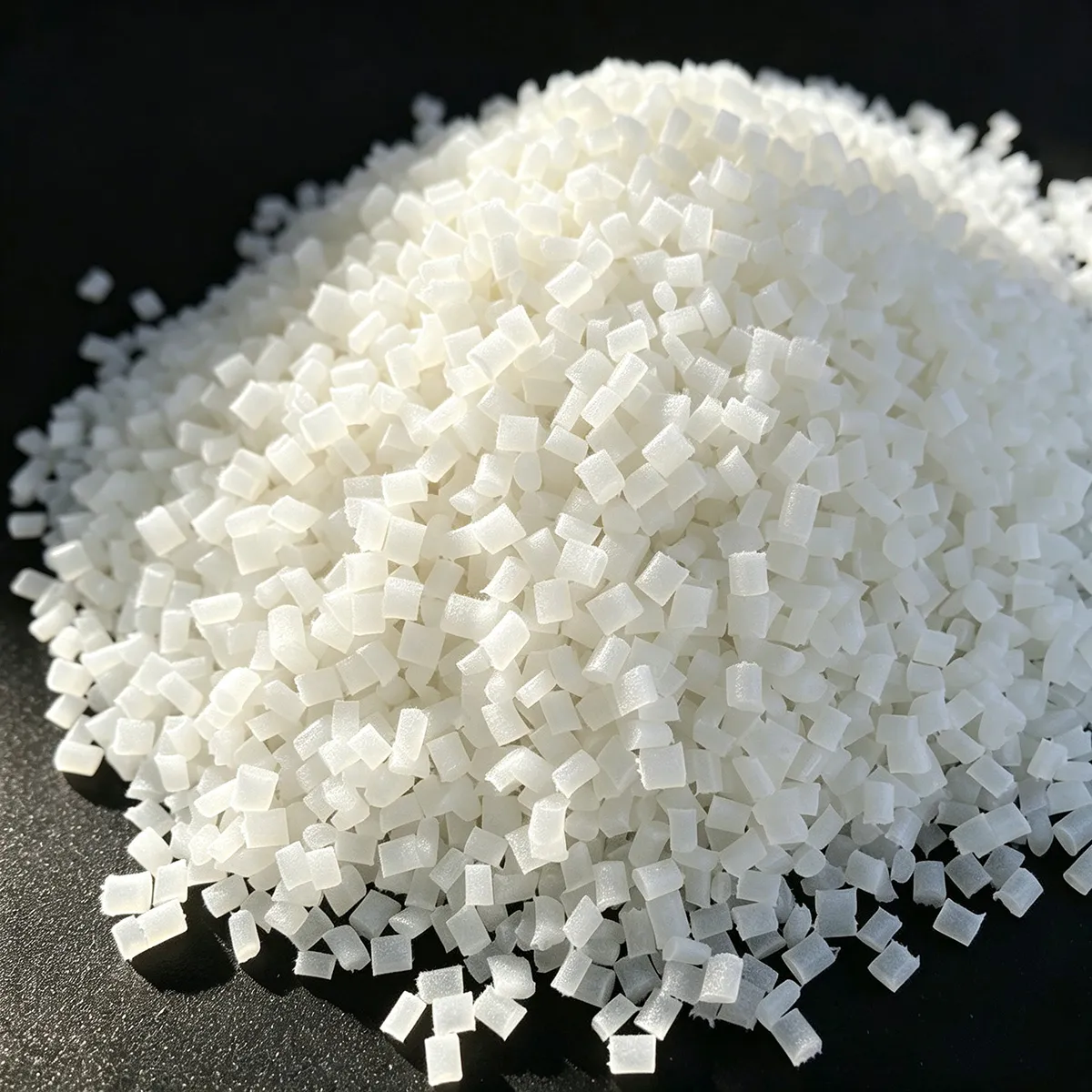
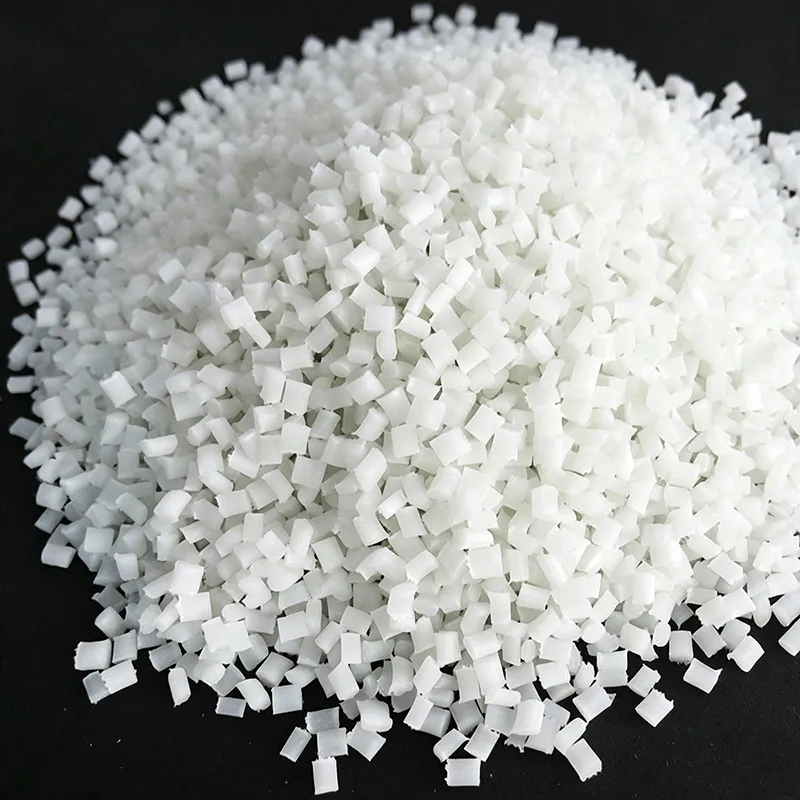
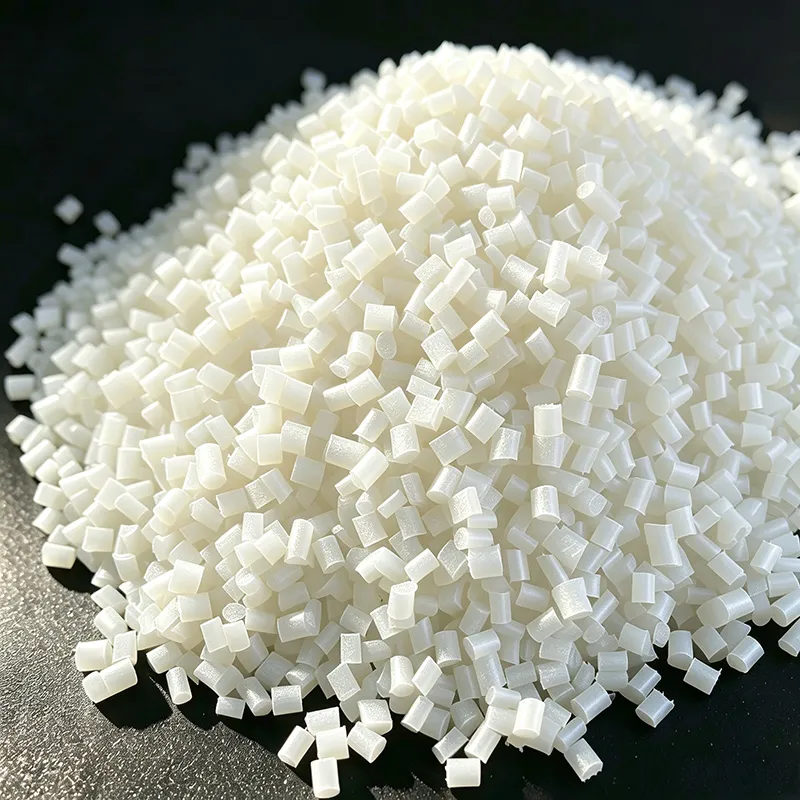
| Pellet Size & Geometry Uniformity | Length 3.0 ± 0.5 mm; diameter 2.5 ± 0.3 mm; 99% within tolerance | Manual caliper on 50 pellets per lot + inline pellet camera screening | Adjust cutter gap / pelletizer speed at no cost; re-screen if oversized tails exceed 1% |
Incoming Raw Material QC — Base Resin, GF, Mineral & Additives
Every incoming raw material lot under FTF02 program undergoes documented incoming inspection before being released to the twin-screw extrusion floor. The QC checks vary by raw material category but all include lot-number traceability, certificate of analysis (CoA) verification against Juhai spec, and a functional verification test.
Base Resin (PA6 / PA66 / PP): MVR measured at standard condition against supplier CoA (±10% acceptance band); moisture content via Karl Fischer titration (< 0.10% for PA, < 0.02% for PP); visual inspection for contamination or yellowing. Any lot out of spec is quarantined and returned to the polymer producer under Juhai supply agreement.
Chopped Glass Fiber: Fiber length and diameter verified via optical microscopy; silane sizing content confirmed via loss-on-ignition; moisture content < 0.05% mandatory before release to side feeder. E-glass composition checked via XRF spot test on high-volume lots.
Mineral Fillers (Talc, CaCO₃, Wollastonite, Kaolin, Mica): Particle size distribution via laser diffraction PSD; moisture content < 0.20% mandatory (oven-dried at 120°C before extrusion if above); brightness L* checked for kaolin and talc for color-sensitive grades.
Impact Modifiers & Specialty Additives: POE-g-MA and EPDM-g-MA graft level verified via extraction titration on a sampling basis; HFFR P-N intumescent packages tested for onset decomposition temperature via TGA; CNT conductive masterbatch verified for resistivity dispersion via compressed plaque test.
Color Masterbatch: Carrier resin matched to base resin family verified via DSC melting point; pigment loading confirmed via extraction; full ΔE plaque run vs. target chip before release for first production lot.
Program Benefits & Volume Incentive Structure
Beyond the baseline NRE-waiver tiers, FTF02 offers structured program benefits for customers committing to annual volumes and multi-formulation frame contracts. The incentive structure is deliberately transparent and written into every frame contract so that savings scale predictably with volume.
Annual Volume Tier Benefits
| Annual Volume Commitment (12-month written frame) | NRE Fee Treatment | Price Benefit vs. Spot Orders | Additional Program Benefits |
|---|---|---|---|
| Tier Entry — 3 MT / yr to 9 MT / yr | Standard NRE 500 USD per formulation; 100% refunded on first ≥ 5 MT order | Standard tiered pricing per formulation cost-band | Dedicated technical engineer; 2 complimentary formulation adjustment loops; ISO mechanical QC report per lot included |
| Tier Mid — 10 MT / yr to 19 MT / yr | NRE FEE 50% DISCOUNTED upfront (250 USD per new formulation); remaining 250 USD refunded on first ≥ 5 MT order | −4% vs. spot tiered pricing across all active formulations in the frame | All Entry benefits + 3 complimentary adjustment loops + annual supplier-day virtual engineering review + FDA/EU FC DoC templates pre-filled for frame formulations |
| Tier Upper — 20 MT / yr to 49 MT / yr | NRE FEE WAIVED 100% from project day one for every new formulation under the frame | −8% vs. spot tiered pricing across all active formulations | All Mid benefits + 4 complimentary adjustment loops per new formulation + reserved production-slot priority on our 65 mm lines (lead time reduced to 7 working days post lock) + dual-site backup bag sampling for critical programs |
| Tier Strategic — ≥ 50 MT / yr single-family OR ≥ 30 MT / yr with ≥ 4 active formulations | NRE WAIVED entirely + dedicated formulation master-batch stock held for exclusive customer use | −12% to −16% vs. spot tiered pricing; exact delta locked per frame contract and indexed semi-annually to polymer producer price lists | All Upper benefits + annual on-site visit by Juhai formulation and QC team at customer facility + IATF 16949 process documentation pack for automotive programs + reserved 75 mm production line time slot per month + 6 complimentary adjustment loops per formulation + joint R&D on next-gen part optimization if customer shares part CAD |
Multi-Formulation Customer Advantage
Customers running three or more locked formulations under FTF02 qualify for Multi-SKU Consolidation Benefits beyond the volume tiers above: (1) MOQ per production run may be reduced from 3 MT to 1 MT for the lower-volume SKUs when shipped together on a single combined pallet invoice; (2) color masterbatch setup fees for the second and subsequent Pantone/RAL colors on the same base formulation are halved; (3) joint raw-material pooling of base polymers across the customer's SKUs enables additional 2-3% raw material cost savings that are passed through directly in the frame price re-set.
Technical Support & After-Sales Commitment
Every FTF02 project — from the smallest 3T custom color trial to the largest 50+ MT/yr strategic frame program — is backed by a written technical support commitment. Our engineering team consists of eight formulation chemists, three injection-molding process engineers and two regulatory compliance officers, all on-site at our Ningbo facility with no out-sourced technical support layers.
Written Technical Support SLA
| Support Category | Response SLA (GMT+8 working days) | Deliverable Format | Escalation Owner |
|---|---|---|---|
| Incoming new-spec feasibility | < 24 business hours from email / form submission | Written feasibility sheet: go / conditional-go / no-go, estimated cost-tier, NRE note, sample lead | Assigned technical sales engineer |
| Formulation mechanical / color question after sample receipt | < 12 business hours for data clarification; < 48 business hours for recommendation on formulation adjustment | Email with attached QC re-analysis data; if adjustment needed a revised sample ship date | Formulation chemist + sales engineer pair |
| Injection molding processing issue at customer site | < 8 business hours initial triage call; < 24 business hours written recommendation | Telephone / WeChat / WhatsApp screen-share triage; written parameter sheet with ± window | Customer process engineer (injection molding specialist) |
| Regulatory compliance question (FDA / EU / UL / ROHS / REACH) | < 48 business hours for standard letter templates; < 10 business days for custom dossier compilation | PDF compliance letter, DoC per EU 10/2011 Art. 16, UL witness test coordination calendar invite | Regulatory compliance officer |
| Out-of-spec production lot (CpK / consistency guarantee escalation) | < 4 business hours initial root-cause response; < 10 business days from confirmed non-conformance to replacement 3T lot or 100% credit against next invoice at customer's option | 8D root cause analysis report (D1-D8 format); replacement lot or credit note per customer choice | FTF02 program manager + QC manager dual sign-off |
| Competitor-grade match performance question post-reverse-engineering | < 24 business hours for mechanical side-by-side commentary; < 5 business days for complimentary second iteration sample if mechanicals outside ±5% band | Side-by-side mechanical delta table; revised 25 kg sample ship date if required | Reverse-engineering lead chemist |
Processing Problem-Solving — Typical Scenarios Handled
Weld line strength below customer part-level test: Our process engineers review weld-line position in customer tool; recommend mold-temperature raise, switch from hot-runner valve-gate sequence or adjust formulation with higher-MFR base resin + compatible impact modifier package to improve knit-line toughness — complimentary sample iteration if under adjustment-loop allowance.
Surface splay marks on PA6 / PA66 parts: First-tier check: confirm customer dryer dew-point (target ≤ -40°C dew-point = ~0.06% moisture). If dryer confirmed compliant, we analyze pellet residual moisture via Karl Fischer and trace back to packaging seal integrity or warehouse ambient exposure — replacement batch and upgraded packaging seal sent at zero cost if root cause confirmed on Juhai side.
Sink marks on GF PA6 thick-rib sections: Quantify rib-to-wall thickness ratio; recommend holding pressure / time extension on customer side OR reformulate with minor MVR increase + nucleating agent to reduce skin freeze time and improve packing transfer into rib.
HFFR V0 UL94 fail at customer side after formulation V0 pass at Juhai lab: Joint screen-shot call to confirm injection molding melt temperature and residence time; HFFR intumescent systems are time-temperature sensitive and degrade if residence time exceeds 8 minutes above 270 °C. Recommend barrel-size match to shot size and back-pressure reduction. If lab protocol was followed without success we iterate the FR package at no charge.
Color mismatch on production lot 2, 3, etc. vs. locked reference: Issue a 500-piece retention plaque set from the lock lot for customer reference; on complaint we run CM-3600d re-measurement vs. customer-supplied plaque and either re-calibrate masterbatch letdown ratio on our extrusion line (most common cause) or, at no charge for ΔE > 1.0 confirmed, produce a complimentary single masterbatch re-spin and replace affected bags.
Production & Manufacturing Capability Snapshot
The FTF02 custom OEM program runs on Juhai Plastics' dedicated twin-screw compounding facility in Yuyao, Ningbo, with 18,000 sqm production hall and 1,200 sqm on-site R&D and QC lab. The lines below are all owned and operated by Juhai; no sub-contracting of custom compounding is performed under the FTF02 program.
Extrusion & Compounding Lines
| Line ID | Screw Size & L/D | Typical Output | Dedicated Use Under FTF02 | Gravimetric Feeders | Additive Injection Capability |
|---|---|---|---|---|---|
| TSE-50A (Trial Line 1) | 50 mm co-rotating intermeshing; L/D 52 | 80 — 200 kg/hr | 25 kg — 200 kg FTF02 trial batches and small-run custom color / additive variation | 4 loss-in-weight main feeders + 2 side feeders + 2 micro-feeders | Liquid side-stream injection for liquid HALS / UVA packages |
| TSE-50B (Trial Line 2) | 50 mm co-rotating; L/D 48 | 60 — 180 kg/hr | Dedicated line for HFFR intumescent and CNT conductive specialty trials to avoid cross-contamination | 3 main loss-in-weight + 2 side feeders + 2 high-precision micro-feeders (0.01% precision) | CNT pre-dispersion side feeder with shear pin mixing element |
| TSE-65A (Volume Production 1) | 65 mm co-rotating; L/D 56 | 350 — 700 kg/hr | 3T — 20T production MOQ runs for mid-tier PA6 and PP custom formulations | 6 main loss-in-weight + 3 side feeders + 3 micro-feeders | Liquid injection for color / stabilizer; atmospheric + vacuum vent stages |
| TSE-65B (Volume Production 2) | 65 mm co-rotating; L/D 56 | 350 — 700 kg/hr | Dedicated for FDA / EU food-contact formulations only; positive physical line separation with color-coded raw material zones | 6 main + 3 side + 3 micro-feeders; dedicated FDA-silo feed system | Full purge validation sheet with every product changeover on this line |
| TSE-75A (High Volume) | 75 mm co-rotating; L/D 60 | 800 — 1,500 kg/hr | 20T+ strategic frame programs for PA66 high-heat, SSF EMI shielding and other high-output custom formulations | 8 main loss-in-weight + 4 side feeders + 4 micro-feeders with inline MVR monitor | Inline near-IR color spectrometer closed-loop control + inline MVR viscometer for ±10% consistency |
On-Site QC & R&D Lab Equipment for FTF02
Injection Molding Presses (ISO Specimen): 80T servo-hydraulic press for 4mm ISO multi-purpose bar; 120T press for 60×60×2 mm color plaques and UL94 0.8/1.5/3.0 mm bar molds; closed-loop mold temp control ±1°C for HDT-relevant samples.
Mechanical Test: Three-column 100 kN universal tester for ISO 527 / 178 (≤ 0.5% load cell accuracy); motorized Izod / Charpy impact tester with 5.5 J and 22 J hammers; automated HDT / Vicat station with 6-position sample rack for ISO 75 / 306 runs.
Melt & Flow: Two MVR melt volume-flow rate testers with automated piston timing (ISO 1133); capillary rheometer available for viscosity-curve profiling of low- and high-MVR custom grades.
Thermal & Analysis: DSC (differential scanning calorimeter) for melting point, crystallinity and glass-transition verification; TGA (thermogravimetric analyzer) for GF%/mineral% ash-content verification and HFFR onset-decomposition check; Karl Fischer titrator for PA6/PA66 residual moisture.
Color: Konica Minolta CM-3600d bench-top spectrophotometer D65/10° with spectral component included (SCI/SCE); 5-point calibration check against calibration tile every working shift with full audit log.
Electrical & FR: UL94 vertical burn cabinet with camera recording; CTI comparative tracking index test chamber per IEC 60112; surface / volume resistivity test fixture per IEC 60093 for anti-static CNT grades.
Weathering (Sample Pre-Screening): QUV accelerated weathering tester (UV-A 340 nm lamps) for 500-hour and 1000-hour customer pre-screening of HALS/UVA custom outdoor grades before third-party independent certification.
Request Custom Formulation Spec, 5-Day Sample or Volume Quotation
Fill in the form below for an FTF02 custom formulation project. Our dedicated technical sales engineer will reply within 24 business hours with written feasibility assessment, estimated formulation cost-tier, NRE fee note and exact sample lead time for your exact specification. We typically respond within 4-8 business hours during GMT+8 Mon-Sat working window. For urgent competitor-grade reverse-engineering requests please upload TDS in the application details and mail a 1 kg sample in parallel to our Ningbo office address.