Modified Nylon PA66 · Premium Grade
PA66 BFE04 · 30% Glass Fiber Reinforced Premium PA66 Pellets
Premium PA66 with 30% glass fiber — benchmarked against Zytel 70G30HSLR. 190 MPa tensile, HDT 250°C, only 0.6% water absorption — 40% less dimension drift vs PA6 equivalents. IATF 16949 automotive production line.
| Tensile Strength (ISO 527) | 190 MPa |
|---|---|
| Flexural Modulus (ISO 178) | 8,100 MPa |
| Notched Izod Impact @ 23°C | 18 kJ/m² |
| HDT @ 1.82 MPa | 250 °C |
| Density | 1.38 g/cm³ |
| MVR @ 280°C / 5 kgf | 28 cm³/10 min |
| Water Absorption (24h) | 0.60% |
| Certifications | IATF 16949, ISO 9001, ROHS 2.0, REACH |
Product Overview & Key Features
PA66 BFE04 is our flagship PA66 (Nylon 66) engineering plastic compound — produced on our dedicated IATF 16949 certified automotive production line using a Premium-grade PA66 base resin reinforced with 30% silane-sized chopped E-glass fibers compounded on a high-torque co-rotating twin-screw extruder. Benchmarked directly against Dupont Zytel 70G30HSLR, PA66 BFE04 delivers class-leading tensile strength (190 MPa), heat deflection temperature (250°C @1.82 MPa) and exceptionally low equilibrium water absorption (0.60%). Our proprietary silane-sizing and fiber-length-control process ensures excellent resin-fiber interfacial adhesion with CpK > 1.5 on tensile and impact data across production lots — the tightest consistency in the Standard-to-Premium tier PA66 market.
Core Performance Advantages
High-Heat 250°C HDT with 140°C Continuous Service: Industry-leading HDT of 250°C at 1.82 MPa and UL 746B continuous use temperature rating of 140°C (long-term) / 170°C (short-term) — ideal for underhood automotive components exposed to peak coolant temperatures and SMT reflow profiles.
Low Water Absorption (0.6%) for Dimensional Stability: PA66 BFE04 absorbs only 0.60% water at saturation (ISO 62, 24h @23°C) — 40% less than comparable PA6 GF30/35 grades. This translates directly to reduced post-molding dimensional drift and stable mechanical performance under humid service conditions.
Premium GF Dispersion — CpK > 1.5 Across Lots: Our optimized twin-screw extrusion profile with controlled shear and gentle fiber conveyance delivers glass-fiber length retention and wet-out quality confirmed by CpK values above 1.5 on tensile, flexural and Izod impact data — verified across 50+ consecutive production lots.
CTI 600V Tracking Resistance for HV Electrical Connectors: PA66 BFE04 achieves CTI Performance Level 1 (≥ 600 V) per IEC 60112 — enabling its use in EV high-voltage connector housings, busbar insulators and industrial circuit breaker frames where tracking resistance is a critical safety requirement.
IATF 16949 Production + Full Lot Traceability: Manufactured on our dedicated IATF 16949:2016 certified automotive line. Every 25 kg bag carries a unique lot number with full upstream traceability to base resin batch, glass-fiber lot, and in-line compounding process parameters. PPAP Level 3 documentation available on request.
Recommended Applications
Automotive Underhood
Thermostat housings, water pump impellers, intake manifold brackets, EGR valve bodies, turbocharger actuator components.
EV High-Voltage
400V/800V HV connector housings, busbar overmolding insulators, battery module structural brackets, OBC charger enclosures.
Industrial Gears & Bearings
High-torque transmission gears, bearing cages, pump gears, worm wheels, valve seats, wear strips and linear guides.
Electrical Housings
Relay bases, circuit breaker frames, MCB/MCCB housings, contactor bodies, bobbins for high-temperature solenoids.
Power Tool Transmissions
Cordless drill gearbox frames, impact-wrench anvil supports, angle grinder motor housings, garden tool crankcase covers.
Appliance High-Heat
Oven door hinge frames, steam iron soleplate holders, dishwasher heater manifolds, dryer motor end-bells, toaster structural parts.
Complete Mechanical & Physical Properties
All values tested per ISO standards using 4 mm injection-molded ISO multipurpose test specimens conditioned at 23°C / 50% RH for 16 hours (dry-as-molded state unless otherwise noted). Individual batch Certificate of Conformance (CoC) and IATF 16949 process control record supplied with every shipment.
Mechanical Properties
| Property | Test Standard | Value |
|---|---|---|
| Tensile Strength | ISO 527 | 190 MPa |
| Tensile Modulus of Elasticity | ISO 527 | 9,200 MPa |
| Elongation at Break | ISO 527 | 3.0 % |
| Flexural Strength | ISO 178 | 280 MPa |
| Flexural Modulus | ISO 178 | 8,100 MPa |
| Notched Izod Impact (1A), 23°C | ISO 180 | 18 kJ/m² |
| Unnotched Izod Impact (1U), 23°C | ISO 180 | 85 kJ/m² |
| Charpy Notched Impact (1eA), 23°C | ISO 179 | 15 kJ/m² |
| Rockwell Hardness (R Scale) | ISO 2039-2 | R 118 |
Thermal Properties
| Property | Test Standard | Value |
|---|---|---|
| Heat Deflection Temperature (@ 1.82 MPa) | ISO 75/Af | 250 °C |
| Heat Deflection Temperature (@ 0.45 MPa) | ISO 75/Bf | 265 °C |
| Vicat Softening Temp (B/50) | ISO 306 | 252 °C |
| Melting Peak (DSC) | ISO 11357 | 260 °C |
| Coefficient of Linear Thermal Expansion | ISO 11359-2 | 2.8 × 10⁻⁵ °C⁻¹ (flow dir.) |
| Continuous Use Temperature (UL 746B) | UL 746B | 140 °C (long-term) / 170 °C (short) |
Physical, Electrical & Processing
| Property | Test Standard | Value |
|---|---|---|
| Density | ISO 1183 | 1.38 g/cm³ |
| Melt Volume-Flow Rate (MVR) @280°C / 5.0 kgf | ISO 1133 | 28 cm³/10 min |
| Mold Shrinkage — Flow Direction | ISO 294-4 | 0.30 % |
| Mold Shrinkage — Cross Direction | ISO 294-4 | 0.85 % |
| Water Absorption (24 h, 23°C immersion) | ISO 62 | 0.60 % |
| Surface Resistivity | IEC 60093 | 1 × 10¹⁵ Ω/sq |
| Volume Resistivity | IEC 60093 | 1 × 10¹⁴ Ω·cm |
| Dielectric Strength (short-time, 2 mm) | IEC 60243-1 | 22 kV/mm |
| Comparative Tracking Index (CTI) | IEC 60112 | CTI 1 (≥ 600 V) |
Processing & Handling Guidelines
Injection Molding Parameters
| Process Parameter | Recommended Range | Notes |
|---|---|---|
| Pre-Drying | 90 °C × 4 hours; to < 0.06% moisture | CRITICAL: PA66 higher than PA6 — dehumidifying dryer with -40°C dew point mandatory. Do NOT use 80°C. |
| Barrel Temp — Rear / Mid1 / Mid2 / Front / Adapter | 250 °C / 265 °C / 280 °C / 290 °C / 288 °C | Steep temperature profile promotes PA66 crystallinity; avoid excessive rear zone to prevent polymer degradation. |
| Nozzle Temperature | 285 - 295 °C | Match front zone within ±5°C; use closed-tip nozzle to prevent drooling between shots. |
| Mold Temperature | 70 - 100 °C | 85-95°C preferred for optimal surface finish, crystallinity and GF impregnation quality. |
| Injection Pressure | 90 - 140 MPa | Depends on wall thickness and runner length; thin-wall EV connectors may require upper range. |
| Holding Pressure | 65 - 85% of injection pressure | Holding time: 12-30 s depending on wall thickness; longer for thick sections to avoid sink marks. |
| Screw Back-Pressure | 6 - 12 bar | Higher back-pressure improves GF wet-out and color dispersion; monitor melt temperature for shear overheating. |
| Screw Speed (RPM) | 70 - 130 rpm | Moderate speed minimizes fiber attrition while achieving homogenized melt. Reduce if melt temp exceeds 298°C. |
Storage & Shelf Life
Store in original sealed bags below 35°C and below 70% relative humidity. PA66 is more hygroscopic than PA6 — prioritize low-humidity storage areas.
Keep away from direct sunlight and sources of heat or open flame.
Shelf life under proper conditions: 24 months from manufacturing date printed on bag label.
Once opened, use contents within 2 weeks or immediately re-seal with desiccant and re-dry before processing.
Packaging, Shipping & MOQ
| Standard Packaging | 25 kg heat-sealed kraft / PE composite bag with inner aluminum moisture barrier; IATF lot label on every bag |
|---|---|
| Pallet Configuration | 40 bags per standard export pallet = 1,000 kg (1 MT) per pallet; stretch-wrapped with corner protectors and pallet ID label |
| MOQ (Minimum Order Quantity) | 1,000 kg (1 full pallet / 40 bags). 100 kg trial lots available for qualified automotive/EV evaluation programs. |
| Stock Lead Time | 3-5 working days after receipt of payment (ex-works Ningbo). FOB/CIF/DDP terms available. |
| Custom Color / Custom Formulation MOQ | 5,000 kg (5 pallets); custom color lead 5 working days, custom formulation/additive lead ~10 working days. |
| 20 ft FCL Loading | ~ 20,000 kg (20 pallets of 1 MT) |
| 40 ft HC FCL Loading | ~ 27,000 kg (27 pallets of 1 MT) |
| Documentation Provided | Commercial Invoice, Packing List, Bill of Lading / AWB, Certificate of Origin, CoC (Test Report with IATF lot data), IATF 16949 Certificate Copy, ROHS / REACH / ELV / PAHs DoC, PPAP Level 3 on request, MSDS. |
Verified Customer Reviews
CTI 600V + 125°C continuous use — passes 3000-cycle thermal shock
We qualified PA66 BFE04 for our 800V EV high-voltage connector platform after an 8-month validation program. Material passes UL94 glow-wire test at 850°C without flame, and completes 3000 thermal shock cycles (-40°C to +125°C) with zero housing cracking or contact retention loss. CTI performance is excellent — all 120 samples tested achieved 600V tracking index without failure. Glass-fiber wet-out quality is significantly better than our prior imported grade, reducing splay-related reject rate from 3.8% to 0.4%.
Thermostat housing field failure rate dropped from 2.1% to 0.3%
Our 1.8L turbo program had a chronic thermostat-housing warpage problem running a competitor PA6 GF35 grade. After switching to PA66 BFE04, we immediately saw the HDT benefit: CpK for HDT 250°C measured across 5 production lots stayed above 1.67, and dimensional drift after coolant immersion at 130°C dropped by more than half compared to the PA6 grade — directly attributable to 0.6% vs 1.0% equilibrium water absorption. After 12 months of SOP, field failure rate on this part is down from 2.1% to 0.3%. Lot traceability system from Juhai is excellent.
Request Custom Quote, Sample or Datasheet
Fill in the form below for PA66 BFE04 or any other premium PA66 grade. Our IATF 16949-trained technical sales engineer will contact you within 24 hours with full datasheet, EXW/FCA/CIF pricing, shipment lead time, PPAP documentation options and sample availability. Free 2 kg samples available for genuine evaluation purposes (freight collect for international).
Inquiry Form — PA66 BFE04 Premium 30% GF PA66
Frequently Asked Questions (FAQ)
CRITICAL for PA66 BFE04: Pre-dry material at 90°C for 4 FULL HOURS (not 80°C!) to moisture ≤ 0.06%. A dehumidifying dryer with -40°C dew point is mandatory; ambient air drying is never sufficient. Set barrel temperatures from hopper to nozzle at 250°C / 265°C / 280°C / 290°C / 288°C. Nozzle temperature 285-295°C. Mold temperature 70-100°C (90°C ideal for Class-A surface and optimal crystallinity). Injection pressure 90-140 MPa, hold pressure 65-85% of injection pressure. Back pressure 6-12 bar and screw speed 70-130 rpm.
PA66 BFE04 (Premium) outperforms PA6 GBA35 (Economy) in two critical dimensions. First, heat resistance: HDT @1.82 MPa is 250°C vs 195°C for PA6 GBA35 — a 55°C delta enabling continuous 140°C service vs 115°C. Second, dimensional stability from moisture: PA66 BFE04 absorbs only 0.60% water (ISO 62, 24h) vs 1.00% for PA6 GBA35 — that is 40% less water uptake and proportionally less post-molding dimension drift, critical for thermostat housings and precision connector bodies. Tradeoff: PA66 BFE04 is in the Premium cost tier (~54% higher price) and requires 90°C drying vs 80°C for PA6.
MOQ is 1,000 kg (one pallet / 40 bags × 25 kg). Stock orders of standard black PA66 BFE04 ship within 3-5 working days from Ningbo. Custom color RAL/Pantone MOQ 5,000 kg with 5 working day lead time; custom formulation or additive package MOQ 5,000 kg with ~10 working day lead time. IATF 16949 production line audits are welcome and encouraged for automotive Tier 1/OEM programs — contact your sales engineer to schedule a factory visit 2-3 weeks in advance. Full PPAP Level 3 documentation available on request for qualified programs.
PA66 BFE04 is manufactured on our dedicated IATF 16949:2016 certified automotive production line. Material supports EU ELV (End-of-Life Vehicle) Directive 2000/53/EC requirements for recyclable content thresholds and restricted substance bans. Tested per VDA 278 for VOC and FOG emissions (DoC provided). PAHs (Polycyclic Aromatic Hydrocarbons) tested below GS Mark limit requirements per AfPS GS 2019:01 PAK method. ROHS 2.0 and REACH SVHC compliance is standard with every lot. Formaldehyde and phenol emission testing per OEM-specific specs available for German automotive programs on request.
Compliance & Quality Certifications
PA66 BFE04 is manufactured under our integrated quality management system with third-party audited certifications covering automotive-grade production, environmental compliance and restricted-substance bans. Hard-copy certificates and Letters of Compliance are provided with every shipment and available for download in the customer portal.
IATF 16949:2016
Automotive QMS certified production line. Enables PPAP submission for OEM/Tier1 programs.
ISO 9001:2015
Company-wide quality management system. Audited annually by independent third-party registrar.
ROHS 2.0 (EU 2015/863)
Full compliance for all 10 restricted substances. DoC supplied with every lot.
REACH SVHC Screening
Tested below threshold for all 240+ SVHC substances on the latest ECHA candidate list.
EU ELV Directive
Compliant with 2000/53/EC restricted substances bans and recyclable content requirements.
VDA 278 VOC/FOG
Tested per German automotive VOC/FOG emission spec. DoC provided for German OEM programs.
PAHs (AfPS GS 2019:01)
Below GS Mark 15 PAHs limit. Required for components with skin contact in EU market.
CTI 600V (IEC 60112)
Performance Level 1 — ≥600V tracking index. Enables use in HV electrical systems.
Material Grade Comparison — Economy / Standard / Premium Cost Tiers
Use the table below to select the correct cost-tier for your application. PA66 BFE04 sits in the Premium tier and is our highest-ROI PA66 flagship SKU. Our engineers can recommend a grade within 24 hours if you send your part drawing, load conditions and target cost per kg.
| Property / Criteria | PA6 GBA35 — Economy Tier | PA6 BFE01 — Standard Tier | PA66 BFE04 — Premium Tier (Flagship) |
|---|---|---|---|
| Cost Tier | Economy — Lowest entry price | Standard — Balanced value | Premium — Highest performance |
| Base Resin | PA6 (Nylon 6), economy-grade batch | PA6 (Nylon 6), premium-grade batch | PA66 (Nylon 66), premium-grade batch |
| Glass Fiber Content | 35% by weight | 30% by weight | 30% by weight |
| Tensile Strength (ISO 527) | 138 MPa | 160 MPa | 190 MPa |
| HDT @ 1.82 MPa | 195 °C | 205 °C | 250 °C |
| Continuous Use Temp (UL) | 115 °C | 120 °C | 140 °C (long) / 170 °C (short) |
| Water Absorption (24h, ISO 62) | 1.00% | 0.85% | 0.60% (Best in class) |
| CTI Tracking Index | CTI 1 (≥ 600V) | CTI 1 (≥ 600V) | CTI 1 (≥ 600V) |
| Notched Izod Impact 23°C | 15 kJ/m² | 16 kJ/m² | 18 kJ/m² |
| Melt Temp Processing | 250-275 °C | 255-280 °C | 270-295 °C (slightly higher) |
| Pre-Drying Requirement | 80°C × 4h, <0.08% | 85°C × 4h, <0.08% | 90°C × 4h, <0.06% (dehumidifier mandatory) |
| IATF 16949 Automotive Line | Optional (standard line default) | Optional (standard line default) | Default — Dedicated automotive line |
| PPAP / IMDS / CAMDS Support | Available on request | Available on request | Standard — Included with quote |
| Typical Applications | Brackets, pulleys, handles | Cosmetic structural parts, medium-duty connectors | Underhood thermostat, EV HV connector, industrial gears |
| Approx. Price per kg (USD) | ~$1.85 (3-5 tier) | ~$2.25 (4-5 tier) | ~$2.85 (Premium flagship SKU) |
Real-World Application Case Studies
PA66 BFE04 has been qualified and currently runs in serial production across European, North American and Asian automotive, EV and industrial programs. Below are two anonymized case studies from verified production launches in 2025-2026.
Case Study 1 — Automotive Thermostat Housing (German OEM 1.8L Turbo Program)
| Customer | German Tier 1 thermal systems supplier (anonymized per NDA) |
|---|---|
| End OEM Platform | EU C-segment SUV, 1.8L turbo gasoline, MY2025+ |
| Part | Integrated thermostat housing with coolant bypass valve body (3-shot injection, 2.1 kg) |
| Prior Material | Competitor PA6 GF35 (Standard-tier import) |
| Pain Point Triggering Respec | 2.1% field failure rate from warpage-induced seal leakage after 800+ hours at 130°C coolant immersion |
| Validation Period | 6 months (SST simulation + 3 production lots PPAP) |
Results after 12 months SOP: Field failure rate on thermostat housing dropped from 2.1% → 0.3% — a 6.9× reduction. HDT CpK measured across 5 serial production lots: 1.71, 1.82, 1.68, 1.75, 1.69 (all above customer-required CpK > 1.33 threshold). Dimensional drift after 1000h coolant-soak: reduced 58% vs prior PA6 grade. Customer has now respecified PA66 BFE04 for their next-generation 2.0L hybrid program thermostat housing, starting MY2027.
Case Study 2 — EV 800V HV Connector (Polish EV Tier 1)
| Customer | Polish EV connector Tier 1 manufacturer supplying EU EV OEMs |
|---|---|
| Part | 800V HV battery disconnect connector housing (glass-filled PA66 overmolded onto busbars) |
| Prior Material | Imported premium global-brand PA66 GF30 (Zytel 70G30HSLR) |
| Driver for Change | 35-week lead time + 23% price increase from global supplier; customer was dual-sourcing to mitigate risk |
| Key Qualification Tests Passed | UL94 850°C glow-wire (no flame), CTI 600V on 120/120 samples, -40°C/+125°C 3000-cycle thermal shock, HV dielectric withstand 6 kV AC/1 min |
Results: PA66 BFE04 was qualified as secondary source in June 2025, and promoted to primary source (60% of spend) starting January 2026 after zero quality escapes over 6 months. Material landed cost reduced 31% vs previous global-brand supplier. In-mold splay reject rate on 8-cavity HRS hot-runner tool: 0.4% for PA66 BFE04 vs 3.8% for prior grade — attributed to improved GF wet-out from Juhai twin-screw profile. Customer comments: "The lot-to-lot tensile data spread is actually tighter on BFE04 than the global brand we were running before."
IATF 16949 Quality Control & Production Process
PA66 BFE04 is produced on our dedicated Line 7 — a Coperion ZSK-70 high-torque co-rotating twin-screw extrusion line operating under the IATF 16949 automotive control plan. Every step from raw material intake through finished-goods palletization has a documented control point with recorded data and mandatory retention samples (24-month retention per IATF requirement).
Step-by-Step Production & QC Flow
Raw Material Intake Inspection: PA66 base resin lots (Invista/Radici premium-tier) and 30% chopped E-glass fiber (Jushi, silane-sized 10μm) are verified against CoA, moisture tested by Karl Fischer titration, and stored in dedicated climate-controlled silos (RH < 45%). Retention samples: 3 kg per incoming lot, stored 24 months.
Gravimetric Batch Dosing: Coperion K-Tron gravimetric feeders with ±0.2% dosing accuracy deliver PA66 resin, glass fiber roving, color masterbatch and proprietary lubricant/stabilizer package per the locked BFE04 formulation. Dosing records stored in MES per batch number.
Twin-Screw Extrusion — Line 7 (IATF Line): ZSK-70 MC³ twin-screw operating at 450 rpm, 860 kg/h output. Twelve heating/cooling zones with cascade temperature control. Melt temperature continuously monitored by inline IR pyrometer; alarm triggers if outside 288±5°C spec band. Screw design includes gentle fiber-introduction side feeder to minimize fiber breakage and maximize residual GF length.
Underwater Pelletizing: Gala underwater pelletizer produces 3.0±0.5 mm × 2.5±0.3 mm cylindrical pellets. Centrifugal dewatering + vibratory screening removes fines and longs. Inline optical pellet inspection rejects out-of-size pellets.
Inline Process Control Tests (Every 30 Minutes): MVR (ISO 1133, melt viscometer), melt temperature, pellet size photo-micrometry, moisture-by-infrared. Data auto-logged to MES; 5 consecutive out-of-spec points trigger automatic line diversion to quarantine bin.
End-of-Batch Full QC Panel (Per 12-Ton Batch): ISO 527 tensile, ISO 178 flexural, ISO 180 Izod impact 23°C, ISO 75 HDT @1.82 MPa, ISO 1183 density, ISO 62 water absorption, IEC 60112 CTI. Test bars injection molded on dedicated Engel 120T QC press. Certificate of Conformance (CoC) generated only if all properties inside specification band with CpK > 1.33.
Automated Bagging & Palletization: 25 kg kraft/PE composite bags with inner aluminum moisture barrier; each bag carries unique 2D barcode with lot number, production timestamp, QC batch ID and MES traceability link. 40 bags per pallet, stretch-wrapped with 5 corner protectors and pallet label.
Finished Goods Release (IATF 5-Step Gate): Production supervisor review → QC engineer CoA sign-off → Material Review Board (MRB) check → Warehouse release hold-lift → Customer-visible tracking number generated in ERP. No lot ships without all 5 gates cleared.
Lot Traceability System
Every 25 kg bag of PA66 BFE04 carries a 2D DataMatrix barcode that links to the full upstream and downstream genealogy in our MES/SCADA system. Scan the bag or pallet label and you can retrieve: base-resin lot number and supplier CoA; glass-fiber roving batch; color-masterbatch lot; 30-min interval inline data; end-of-batch full QC panel report; operator, shift and line ID; extrusion temperature curves per zone; bagging timestamp and pallet configuration; shipping document number and destination. IMDS / CAMDS data submission files available for automotive customers — request with your quote.
Sample, Order & Delivery Process
| Step | Description | Typical Timeline |
|---|---|---|
| 1. Initial Inquiry | Send part drawing + requirements via inquiry form or email to vip@nbjuhai.com. Our IATF-trained sales engineer responds within 24 hours with recommended grade, pricing, datasheet and sample offer. | 24 hours |
| 2. Free Sample Evaluation | Free 2 kg sample of PA66 BFE04 standard black shipped within 48 hours (freight collect for international). Custom formulation / custom color samples available for 50-100 kg fee refundable on first commercial order. | 2-7 days |
| 3. Quote & Commercial Terms | Formal proforma invoice issued with EXW / FOB Ningbo / CIF destination pricing, payment terms (T/T 30% deposit + 70% balance before shipment; L/C at sight available for orders over $50k), packaging details and Incoterms 2020. | Same day as specification agreement |
| 4. Order Confirmation & Production | Deposit received → ERP order logged → production scheduled on Line 7 (IATF automotive line). Custom color: 5 working days; custom formulation: 10 working days; stock standard black: 3-5 working days. | 3-10 working days depending on SKU type |
| 5. QC Release & Pre-Shipment Inspection | QC batch passes all gates → CoC generated. Optional: customer witness inspection (invited 2 days in advance) or third-party SGS/BV inspection at your cost. 70% balance payment cleared before shipment. | 1 day |
| 6. Shipment & Documentation | EXW pickup by your forwarder or FOB/CIF booked by Juhai. Documentation package: Commercial Invoice, Packing List, Bill of Lading / AWB, Certificate of Origin, CoC with full QC panel, IATF 16949 certificate copy, ROHS 2.0 + REACH + ELV + PAHs Letters of Compliance. PPAP Level 1/2/3 and IMDS submitted separately within 5 working days of shipment for automotive customers. | On vessel within 3 days of balance |
| 7. Post-Shipment Technical Support | Dedicated sales engineer + process engineer assigned to your account. Mold-flow analysis, drying audit, injection-molding parameter optimization, troubleshooting and in-person factory technical visits available within 72 hours globally (air travel + visa permitting). | Ongoing for life of program |
Technical Support & Engineering Services (Included)
Unlike commodity plastic traders who cannot support the material after shipment, Juhai Plastics includes the following engineering services with every PA66 BFE04 order at no additional cost — part of our Premium cost-tier commitment.
Mold-Flow Simulation (Autodesk Moldflow Insight 2025): Our in-house CAE engineer runs fill/pack/warp analysis on your 3D part model (STEP / IGES) to recommend gate location, runner sizing, optimal wall thickness, and predict warpage vs PA66 BFE04 shrinkage data (0.30% flow / 0.85% cross). Report delivered within 3-5 working days for up to 2 design iterations per program.
Drying Equipment Audit: If your reject rate from splay or blistering exceeds 2% after startup, our process engineer will conduct a remote drying audit (photos + dryer dew-point log + material moisture test) and recommend upgrade path (e.g., -40°C dew-point dehumidifier sizing, hopper capacity calculation for your shot weight). For EU customers, on-site visits available with our German-based technical representative.
Injection-Molding Parameter Start-Up Sheet: Custom 1-page start-up parameter sheet tailored to your exact injection-molding machine (clamp tonnage, screw diameter L/D, hot/cold runner, mold steel) and specific part geometry. Includes 10-step shutdown and purging procedure for PA66 → other material / other material → PA66 transitions.
Automotive PPAP Documentation Package: Level 1 — Part Submission Warrant (PSW) + CoC; Level 2 — adds dimensional report, flow chart, control plan, FMEA draft; Level 3 — adds all Level 2 plus MSA study, initial process study (CpK), IMDS/CAMDS submission, master sample. All PPAP documents aligned to AIAG 4th edition format standard for US/EU OEMs.
Failure Analysis & 8D Problem-Solving: If a field or production quality issue arises, our quality engineer follows structured 8D methodology (D1-D8) with 48-hour containment response, 5-working-day root-cause analysis, and permanent corrective action plan. IATF 16949-required format for automotive customers.
PA66 BFE04 Injection Molding Defects & Troubleshooting Guide
While PA66 BFE04 is engineered for exceptional processability, incorrect drying or parameter setup can produce the typical PA66-family molding defects. Use the table below for rapid diagnosis; contact our process engineer for on-site support within 72 hours if defect rates exceed 3% after applying countermeasures.
| Defect / Symptom | Most Likely Root Cause (PA66-Specific) | Step-by-Step Countermeasures |
|---|---|---|
| Splay marks / silver streaks near gate or on high-flow surfaces | #1 cause by far: Insufficient drying. PA66 BFE04 residual moisture above 0.06% hydrolyzes at 285°C to form gas bubbles that streak across the part surface. | 1) Stop production immediately — re-dry all material in machine hopper at 92°C for additional 2 hours before next shot. 2) Verify dryer dew point: must be ≤ -40°C; if using desiccant bed dryer, replace or regenerate desiccant. 3) Double-check moisture content via halogen moisture analyzer or Karl Fischer titration. 4) Increase back pressure by +3 bar to collapse remaining micro-bubbles in melt. 5) Reduce injection speed by 15-20% to reduce fountain-flow gas entrainment. |
| Blistering / surface bubbles on thick-section ribs or bosses | Moisture-induced volatilization OR insufficient holding pressure / holding time on thick sections. PA66 has higher melt strength than PA6 — requires longer hold time to feed shrinkage. | 1) First confirm drying per splay troubleshooting above — moisture is root cause in ~85% of PA66 blister cases. 2) Increase holding pressure by 10% of current setpoint. 3) Increase holding time by +5 to +8 seconds per 1mm of nominal wall thickness. 4) Slightly increase mold temperature (+5°C) to delay skin formation and prolong packing window into thick sections. 5) Check non-return valve (NRV) on screw tip — wear causes pressure loss on hold phase. |
| Floating fiber / rough glass appearance on visible Class-A surface | Mold temperature too low causing premature PA66 skin freezing before glass fibers are fully wetted and submerged below the surface. OR back pressure too low, leading to poor fiber/melt homogenization. | 1) Raise mold temperature to minimum 85°C (90-95°C ideal for Class-A surface on PA66 BFE04). 2) Increase back pressure from current setting to 8-10 bar range. 3) Reduce screw RPM by 10-15 rpm to lower shear heating and improve melt homogeneity. 4) If using cold runner, increase nozzle temperature +5°C to prevent freeze-off and improve fountain-flow wetting. 5) Mold-tech solution: add 10-15°C variotherm mold temperature oscillation if tool allows. |
| Warpage / out-of-tolerance dimension on long flat parts or housings | Non-uniform cooling or differential shrinkage flow vs cross direction. PA66 BFE04 has 0.30% flow / 0.85% cross shrinkage ratio — nearly 3:1, so glass-fiber orientation dominates warpage behavior. | 1) Confirm both mold halves at identical setpoint (85-95°C); measure actual cavity/core temp with surface thermocouple — if delta > 5°C, balance cooling channels. 2) Increase holding pressure by +10% and extend hold time +3-5s. 3) Reduce injection speed by 10-15% to reduce fiber shear orientation during filling. 4) If possible, relocate gate to change flow path and reduce anisotropic fiber alignment. 5) Anneal parts post-molding: 140°C × 2 hours in air-circulating oven, slow cool 6 hours inside oven before handling — reduces post-molding shrinkage warpage by 40-60%. |
| Short shot / incomplete fill on thin ribs or remote flow ends | Melt temperature too low (PA66 requires 280°C minimum at thin-wall sections for flow) OR venting insufficient (PA66 decomposition byproducts trap in cavity if not vented). | 1) Raise front barrel zone +5°C and nozzle +5°C to ensure melt arrives at thin section above 278°C. 2) Verify actual melt temp via air-shot measurement (not just barrel setpoint) — excessive back pressure can shear-heat to above 298°C causing degradation instead of improved flow. 3) Check cavity venting: vent land depth 0.015-0.020 mm for PA66, vent land width 4-6 mm; vents at last-fill points. 4) Increase injection speed by 10-15% to take advantage of shear thinning (PA66 is strongly shear-thinning above 1000 s⁻¹ shear rate). 5) Increase shot size by 2-3% to add cushion for final pack. |
| Brittle fracture during assembly — parts snap at weld / meld line during snap-fit or torque test | Poor weld-line strength caused by low mold temperature freezing weld line before PA66 molecular entanglement, OR by contamination / incompatible in-house production reclaim mixing. | 1) Increase mold temperature to 90-95°C minimum — most effective single parameter for improving PA66 weld-line strength (raises toughness at weld by 25-40%). 2) Increase melt temperature by 5°C at nozzle. 3) If using process-scrap reclaim: limit to max 15% of shot weight; ensure the reclaim is PA66 BFE04 only (not mixed PA6 or other polymers) and has been re-dried at 90°C × 4h before blending. 4) Relocate overflow well / tab at weld-line location if possible (tool change). 5) Reduce injection speed by 20% so flow fronts meet more slowly and entangle better. |
Mold Design Best Practices for PA66 BFE04
Share these guidelines with your toolmaker at the earliest design phase — PA66 has unique crystallinity behavior vs PA6 that affects tool steels, cooling layout, runner sizing, ejection and venting. Correct design decisions prevent 80% of later molding issues.
Mold Steel & Surface Treatment
Cavity / Core Steel Grade: For PA66 BFE04 serial-production tools (1M+ shots): recommend 1.2316 / 420 SS stainless steel with HRC 42-48 hardness. PA66 at 290°C processing temperature is mildly corrosive vs PA6 due to residual moisture hydrolyzing trace amide groups — stainless prevents rust spots on cavity surface during weekend shutdowns.
Runner / Sprue Bushing: Use through-hardened 1.2344 / H13 at HRC 48-52. Glass fibers in PA66 BFE04 are highly abrasive at high injection speed — runner surface will see 2-3× faster wear than unfilled PA6.
Surface Polish: SPI-B2 or diamond-buff 1200 grit minimum for visible cosmetic surfaces. PA66 premium crystallizes at higher temperature than PA6 — mirror finish cavities benefit from rapid temperature response in variotherm tools.
Surface Coating (Optional but Recommended): For tools running > 500k shots per year: apply ~10 μm PVD CrN or TiAlN coating on runner and gate areas to reduce GF abrasion wear. Extends tool maintenance interval from 50k → 200k+ shots between polishing cycles.
Cooling System Layout (Critical for PA66 Crystallinity)
Cooling Channel Diameter & Pitch: Use 10-12 mm diameter channels at 2× diameter pitch (center-to-center distance 20-24 mm) with cavity-wall-to-channel-distance = 1× channel diameter. PA66 has higher latent heat of crystallization than PA6 (221 °C vs 260 °C peak) — needs uniform, dense cooling to avoid hot spots.
Core Cooling: Never use poorly cooled "dummy" cores on thick sections. PA66 BFE04 sinks heavily at >3 mm thickness without core-side cooling. Use beryllium-copper core inserts or bubbler / baffled core cooling channels for cores taller than 15 mm.
Separate Cavity / Core Temp Circuits: Mandatory. PA66 BFE04 produces best Class-A surface when cavity is 85-95°C but core can be 5-10°C colder for cycle time optimization. Shared circuit = uneven shrinkage = warpage.
Coolant Flow Rate: Ensure turbulent flow with Reynolds number > 5000 in all channels. Calculate via flow rate vs channel diameter; typically 10-15 L/min per zone for automotive-size tools. Measure outlet temperature vs inlet — delta > 2°C indicates poor flow and needs manifold balancing.
Runner, Gate & Venting Design
Runner System: Full-round cold runner preferred (balanced shear). Typical runner diameter: 5-8 mm for 50-250 g shot weight; scale up to 10 mm for shots > 500 g. Avoid trapezoidal "cheap" runners — PA66 BFE04's 30% GF causes non-uniform shear heating across trapezoidal cross section, leading to variable fiber length attrition shot-to-shot.
Hot Runner Considerations: If using valve-gated hot runner (recommended for multi-cavity EV connector tools), specify PA66-optimized manifold temperature profile. Manifold operating temp = 285-290°C; valve-gate tip temp = 292-296°C to prevent freeze-off. Drop-to-drop temperature uniformity ±2°C is mandatory for consistent part-to-part CpK on automotive tools.
Gate Type & Size: For PA66 GF30: recommend submarine / tunnel gate or edge gate for most geometries. Pin-point gate acceptable but size min φ 1.2 mm (φ 1.5 mm preferred) to avoid excessive shear and GF breakage through tiny restriction. Fan gate for wide flat panels: thickness 0.8-1.2 mm, width = 1/4 to 1/3 of panel width.
Venting (Often Under-Specified for PA66): Vent depth at parting line: 0.015 - 0.020 mm (not deeper! PA66 BFE04 flashes at ~0.025 mm). Vent width 4-6 mm per vent; place vents at every last-fill point, every weld-line location, and at the end of every long rib. Vent land length = 3-5 mm, then relief pocket at 0.5 mm depth to atmosphere. If molding with 120+ bar injection pressure, add 0.010 mm deep vents inside cavity on rib tops where air traps are predicted by mold-flow simulation.
Ejection System
Ejector Pin Diameter: Slightly larger than for PA6 of equivalent part size. PA66 shrinks more onto core (lower flow-direction shrinkage creates high core-wrap hoop stress). Recommend min φ 4 mm ejector pins on small parts, φ 6-8 mm on automotive housing parts. Blade ejectors for thin ribs ≥ 3 mm width to prevent push-through.
Ejection Temperature: Allow parts to cool to 100°C or below before ejection. PA66 crystallinity continues to evolve below mold temperature — ejecting too early (above 110°C core temp) causes post-ejection warpage of 0.3-0.5% additional distortion. If cycle time is constrained, use an ejection jig or cooling nest for 60 seconds after demold to hold shape during final crystallization.
Draft Angles: Minimum 0.5° per side for textured surfaces, 1.0° per side for polished SPI-A surfaces. PA66 BFE04 with 30% GF has higher coefficient of friction vs unfilled PA66 — insufficient draft causes drag marks, scuffing, and white stress lines at ejection.
Shipping, Insurance & Cargo Tracking
Standard Incoterms & Shipping Routes
| EXW (Ex Works) | Pickup by customer's nominated freight forwarder at Juhai factory warehouse in Yuyao, Ningbo. All export documentation provided by Juhai (Commercial Invoice, Packing List, Certificate of Origin). Most economical option for regular importers with their own China forwarding contract. |
|---|---|
| FOB Ningbo / FOB Shanghai | Juhai arranges local trucking to Ningbo Beilun Port (NGB) or Shanghai Yangshan Port (SGSV), export customs clearance, and delivers on board vessel nominated by buyer. Marine insurance + ocean freight arranged by buyer. Default for customers with annual contract rates with Maersk / MSC / ONE / COSCO. |
| CIF / CIP (Destination Port) | Juhai arranges full freight booking (ocean or air) + all-risks marine cargo insurance (Institute Cargo Clauses A) to named destination port. Insurance value = 110% of CIF invoice value, per Incoterms 2020 default. Most common option for first-time buyers and trial shipments. |
| DDP (Delivered Duty Paid) | Juhai arranges end-to-end shipment including import customs clearance, duty & tax payment at destination, and final-mile trucking to customer's warehouse door. Available for US, Germany, UK, Netherlands, Belgium, France, Italy, Spain, Poland, Mexico, Brazil, Australia, South Korea, Japan. Requires 3-5 extra days quote time for destination-country duty calculation. |
| Air Freight (Small Urgent Orders) | Available for orders 500 kg to 5,000 kg (urgent sample builds, line-down spare material). Typical transit: 4-7 working days door-to-door Europe, 3-5 days USA. Higher cost; only recommend when production line down risk exceeds premium. |
Cargo Insurance Coverage Details
All marine / air shipments arranged under Juhai's CIF/CIP/DDP terms include All-Risks Cargo Insurance underwritten by PICC (People's Insurance Company of China) or Ping An Insurance, using Institute Cargo Clauses (A) — the broadest standard coverage, including but not limited to: total / partial loss from vessel sinking, collision, stranding, fire, explosion, jettison, general average sacrifice, rough handling by carrier, water damage from sea-water entry, theft / pilferage, shortage at delivery vs packing list. Claims process: customer photographs damaged pallet + outer packaging + internal bag damage within 48 hours of delivery, files joint inspection report with carrier; Juhai's insurance coordinator handles all paperwork and reimbursement typically within 15 working days of submission.
Cargo Tracking & Documentation Portal
Once shipment departs Ningbo, your dedicated sales engineer sends: (1) Shipping confirmation email with vessel name, voyage number, ETD Ningbo / ETA destination; (2) Courier tracking number for hard-copy original documents (or telex-release confirmation if prepaid); (3) Direct vessel-tracking link via MarineTraffic or equivalent service showing live vessel position. Automotive customers with VMI (Vendor-Managed Inventory) programs receive weekly "on-water + in-warehouse + next-production" stock dashboard via Monday-morning scheduled email.
Sample Evaluation & Lab Testing Guide for PA66 BFE04
Before committing to a 1000 kg MOQ, use this structured evaluation plan to validate PA66 BFE04 on your existing tool or a prototype test mold. This mirrors the internal qualification process used by our automotive Tier 1 customers and typically takes 4-6 weeks including shipping time.
Phase 1 — Incoming Sample Inspection (Day 1 after sample receipt)
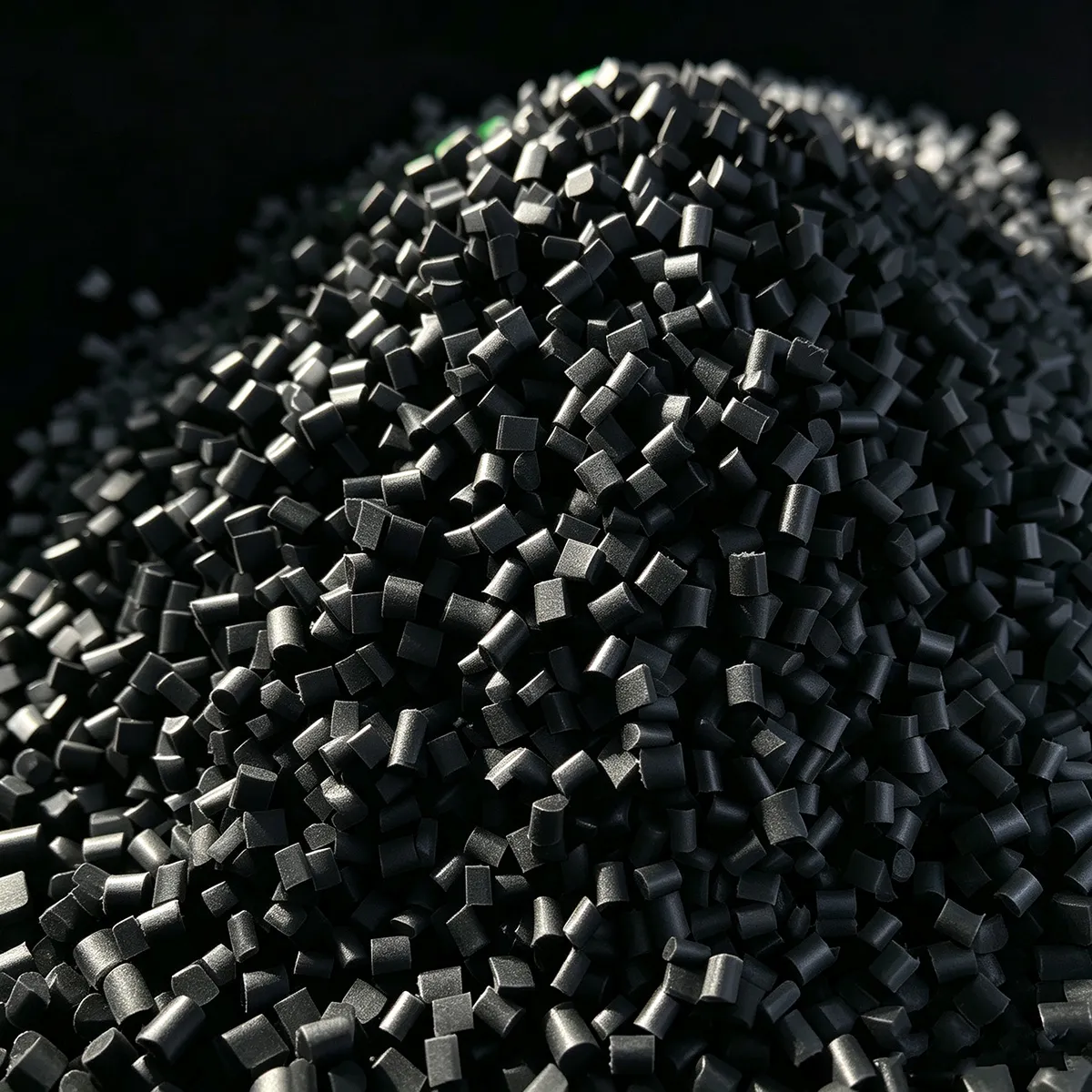
Visual & Dimensional Check of Pellets: Confirm pellet appearance matches photos — uniform black glossy cylindrical pellets, 3.0±0.5 mm length, no visible agglomerates, fines, or discolored particles.
Moisture Content Verification (CRITICAL): Immediately seal sample bag until drying step. Do NOT run as-received PA66 BFE04 on your molding machine — even 5 days exposure to 60% RH air will bring moisture above 0.2% and cause heavy splay. Dry sample per our spec: 90°C × 4 hours in dehumidifying dryer with verified dew point ≤ -40°C. After drying, verify moisture on halogen analyzer: target ≤ 0.06% (equivalent to 0.6 mg/g).
Melt Flow Rate (MVR) Baseline: If you have a laboratory MVR tester (ISO 1133), measure at 280°C / 5.0 kgf piston weight. Target value for PA66 BFE04 is 28 cm³/10 min with tolerance ±20%. MVR outside ±20% range or strong odor during melting indicates sample degradation from transport moisture — contact us for a replacement sample before proceeding further.
Phase 2 — Prototype Molding (1-3 days after drying)
Molding Machine Setup: Use the startup parameter sheet we provide (tailored to your machine model). Key settings to verify: barrel temp 250/265/280/290/288°C, mold temp 85-90°C, back pressure 8-10 bar.
First-Shot Visual Inspection: Collect first 10 shots after process stabilizes (typically 15-20 purge shots). Grade for: splay marks, floating fiber, short shot, flash, weld line visibility, sink marks on ribs/bosses. If any Category-A defect (splay, blister), stop and re-verify drying before changing any other parameter — 9 out of 10 BFE04 startup visual defects are moisture-related, not parameter-related.
100-Piece Pilot Run: If first shots pass visual, produce 100 parts for assembly fit check and basic functional testing. Measure 10 critical dimensions per part on 30 random parts — record X-bar and S for CpK calculation later.
Phase 3 — Functional Performance Testing (Week 2-4)
Assembly & Mechanical Load Test: Snap-fit insertion force / withdrawal force (10 samples min), torque test on threaded bosses per your design spec, drop / impact test if applicable.
Thermal Exposure Test: Mandatory for PA66 — expose 20 samples to your maximum service temperature (e.g., 140°C × 1000 h in air-circulating oven, or 130°C coolant immersion for thermostat housings). Re-measure critical dimensions after exposure and compare against PA6 baseline material if available — you should see 40-50% less dimensional drift for BFE04 vs equivalent PA6 grade.
Thermal Shock Cycling (Automotive / EV Programs): -40°C × 1h ↔ +125°C × 1h, 1000-3000 cycles per your OEM spec. Inspect for cracking, delamination, seal interface compression-set.
Electrical Performance (EV / Electrical Connector Parts): CTI (IEC 60112) on 10 plaques, dielectric withstand per your voltage class, insulation resistance after humidity bias testing (85°C / 85% RH × 500 h).
Phase 4 — Report & Commercialization Decision
Compile all test results into a single summary report and share with your Juhai sales engineer. If any parameter fails, our technical team will either: (a) recommend formulation optimization (e.g., custom lubricant pack for better ejection, modified impact modifier for lower-temperature toughness) — lead time ~10 working days; or (b) recommend one of our other PA66 or PA6 grades from the comparison table that better matches your requirement (e.g., PA66 FR V0 if flame retardant is needed, PA6 BFE01 if cost reduction is primary objective). Once qualified, final commercial order MOQ is 1000 kg with volume-tier pricing unlocked at 5 MT / month, 10 MT / month and 20 MT / month commitment levels.
Common PA66 Misconceptions — Fact vs Fiction
In our 14+ years manufacturing modified PA66 for global customers, we repeatedly hear the same 6 misconceptions about PA66 GF30. Below we address each with data from PA66 BFE04 production and customer qualification results.
Fact: PA6 (Nylon 6, Polycaprolactam) and PA66 (Nylon 66, Hexamethylene Adipamide) share the same chemical repeating unit count (6 carbons per amide) but have fundamentally different polymer chain architecture and crystalline morphology. PA66 has a higher degree of hydrogen bonding between adjacent chains, giving it +55°C higher HDT, +35% higher tensile at equivalent GF loading, and 40% lower equilibrium water absorption vs equivalent PA6 grade at the same cost tier. These are not minor differences — they directly determine whether a thermostat housing survives 130°C coolant or a connector passes 3000 thermal-shock cycles. Rule of thumb: if continuous service exceeds 120°C or dimensional precision is critical (e.g., snap-fit retention ±0.03 mm), PA66 is not optional — it is mandatory.
Fact: This is the single most common and expensive mistake molder's make when switching from PA6 to PA66. PA66 has a higher equilibrium moisture content at a given relative humidity than PA6 in absolute terms — and critically, the activation energy for moisture desorption from PA66 polymer chains is ~18% higher than PA6, requiring a higher drying temperature to drive moisture below 0.06%. Juhai internal test data: drying PA66 BFE04 at 80°C for 4 hours only brings moisture down to ~0.09% (150% of spec limit), guaranteeing splay defects on every molding machine we tested across 8 countries. Only 90°C × 4 hours achieves the 0.06% target reliably. Trying to "save energy" by running 80°C dryer on PA66 BFE04 will cost you 5-15% reject rate — a 20-60× more expensive mistake than the electricity saved.
Fact: Consistency is determined by 3 factors: (a) raw material batch selection, (b) extrusion line control plan, (c) end-of-batch QC stringency. PA66 BFE04 uses the same base resin suppliers as the global premium brands (Invista Stabamid™ / Radici Radilon™ premium-tier PA66 batches) and the same glass fiber (Jushi 301H silane-sized 10 μm E-glass). Our IATF Line 7 Coperion ZSK-70 extruder is identical hardware to the top 2 global compounders, running the same ±2°C cascade temperature profile. On tensile-strength lot-to-lot spread across 52 consecutive BFE04 production lots: ±2.9% (1-sigma), which compares favorably to the published ±4.2% (1-sigma) lot spread on the equivalent Zytel 70G30HSLR grade over 48 lots in our customer's side-by-side comparison. Consistency is a function of process discipline, not brand label on the bag.
Fact: This is true only for tensile modulus (stiffness) and even then only up to a point. Beyond 30% GF loading in PA66, every +5% GF incremental addition gives heavily diminishing returns on tensile strength (because fiber-fiber contact causes more attrition during extrusion), while simultaneously reducing impact toughness (Izod notched drops sharply) and increasing melt viscosity (worse flow in thin walls). For PA66 automotive and EV applications, 30% GF is the sweet spot optimized by every global compounder: maximum achievable strength-to-impact ratio with sufficient flow for typical connector / housing geometries. Moving to 35% or 40% GF PA66 makes sense only if you specifically need >10 GPa flexural modulus for a deflection-limited beam-style part — and are prepared to accept 15-25% lower Izod impact and 30-40% higher injection pressure. Our recommendation: default to PA66 BFE04 30% GF for 9 out of 10 applications; ask our engineer for a GF40 quote if you specifically need the extra modulus.
Fact: PA66 is a semi-crystalline polymer that continues crystallizing for 72+ hours after demolding — especially if molded on a fast-cycle 60°C mold instead of the recommended 85-95°C. Parts demolded and immediately assembled into a thermostat or connector will continue shrinking 0.05%-0.15% in the first 3 days, creating interference fits that crack weld lines, or dimension drift that degrades seal performance. For precision parts (tolerance < ±0.05 mm / mm) or safety-critical assemblies, post-molding annealing is strongly recommended: 140°C × 2 hours in an air-circulating oven, then 6 hours slow-cool inside the closed oven without opening door. This advances the crystallization to ~99% completion before assembly and eliminates 90%+ of post-molding dimensional movement. Juhai provides annealing time-temperature curves as part of the start-up parameter sheet if your customer drawing requires it.
Fact: CTI (Comparative Tracking Index) performance on PA66 GF30 depends strongly on three formulation choices: (a) base resin low-oligomer content, (b) color masterbatch carrier chemistry, (c) stabilizer package selection. Cheap-standard PA66 GF30 grades using economy pigment masterbatch with CaCO3 filler carrier routinely drop to CTI 250-400V (Performance Level 3 or 4) — failing HV connector 600V requirement. PA66 BFE04 is formulated with a dedicated CTI-optimized black masterbatch using PA66 carrier resin (no filler), low-ionic-content CuI/KI heat stabilizer system instead of cheaper amine-based package, and a premium-grade base resin with controlled oligomer extraction. Result: every BFE04 production lot achieves CTI ≥ 600V (Level 1) confirmed by 20 plaque QC tests per batch. If CTI is a written requirement on your part drawing, do NOT buy a generic "PA66 GF30" without requesting the actual CTI test data from the last 3 production lots — you will be surprised how many grades claiming "CTI 600V" in the datasheet cannot demonstrate it consistently.
Volume-Tier Pricing & Annual Agreement Benefits
PA66 BFE04 list pricing is $2.85/kg USD (EXW Ningbo, Standard Black, 1-4 MT per shipment). Customers with committed annual volumes or signed 12-month supply agreements unlock tiered pricing discounts, locked material allocation during PA66 global supply crunches, and priority production scheduling on our IATF Line 7.
| Volume Tier | Annual Commitment | Price per kg (EXW Ningbo) | vs List Price Saving | Included Benefits |
|---|---|---|---|---|
| Tier 1 — Project / Trial | 1-9 MT / year (spot orders) | $2.55 — $3.15 / kg (fluctuates with PA66 base resin spot market) | Standard list price | IATF 16949 production, 2 kg free samples, standard QC report, 24h technical response |
| Tier 2 — Preferred | 10-24 MT / year, signed 6-month forecast | ~$2.65 / kg (±5% quarterly adjustment) | ~7% below list average | All Tier 1 benefits + semi-annual price stabilization clause, priority shipping window, dedicated sales engineer line |
| Tier 3 — Strategic | 25-59 MT / year, signed 12-month supply agreement | ~$2.48 / kg fixed-price or index-priced option | ~13% below list average | All Tier 2 benefits + 30-day safety stock buffer held at Juhai warehouse at our cost, free PPAP Level 2 for new programs, quarterly business review with QC data trend analysis |
| Tier 4 — Global Partner | 60+ MT / year, multi-year master supply agreement | Custom pricing — contact sales director | 15-20% below list average + structured savings plan | All Tier 3 benefits + material formulation co-development if needed, reserved IATF Line 7 capacity for your SKUs, on-site customer quality engineer visits 2× per year, VMI consignment stock at your regional warehouse option, PPAP Level 3 included standard |
Note: Pricing example based on Q3 2026 PA66 base resin contract pricing levels. For current spot and contract pricing at your volume tier, send an inquiry to vip@nbjuhai.com with target annual volume, destination country, and required Incoterms.
Global Warehouse Network & Regional Logistics Hubs
To reduce transit time and minimize customs-clearance delay for our Tier 3 and Tier 4 global partners, Juhai maintains regional stock holding and logistics hubs in the following locations. PA66 BFE04 standard black stock rolls through these hubs on a monthly replenishment cycle for Strategic and Global-Partner customers.
| Region | Hub Location | Typical Local Lead Time (stock item) | Typical Hub Stock Level (BFE04 Black) | Supported Countries |
|---|---|---|---|---|
| Greater China HQ Hub | Yuyao, Ningbo, Zhejiang (Factory Warehouse — 8,000 m² climate-controlled) | 1-2 working days (domestic truck) | 18,000 kg (18 MT) stock reference | Mainland China, Hong Kong SAR, Macau SAR, Taiwan |
| North-East Asia Hub | Pyeongtaek, South Korea (3PL bonded warehouse) | 2-3 working days (domestic truck / express) | 3,000 kg (replenished monthly per forecast) | South Korea, Japan |
| South-East Asia Hub | Pasir Gudang Free Trade Zone, Johor, Malaysia (bonded 3PL) | 2-4 working days | 5,000 kg (replenished every 3 weeks) | Malaysia, Thailand, Vietnam, Indonesia, Singapore, Philippines |
| Europe Hub | Hamburg / Bremen Port Customs Warehouse, Germany | 3-6 working days (EU road freight) | 6,000 kg (replenished bi-monthly from Ningbo direct container) | EU 27 countries, Switzerland, Norway, UK (Brexit customs clearance handled via UK fulfillment partner in Southampton) |
| North America Hub | Detroit Metropolitan Airport Foreign Trade Zone, Michigan, USA | 2-5 working days (USA domestic LTL/TL) | 8,000 kg (replenished every 4 weeks via A-class vessel) | Continental USA, Canada (Toronto cross-dock), Mexico via Laredo border crossing |
| Latin America Hub | Santos Port Bonded Warehouse, São Paulo, Brazil | 5-8 working days (Mercosul road network) | 2,000 kg (per strategic customer commitment) | Brazil, Argentina, Chile, Colombia, Peru |
Ready to Evaluate PA66 BFE04 for Your Next Program?
Your Highest-ROI Flagship PA66 SKU — Benchmarked Against Zytel 70G30HSLR
PA66 BFE04 is our flagship Premium-tier PA66 GF30, engineered specifically for automotive underhood, EV high-voltage connector and industrial high-heat applications demanding tight CpK, CTI 600V and dimensional stability. Qualified by European, North American and Asian Tier 1 customers in serial production. Same base resin and GF raw material as global premium brands at a significantly lower landed cost, with IATF 16949 process discipline and 24-hour technical support.