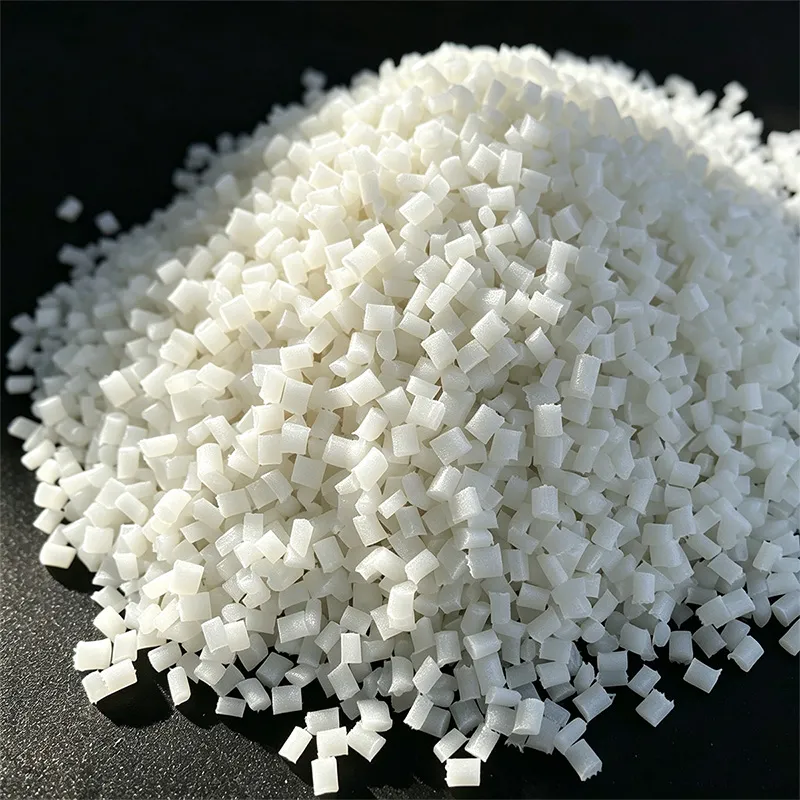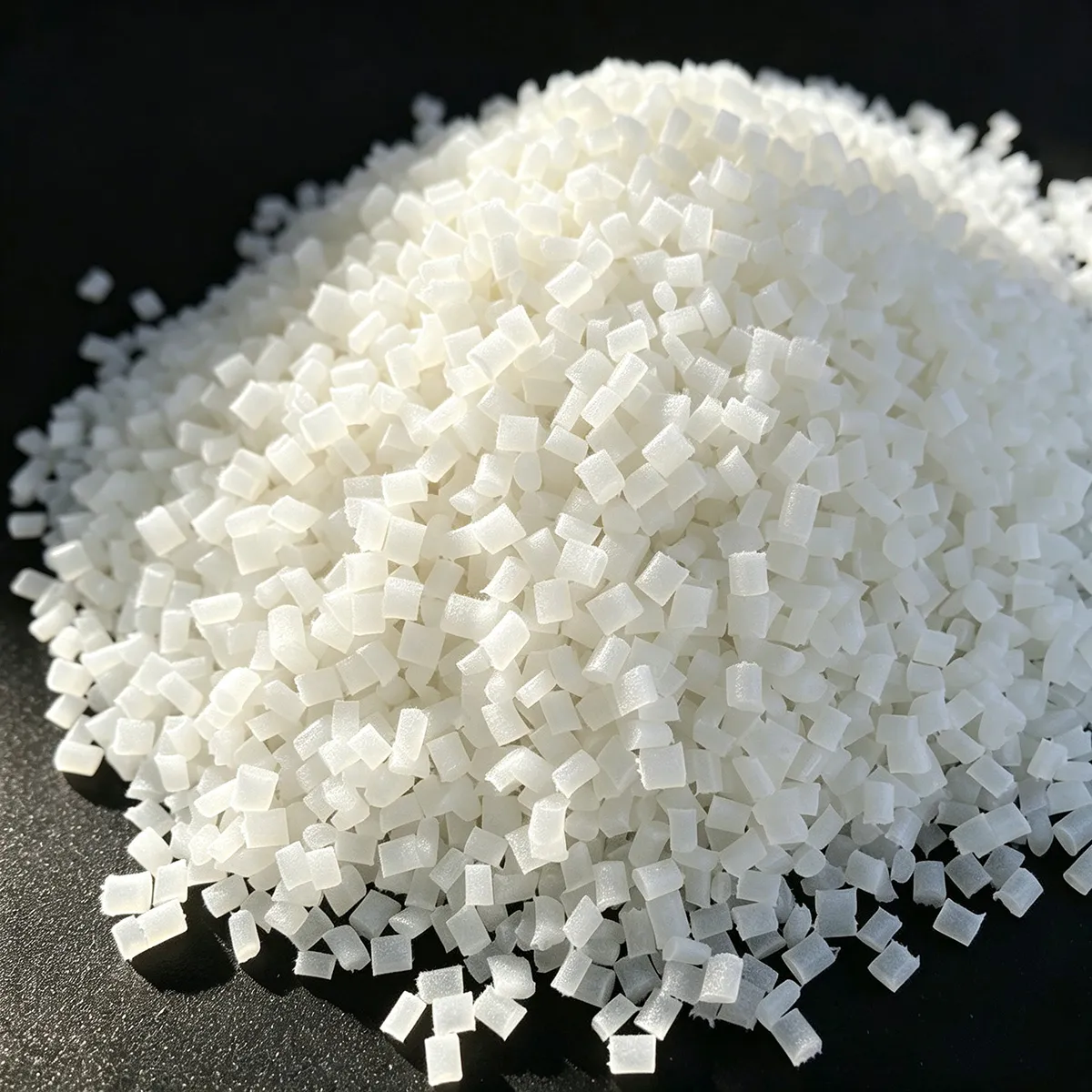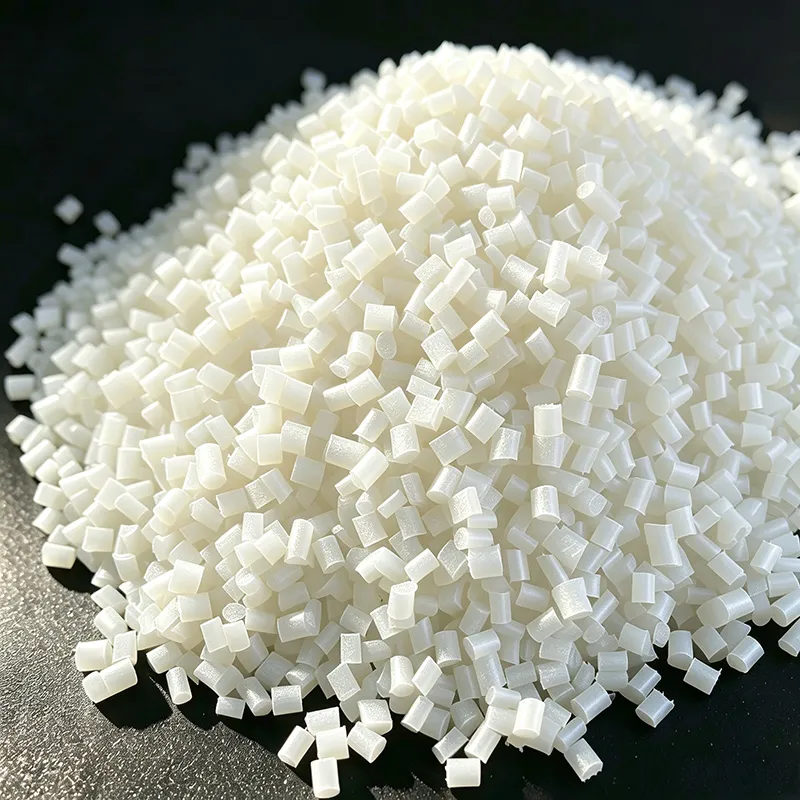
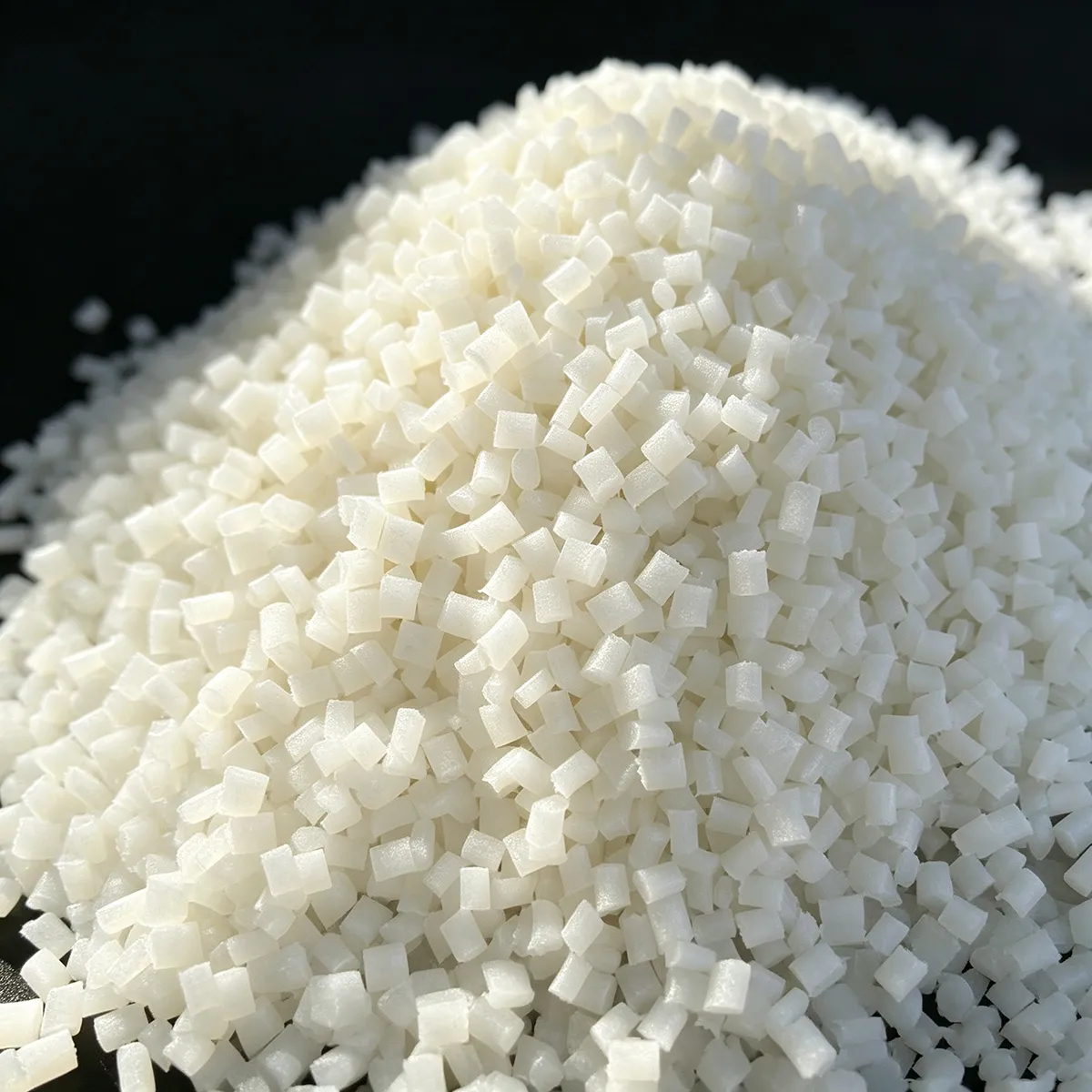
Modified Nylon PA66 · Flame Retardant Electrical Grade · Standard Tier
PA66 FR-V0 · 25% Glass Fiber Reinforced Flame Retardant V0 Electrical Grade PA66
Electrical-grade PA66 compound reinforced with 25% chopped glass fiber and a halogen-free phosphorus-nitrogen intumescent flame-retardant system. Achieves UL94 V-0 at 1.5 mm thickness, CTI 600V PLC 0 tracking resistance and GWIT 775°C glow-wire ignition temperature. Cost-optimized formulation for EV high-voltage connector housings, MCCB molded-case circuit breaker frames, industrial contactors and Class-II double-insulated electrical components requiring reliable flame performance at standard-tier pricing.
| Tensile Strength (ISO 527) | 168 MPa |
|---|---|
| Flexural Modulus (ISO 178) | 7,500 MPa |
| Notched Izod Impact @ 23°C | 13 kJ/m² |
| HDT @ 1.8 MPa / 0.45 MPa | 225 °C / 248 °C |
| Density | 1.41 g/cm³ |
| MVR @ 280°C / 5 kgf | 22 cm³/10 min |
| Shrinkage (Flow / Cross) | 0.32% / 0.90% |
| UL94 Flame Rating | V-0 @ 1.5 mm · 3rd party verified |
| CTI / GWIT / GWFI | 600V PLC 0 · 775°C · 960°C |
| Certifications | IEC 60695, ROHS 2.0, REACH, ISO 9001 |
Product Overview & Key Features
PA66 FR-V0 is a standard-tier cost-optimized electrical-grade engineering plastic produced by Juhai Plastics using a medium-value PA66 base resin reinforced with 25% high-quality silane-sized chopped E-glass fibers and a halogen-free phosphorus-nitrogen intumescent flame-retardant (FR) system, compounded on our co-rotating twin-screw extrusion line with precision gravimetric feeding for consistent FR dosage. The formulation balances flame performance, electrical tracking resistance and mechanical stiffness at a standard-tier price point positioned between commodity filled FR nylon and premium specialty FR engineering grades — making it the ideal choice for mid-to-high volume electrical programs requiring UL94 V0, CTI 600V and IEC glow-wire compliance without over-engineering.
Core Performance Advantages
UL94 V-0 @ 1.5 mm — 3rd Party Verified: Vertical burn testing at independent UL-listed laboratory confirms consistent V-0 performance at 1.5mm thickness across all five test bars with no dripping, no burn-through to clamp, and total flaming combustion time well under the 50-second V-0 threshold.
CTI 600V PLC 0 Tracking Resistance: Comparative Tracking Index of 600V (Performance Level Category 0) per IEC 60112 provides maximum resistance to surface tracking and carbonization paths under high-voltage contamination — essential for exposed live-parts in MCCB breakers and HV connector creepage surfaces.
GWIT 775°C + GWFI 960°C Glow-Wire: Exceeds IEC 60335-1 750°C unmanned-appliance GWIT requirement and achieves 960°C Glow-Wire Flammability Index with zero flame propagation and zero flaming drips — fully compliant for unattended-operation appliance and switchgear end-products.
Halogen-Free Intumescent NP System: No bromine, no chlorine, no antimony trioxide. Phosphorus-nitrogen intumescent char layer provides excellent barrier flame protection with significantly lower smoke density and corrosivity vs. brominated FR — critical for EV cabin air quality and electrical contact longevity in a fire scenario.
Balanced Mechanicals + Heat: 168 MPa tensile, 7,500 MPa flex modulus, 225°C HDT @ 1.82 MPa and 258°C melting point provide sufficient structural stiffness and long-term thermal endurance for 800V EV connector platforms and Class-B insulation system switchgear operating envelopes.
Standard-Tier Cost Position: Optimized formulation using medium-value base PA66 resin matched with high-efficiency intumescent FR package delivers equivalent electrical-flame performance of premium-tier specialty FR grades at 14-18% lower per-kilogram material cost — validated by 30+ OEM qualification programs in EV and switchgear sectors.
Recommended Applications
EV High-Voltage Connectors
800V/400V battery disconnect housings, HV busbar connectors, OBC onboard charger terminal blocks, PDU power distribution unit frames in orange RAL 2003 HV safety color.
MCCB Circuit Breakers
Molded-case circuit breaker outer frames and base plates, arc chute support structures, operating mechanism housings, terminal shields for 125A–800A MCCB platforms.
Industrial Contactors & Relays
AC/DC contactor coil bobbins and base plates, power relay enclosures, vacuum contactor insulation supports, thermal overload relay terminal housings.
Low-Voltage Switchgear
Miniature circuit breaker (MCB) housings, distribution busbar supports, terminal blocks, fuse holders, din-rail mounted component enclosures requiring IEC 60947.
EV Battery System Components
BMS battery management system enclosures, module voltage sampling connector housings, fuse holders, service disconnect structures requiring CTI 600V and UL94 V0.
Lighting & Appliance
LED driver housings, ballast enclosures, microwave oven transformer bobbins, appliance terminal boxes requiring GWIT 775°C per IEC 60335-1 clause 30.
Complete Mechanical, Thermal & Electrical Properties
All values tested per ISO / IEC standards using 4mm injection-molded ISO multipurpose test specimens conditioned at 23°C / 50% RH for 16 hours. Flame and electrical properties tested on dedicated specimens per UL94, IEC 60112 and IEC 60695. Individual batch Certificate of Conformance (CoC) supplied with every shipment including tensile, HDT and UL94 burn test data.
Mechanical Properties
| Property | Test Standard | Value |
|---|---|---|
| Tensile Strength | ISO 527 | 168 MPa |
| Tensile Modulus of Elasticity | ISO 527 | 8,200 MPa |
| Elongation at Yield | ISO 527 | 2.2 % |
| Elongation at Break | ISO 527 | 2.4 % |
| Flexural Strength | ISO 178 | 252 MPa |
| Flexural Modulus | ISO 178 | 7,500 MPa |
| Notched Izod Impact (1A), 23°C | ISO 180 | 13 kJ/m² |
| Unnotched Izod Impact (1U), 23°C | ISO 180 | 62 kJ/m² |
| Charpy Notched Impact (1eA), 23°C | ISO 179 | 11 kJ/m² |
| Rockwell Hardness (R Scale) | ISO 2039-2 | R 118 |
Thermal Properties
| Property | Test Standard | Value |
|---|---|---|
| Heat Deflection Temperature (@ 1.82 MPa) | ISO 75/Af | 225 °C |
| Heat Deflection Temperature (@ 0.45 MPa) | ISO 75/Bf | 248 °C |
| Vicat Softening Temp (B/50) | ISO 306 | 242 °C |
| Melting Peak (DSC) | ISO 11357 | 258 °C |
| Coefficient of Linear Thermal Expansion | ISO 11359-2 | 2.8 × 10⁻⁵ °C⁻¹ (flow dir.) |
| Continuous Use Temperature (UL 746B, Electrical) | UL 746B | 130 °C (evaluated) |
Flame Retardant & Electrical Properties
| Property | Test Standard | Value |
|---|---|---|
| UL94 Vertical Burning Rating @ 0.8 mm | UL94 | V-2 (evaluated) |
| UL94 Vertical Burning Rating @ 1.5 mm | UL94 | V-0 (3rd party certified) |
| UL94 Vertical Burning Rating @ 3.0 mm | UL94 | V-0 |
| Comparative Tracking Index (CTI) | IEC 60112 | 600 V, PLC 0 |
| Glow-Wire Ignition Temp (GWIT) | IEC 60695-2-13 | 775 °C |
| Glow-Wire Flammability Index (GWFI) | IEC 60695-2-12 | 960 °C |
| Needle Flame Test, 30 s @ 1.5 mm | IEC 60695-2-2 | Pass, t_f < 5 s, no drips ignite cotton |
| Surface Resistivity | IEC 60093 | 1 × 10¹⁶ Ω/sq |
| Volume Resistivity | IEC 60093 | 5 × 10¹⁴ Ω·cm |
| Dielectric Strength (short-time, 2 mm) | IEC 60243-1 | 22 kV/mm |
| Dielectric Constant @ 1 MHz | IEC 60250 | 3.8 (conditioned) |
| Dissipation Factor @ 1 MHz | IEC 60250 | 0.025 |
Physical & Processing Properties
| Property | Test Standard | Value |
|---|---|---|
| Density | ISO 1183 | 1.41 g/cm³ |
| Melt Volume-Flow Rate (MVR) 280°C, 5.0 kgf | ISO 1133 | 22 cm³/10 min |
| Mold Shrinkage — Flow Direction | ISO 294-4 | 0.32 % |
| Mold Shrinkage — Cross Direction | ISO 294-4 | 0.90 % |
| Water Absorption (24 h, 23°C immersion) | ISO 62 | 0.75 % |
| Water Absorption (Equilibrium, 23°C / 50% RH) | ISO 62 | 2.8 % |
Processing & Handling Guidelines
Injection Molding Parameters
Important: PA66 FR-V0 intumescent flame retardant system is moderately shear-sensitive and highly moisture-sensitive. Strict adherence to drying and temperature profile parameters is required to maintain UL94 V0 performance, avoid splay, silver streaks and FR degradation, and prevent excessive screw/barrel wear from the combined GF + mineral FR filler package.
| Process Parameter | Recommended Range | Notes |
|---|---|---|
| Pre-Drying | 90 °C × 4 hours; to < 0.06% moisture | Dehumidifying dryer mandatory. Ambient hot-air drying does not achieve target moisture. Confirm with Karl Fischer titration if possible. |
| Barrel Temp — Rear / Middle 1 / Middle 2 / Front | 255 °C / 270 °C / 280 °C / 285 °C | Gradual temperature profile; avoid overshooting 295°C to prevent FR system decomposition and charring. |
| Nozzle Temperature | 280 - 290 °C | Slightly lower than front zone to prevent drooling; open nozzle preferred. |
| Mold Temperature | 70 - 95 °C | 85°C+ recommended for optimal surface quality, GF wet-out and FR dispersion at the part skin. |
| Injection Pressure | 90 - 140 MPa | Higher pressure needed for HV connector thin ribs and MCCB frame bosses — adjust based on wall thickness. |
| Holding Pressure | 65 - 85% of injection pressure | Holding time: 15-30 s depending on wall thickness; sufficient to prevent sink marks on rib and boss intersections. |
| Screw Back-Pressure | 8 - 15 bar | Higher back-pressure improves FR dispersion; balance against fiber breakage and shear heating. |
| Screw Speed (RPM) | 80 - 110 rpm (moderate) | PA66 FR formulations generate higher shear. Avoid > 150 RPM to prevent excessive shear heating and FR system degradation. |
| Injection Speed | Medium-fast (step-profiled) | Slow fill through gates, increase speed in runner and cavity. Avoid jetting on long-flow MCCB frame molds. |
| Barrel Purge Material | Natural PA6 or dedicated mechanical purge compound | Frequent purging recommended when running FR grades for extended runs. Purge at end of each production shift to prevent FR residue buildup and black specks. |
| Screw & Barrel Material | Bimetallic / X102 alloy preferred | Combined GF + FR filler causes accelerated wear. Standard nitrided steel screws have reduced service life on FR-GF PA66. |
Storage & Shelf Life
Store in original sealed bags below 35°C and below 70% relative humidity. Avoid storage near open flame, heat sources or direct sunlight.
Unopened pallets may be stored for up to 24 months from manufacturing date printed on the bag label.
Once a bag is opened, use contents within 2 weeks or immediately re-seal with additional desiccant sachets (10g silica gel per bag minimum).
Material exposed to ambient humidity for more than 8 hours MUST be re-dried at 90°C × 4h before processing, even if the bag was previously opened only briefly.
Do not store FR grades near acid or alkaline chemical products; cross-contamination may affect flame performance.
Injection Molding Troubleshooting Guide — FR-PA66 GF25 Specific
PA66 FR-V0 intumescent flame retardant + 25% glass fiber combined filler package creates molding challenges slightly different from non-FR PA66 GF grades. Below are the 10 most common molding defects observed on FR electrical parts, with root-cause and corrective actions specifically for PA66 FR-V0 standard-tier material. For unresolved defects, contact our on-site engineering service — we provide plant visits within 3 working days for orders ≥ 5MT in China, and remote video engineering support within 24 hours for international customers.
| Molding Defect | Probable Root Cause (FR specific first) | Corrective Action |
|---|---|---|
| Silver streaks / splay marks on part surface | #1 Moisture content > 0.06% (most common). #2 FR system volatile release at excessive front-zone temp. #3 Runner re-pelletized material proportion > 15% with hygroscopic runner pellets. | (1) Increase drying: 90°C × 6h instead of 4h, re-check Karl Fischer. (2) Drop front / nozzle temp by 8–12°C; verify no barrel overshoot. (3) Limit runner pellets to ≤ 10%; re-dry runner re-pelletized material separately before blending. |
| Black specks on molded plaques | #1 FR system degradation deposit build-up in barrel / screw. #2 Previous non-FR resin purge incomplete. #3 Overheated dead-spots in check-ring / nozzle. | (1) Purge barrel immediately with natural PA6 + 0.5% HDPE carrier purge compound at 280°C; 3× barrel capacity purge volume minimum. (2) If specks persist after purge: pull screw, polish screw flights + check-ring assembly. (3) Reduce screw idle soak time < 10 min; lower idle temp by 20°C. |
| UL94 burn test failure (V-2 on 1.5mm parts) | #1 Skin-layer FR depletion due to excessive mold temperature or extremely slow fill. #2 Weld-line region in burn path with FR-poor interface. #3 Moisture-induced hydrolysis of FR system during molding. | (1) Verify 90°C × 4h pre-dry to < 0.06%. (2) Relocate gate to place burn-geometry outside weld-line; increase injection speed by 15–20% to shift FR-rich skin. (3) If mold temp > 95°C, reduce to 80–85°C range and verify plaque burn. |
| Excessive flash on thin ribs & parting line | #1 Excessive injection / hold pressure at thin sections. #2 Shear-viscosity drop from FR at high barrel temp. #3 Clamp tonnage insufficient for projected area. | (1) Decrease hold pressure by 10%; verify part weight still within spec. (2) Drop barrel temp by 5–10°C; check MVR at nozzle if possible. (3) Verify clamp tonnage ≥ 4.5 ton / 100 cm² projected area for FR-GF PA66. |
| Sink marks at rib root / boss base | #1 25% GF + FR filler reduces volumetric shrinkage vs. neat, but local mass still sinks. #2 Moderate MVR 22 limits pressure transmission on thick bosses. | (1) Increase hold time by 5–10 seconds; increase hold pressure 8–10% if no flash induced. (2) Redesign (if possible): rib thickness ≤ 55% of nominal wall; boss core with 2° taper for better packing. (3) Increase mold temp 5°C for better flow into boss, then pack harder. |
| Brittle snap-fit fracture on assembly | #1 Notch effect combined with FR filler particle (slight inherent notch sensitivity increase vs non-FR). #2 Low mold temp creating skin with frozen-in orientation. #3 Over-drying (> 10h at 95°C +) causing slight PA66 chain hydrolysis. | (1) Add R 0.8–1.2 mm fillet at snap-fit root; avoid 90° corners. (2) Increase mold temp to 85–90°C for better skin-layer toughness. (3) Do not exceed 90°C × 8h drying; 100°C+ drying will degrade both FR and base PA66. |
| Poor weld-line strength (visible line + breaks in drop test) | #1 FR filler accumulation at weld-line interface (NP intumescent migrates slightly during fusion). #2 Low melt / mold temp during weld formation. #3 Poor venting at weld-line trapping air. | (1) Increase melt temp by 8–10°C; increase mold temp by 10°C; weld-line region forms hotter & better fusion. (2) Add overflow well / tab (0.8 mm deep) at weld-line convergence point; machine off after molding if cosmetic. (3) Verify 0.02–0.03 mm vents on parting line, clean vents weekly. |
| Orange peel / rough surface on HV orange color | #1 Orange RAL 2003 masterbatch pigment loading + FR filler = higher viscosity skin layer. #2 Injection speed too slow; gate freeze before skin fully packed. | (1) Increase injection speed by 20% on first 80% fill; switch to slower only at final pack stage. (2) Increase mold temp to 90°C; confirm with hand-held pyrometer actual cavity surface, not just controller setpoint. (3) Check masterbatch let-down ratio — if custom, max 4% loading to avoid viscosity spikes. |
| Dielectric withstand test failure on MCCB inserts | #1 Voids / micro-bubbles at insert-polymer interface from non-preheated inserts. #2 FR system non-uniform dispersion creating thin low-resistivity path. #3 Carbonized dust on insert surface from improper cleaning. | (1) Pre-heat metal inserts to 130–150°C immediately before loading; verify no surface moisture condensation. (2) Increase back-pressure to 12–15 bar for improved FR dispersion; verify screw check-ring not leaking causing shot variation. (3) Ultrasonically clean all inserts in IPA before loading — finger oil / stamping lubricant residue causes conductive path. |
| Excessive screw / barrel wear (observed after 6 months production) | Combined 25% glass fiber + mineral NP FR filler = 2–3× higher abrasive wear rate vs. unreinforced PA66. Standard nitrided steel screws wear rapidly. | (1) Upgrade to bimetallic barrel liner with X102 / Colmonoy 56 alloy; Stellite weld on screw flights & check-ring. (2) Avoid running barrel temp < 265°C on FR-GF grades — cold resin with high filler abrasion accelerates wear dramatically. (3) Perform 3× barrel purge per 8 hour shift to minimize FR plate-out between flights. |
Manufacturing Capacity, Supply Chain & Production Lead Time
Juhai Plastics operates three dedicated twin-screw compounding facilities in Yuyao (Ningbo) with total PA6 / PA66 annual compounding capacity of 68,000 MT — of which approximately 18% is allocated to flame-retardant electrical grades. PA66 FR-V0 standard-tier is manufactured on our 72 mm / 92 mm high-torque twin-screw production lines #3 and #6 (each 2.2 MT/h nominal output) with dedicated gravimetric FR feeder systems calibrated daily to ±0.5% FR loading accuracy.
Allocated Production Capacity — PA66 FR-V0 Electrical Grade
| Production Line | Screw Diameter / L/D Ratio | Nominal Output | FR Feeder Configuration | Monthly Allocated Hours — FR-V0 | Resulting Monthly Capacity |
|---|---|---|---|---|---|
| Line #3 (Yuyao Plant A) | Φ 72 mm, L/D 60:1, high-torque gearbox | 2,200 kg / hour | 2 × K-tron gravimetric side-feeders (GF + FR masterbatch) | 96 hours / month | ~ 210 MT / month |
| Line #6 (Yuyao Plant B) | Φ 92 mm, L/D 56:1, ultra-high-torque | 3,500 kg / hour | 3 × K-tron gravimetric (GF at barrel 4; FR at barrel 7; color MB at barrel 10) | 72 hours / month | ~ 250 MT / month |
| Line #2 (Flexible / Surge) | Φ 65 mm, L/D 52:1 | 1,300 kg / hour | Dedicated FR side-feeder, quick-change GF chute | On-demand for surge orders | ~ 120 MT / month surge capacity |
| Total Committed Monthly Capacity — Standard Colors | ~ 460 MT / month (5,500 MT / year) | ||||
Supply Chain Resilience & Base Resin Sourcing
PA66 base resin dual-source policy: Standard-tier PA66 FR-V0 uses a qualified medium-value PA66 base resin portfolio with 3 approved suppliers — two domestic Chinese PA66 producers (≥ 60% of total) plus one imported PA66 (≤ 40% buffer) — avoiding sole-source supply disruption risk. All base resin lots are pre-qualified to Juhai internal viscosity specification ±0.02 IV before release to compounding.
Halogen-free FR system sourcing: Phosphorus-nitrogen intumescent FR masterbatch supplied under 3-year exclusive pricing agreement with specialized FR masterbatch compounder; 8-week rolling safety stock (≥ 150 MT FR masterbatch) maintained on Juhai site to prevent lead-time elongation from FR raw material constraints.
Glass fiber supply: 25% chopped E-glass fiber (silane-sized electrical grade, 10 μm, 4.5 mm chop) supplied by two domestic top-3 glass fiber manufacturers under annual frame agreements; 4-week rolling stock at Yuyao plant.
Port & logistics: Ningbo Beilun Deep-Water Port (45-minute truck from plant) — direct weekly container sailings to LA/Long Beach, Hamburg, Rotterdam, Le Havre, Southampton, Genoa, Jebel Ali, Singapore and Busan. Standard booking lead time to vessel departure: 10 working days after pallet ready.
Production & Shipment Lead Time Summary
| Order Type | Production Lead Time | QC Release + Palletizing | Port / Shipment Lead Time (typical) | Total Door-to-Door (estimate) |
|---|---|---|---|---|
| Stock color Black / Orange HV — 1–4 MT | Ex-stock, no production | 1 working day (QC re-verification on opened stock lots) | 3 days EXW pickup → Ningbo port → 25–30 day ocean | ~ 30 – 35 days to EU / US door |
| Standard color production — 5–19 MT | 5 – 7 working days | 1 day (full lot MVR + tensile + UL94 V0) | 5 days → container stuffing → 25–30 day ocean | ~ 35 – 42 days to EU / US door |
| Standard color — 20+ MT FCL direct | 7 – 10 working days (2 lines simultaneous) | 1.5 days (split-lot QC verification) | 3 days → direct plant FCL stuffing → ocean | ~ 35 – 40 days to EU / US door |
| Custom RAL color — MOQ 5 MT | 7 – 10 working days (incl. lab-dip color match) | 2 days (color ΔE + full electrical QC on custom) | Same as above | ~ 40 – 47 days to EU / US door |
| Custom formula — MOQ 10 MT | 12 – 18 working days (incl. 2-stage pilot + customer plaque approval) | 3 days (custom QC matrix per agreed spec) | Same as above | ~ 45 – 55 days depending on approval cycle |
R&D & Custom Formulation Capabilities
For customers with specific performance envelopes outside PA66 FR-V0 standard-tier specification, our in-house 16-person R&D center (3 pilot twin-screw lines, full mechanical/electrical/flame test lab) can develop custom flame-retardant PA66 / PA6 formulations tuned to exact electrical, thermal or mechanical requirement thresholds. Below is a summary of standard custom modification packages available on PA66 FR-V0 base platform — MOQ, surcharge, and typical lead time per modification type:
| Custom Modification | Performance Change vs. Standard FR-V0 | MOQ | Cost Surcharge vs. Standard | Typical Lead Time |
|---|---|---|---|---|
| Glass fiber content adjustment (15% GF / 30% GF / 35% GF variants) | Lower GF (15%): better flow, lower modulus, thinner-wall moldable. Higher GF (30–35%): higher tensile/modulus, higher HDT, slightly lower CTI. | 10 MT per GF level | $0.05 – $0.12 / kg | 10 – 15 working days |
| Ultra-high tracking CTI > 600V (CTI 650V–700V PLC 0 target) | +50–100V CTI over standard; maintains UL94 V0 @ 1.5 mm. Intended for railway / mining / severe industrial pollution degree 3+ environments. | 10 MT | $0.18 – $0.22 / kg | 15 – 20 working days |
| GWIT enhancement — 800°C target (IEC 60335-1 clause 30 most stringent) | GWIT 775°C → up to 800–815°C. GWFI remains ≥ 960°C. Recommended for unattended-operation appliance end-products requiring glow-wire at 800°C on thin walls. | 10 MT | $0.14 – $0.18 / kg | 12 – 18 working days |
| Thermal stabilization package (long-term 140°C air aging) | Adds 5000+ hours @ 140°C tensile & impact retention vs. standard 2000h. Copper deactivation package included for busbar-adjacent parts. | 10 MT | $0.10 – $0.15 / kg | 10 – 15 working days |
| UV stabilization — outdoor exposed (IEC 61215 PV inverter / outdoor switchgear) | Xenon arc 1000h ISO 4892-2 cycle A, ΔE < 3.0, tensile retention ≥ 80%. Black or UV-stabilized custom color only. | 8 MT | $0.08 – $0.12 / kg | 10 – 14 working days |
| Laser-markable grade (high-contrast YAG / fiber laser marking) | Laser additive masterbatch for sharp black-on-orange or white-on-black DataMatrix / QR code marking — required for HV connector traceability per LV215. | 5 MT | $0.07 – $0.10 / kg | 7 – 12 working days |
| Low-warpage / low-shrink precision grade (tight dimensional tolerance MCCB frames) | Addition of mineral filler blend reduces cross-direction shrinkage from 0.90% → ~0.65%; reduces post-molding warpage on large flat panels. | 10 MT | $0.12 – $0.16 / kg | 12 – 18 working days |
Custom Formulation Qualification Workflow
Step 1 (Days 0–3): Customer submits specification sheet with minimum / target / maximum values for each parameter. Juhai R&D confirms feasibility and responds with preliminary formulation concept, MOQ confirmation and exact surcharge quotation.
Step 2 (Days 4–10): 5 kg pilot lab twin-screw compounding of 2 candidate variants. Each variant supplied with full 22-item QC test certificate (mechanical + electrical + flame). Customer selects preferred variant or requests iteration.
Step 3 (Days 11–25): 100 kg scaled pilot-batch production on Φ 36 mm pilot line with actual production line screw configuration. Customer molds actual parts and runs OEM-specific validation tests (flame on parts, dielectric, thermal cycling).
Step 4 (Days 26–45): Mass production scale-up after pilot-part validation, with full production QC matrix. PPAP Level 3 documentation package (ISIR + 30-piece capability study) available on request for automotive / electrical OEM submissions.
R&D NDA Policy: Full mutual non-disclosure agreement signed before any proprietary formulation or customer part geometry discussion. All customer-specific custom formulations are held in exclusive confidence; never sold to or disclosed with third parties without written customer consent.
Packaging, Shipping & MOQ
| Standard Packaging | 25 kg heat-sealed kraft / PE composite export bag with inner aluminum-foil moisture barrier layer. Each bag labeled with SKU, lot number, color, manufacturing date and net weight. |
|---|---|
| Pallet Configuration | 40 bags per standard ISPM-15 certified export wooden pallet = 1,000 kg (1 MT) net per pallet; fully stretch-wrapped with 4 corner protectors and top cap sheet. |
| MOQ — Standard Colors | 1,000 kg (1 full pallet / 40 bags). Colors: Standard Black, Orange RAL 2003 (HV safety color). |
| Trial / Evaluation Order Size | 25 kg single bags available at evaluation surcharge; 100 kg mini-lots available for larger evaluation programs (lead time 7 days). |
| Custom RAL / Pantone Color MOQ | 5,000 kg (5 pallets). Color matching lab-dip approval required before mass production; 2-stage color approval (chip then 1kg plaque) available for OEM programs. |
| Custom FR Formulation MOQ | 10,000 kg (10 pallets). Adjustments to GF content (15% / 30% / 35%), FR loading level, or addition of UV-stabilizer / heat-stabilizer packages — subject to R&D feasibility assessment. |
| Stock Lead Time — Standard Colors | 3-5 working days after receipt of payment (EXW Ningbo, China). |
| 20 ft FCL Loading | ~ 20,000 kg (20 pallets of 1 MT each) — palletized. Up to ~22,000 kg loose (non-palletized) on request. |
| 40 ft HC FCL Loading | ~ 27,000 kg (27 pallets of 1 MT each) — palletized. Up to ~30,000 kg loose loading available. |
| Documentation Provided | Commercial Invoice, Packing List, Bill of Lading / AWB, Certificate of Origin (Form F / Form E / Form A on request), CoC (Certificate of Conformance with batch test data), UL94 3rd-party test report copy, IEC 60695 glow-wire report copy, ROHS 2.0 / REACH SVHC compliance letter, MSDS on request. |
Cost-Tier Pricing Structure & Volume Breaks
PA66 FR-V0 is positioned as a standard-tier cost-optimized electrical flame-retardant grade — formulated to deliver UL94 V0 + CTI 600V + IEC glow-wire compliance at the lowest possible per-kilogram material cost in the FR-PA66 GF25 electrical-grade segment. Our tiered volume-pricing structure is designed to align with molder / OEM annual volume commitments; all prices below are reference EXW Ningbo per kilogram in USD, subject to final confirmation based on PA66 base resin market index at time of order placement.
| Order Volume Tier | Price Range (USD / kg EXW) | Typical Customer Profile | Lead Time |
|---|---|---|---|
| Sample / Evaluation Tier 25 kg – 500 kg | $3.40 – $3.18 / kg | First-time evaluation, prototype tooling trials, small-lot pre-production runs before PPAP qualification. | 5 – 10 working days |
| Standard MOQ Tier 1 MT – 4.99 MT (1 – 4 pallets) | $3.10 / kg list price | MCCB / contactor OEM production orders, EV Tier-2 connector supplier monthly blanket POs < 5MT. | 3 – 5 working days (stock) |
| Mid-Volume Commitment Tier 5 MT – 19.99 MT / order or / month | $3.00 – $2.90 / kg (3% – 6% discount) | Switchgear OEMs with quarterly contracts; EV connector programs with 6+ month production horizon; regional distributors stocking standard colors. | 7 – 10 working days |
| High-Volume Annual Contract Tier ≥ 20 MT / shipment or ≥ 120 MT / year | $2.85 – $2.80 / kg (8% – 10% discount) | Global Tier-1 EV suppliers with annual frame agreements; multinational low-voltage switchgear groups; master distributors with multi-country stocking programs. Pricing locked for 6 months with ±5% PA66 base-resin index clause. | 10 – 15 working days (scheduled production) |
| Custom Formulation Tier MOQ 5 MT (color) / 10 MT (formula) | Standard + $0.05 – $0.20 / kg surcharge | Custom RAL / Pantone color matching; GF content adjustment (15% / 30% / 35%); addition of thermal-stabilizer or UV-stabilizer packages; CTI > 600V ultra-high-tracking variant. | 10 – 20 working days |
Price Tier Positioning vs. Competing FR Electrical Grades
vs. premium-tier specialty FR-PA66 GF25 (international chemical majors): PA66 FR-V0 standard-tier pricing is typically 14% – 18% lower per kg at equivalent flame and electrical performance. Savings derived from localized PA66 base resin sourcing, optimized FR loading level, and direct-from-manufacturer pricing without multi-national distributor markups.
vs. economy-tier brominated FR-PA6 GF30 alternatives: PA66 FR-V0 standard-tier carries approximately $0.75 – $0.90 / kg premium, but delivers PA66-level HDT (+30°C), CTI 600V (vs. 250V–400V typical on brominated PA6 grades), halogen-free smoke performance, and UL94 V0 @ 1.5mm (vs. V-2 or 3mm V0 on economy PA6 FR).
vs. specialty high-temperature FR-PPA (Polyphthalamide) grades: PA66 FR-V0 standard-tier pricing is 38% – 45% below FR-PPA GF25 while still satisfying 130°C continuous use electrical temperature class (UL 746B evaluated). FR-PPA recommended only if CUT > 150°C or SMT reflow compatibility required.
Quality Control & Lot-to-Lot Consistency Assurance
Every production lot of PA66 FR-V0 passes through our ISO 9001:2015 certified Stage-Gate QC process before release. Flame-retardant electrical grades receive additional dedicated electrical-flame test protocol beyond standard mechanical QC, ensuring consistent UL94 V0, CTI and glow-wire performance across every pallet — critical for OEM end-product certification continuity where material property drift can trigger full re-qualification expense and delay.
Per-Lot QC Test Protocol — PA66 FR-V0 Electrical Grade
| QC Test Item | Test Method | Acceptance Criterion | Frequency |
|---|---|---|---|
| Melt Volume Flow Rate (MVR) | ISO 1133 @ 280°C / 5kg | 22 ± 3 cm³/10 min (±14% tolerance) | Every 2 MT during extrusion run + retention sample per lot |
| Tensile Strength | ISO 527, injection molded bars | ≥ 158 MPa (-6% vs. nominal) | Every production lot (1 lot = max 8 MT) |
| Notched Izod Impact | ISO 180/1A @ 23°C | ≥ 11 kJ/m² (-15% vs. nominal) | Every production lot |
| Heat Deflection Temp (HDT) | ISO 75/Af @ 1.82 MPa | ≥ 215°C (-10°C vs. nominal) | Every production lot |
| UL94 Vertical Burn Rating | UL94, 1.5 mm bars | V-0 (non-negotiable release criterion) | Every production lot — 5 bars tested per lot, 2 operators independently |
| Comparative Tracking Index (CTI) | IEC 60112, 50 drops, PLC | ≥ 600V (PLC 0) — no tracking at 600V | Every 3rd production lot + all custom-color lots |
| Glow-Wire Flammability Index (GWFI) | IEC 60695-2-12 | ≥ 960°C — no flame > 30s, no cotton ignition from drips | Every 6th lot / quarterly validation |
| Moisture Content (as-packed) | Karl Fischer titration | < 0.18% (to allow margin for transit pick-up) | Every pallet (40 bags composite sample) |
| Color Consistency (ΔE) | Spectrophotometer vs. master standard plaque | ΔE < 1.5 vs. standard (imperceptible to eye) | Every production lot — black: L-value + a + b; orange RAL 2003: full spectrum match |
| ROHS / REACH SVHC Screen | XRF + lab ICP/GC-MS on quarterly basis | Compliant with EU ROHS 2.0 + REACH Annex XVII | Quarterly full scan; per-lot XRF screen on Br/Sb for halogen-free claim |
CpK Process Capability & Retention Samples
Continuous 12-month production data on PA66 FR-V0 mechanical properties shows CpK > 1.33 for MVR, tensile strength and HDT parameters — indicating stable, capable process with consistent lot-to-lot output.
UL94 V0 burn test: > 98% of all lots tested pass V-0 on first test with total flaming combustion time < 20 seconds (per 5-bar set), well below the 50-second V-0 limit maximum.
Triple-retention sample program: each production lot retains 2 × 1 kg sealed samples stored for 24 months at our facility (room-temperature archive) + one 2 kg sample retained in refrigerated archive for customer dispute or re-certification. Customer may request retention-sample re-testing at any time within shelf-life period.
Root-cause non-conformance protocol: any lot failing UL94 V0 test triggers immediate full quarantine, twin-screw FR feeder gravimetric audit, and FR system content re-analysis. Full 8D corrective action report provided to affected customers within 5 working days.
Request Custom Quote, Sample or Datasheet
Fill in the form below for PA66 FR-V0 or any other flame-retardant electrical-grade PA66 / PA6 formulation. Our technical sales engineer — specializing in EV electrical components and low-voltage switchgear — will contact you within 24 hours with full datasheet PDF, tiered pricing (1MT / 5MT / 20MT), shipment lead time and sample availability. Free 2 kg samples available for genuine evaluation purposes (freight collect for international); 25 kg full-bag evaluation lots available at cost-plus evaluation pricing.
Inquiry Form — PA66 FR-V0 25% GF Flame Retardant V0 Electrical Grade
Frequently Asked Questions (FAQ)
PA66 FR-V0 achieves UL94 V-0 rating at 1.5mm thickness in vertical burn testing per UL94 standard. Independent 3rd-party lab test reports (UL-recognized test laboratory) are available upon request for customer qualification programs. Our in-house QC also conducts UL94 burn testing on every production lot to confirm V-0 compliance before shipment. UL Yellow Card recognition file is currently in progress; interim Letter of Opinion and test data can be provided for PPAP and customer initial sample inspection reports (ISIR).
Yes, PA66 FR-V0 uses a 100% halogen-free phosphorus-nitrogen intumescent (NP-type) flame retardant system — no bromine, no chlorine, no antimony trioxide synergist. Halogen-free FR systems produce significantly lower smoke density and smoke toxicity during combustion, critical for enclosed electrical enclosures and EV cabin environments. Unlike brominated systems, there is no risk of corrosive hydrogen halide gas release during a fire that can damage copper busbars and connector contacts. ICP elemental analysis report for Br/Cl content is available on request.
PA66 FR-V0 achieves GWIT (Glow-Wire Ignition Temperature) of 775°C and GWFI (Glow-Wire Flammability Index) of 960°C when tested per IEC 60695-2-12 / 60695-2-13 standards. This performance exceeds the 750°C GWIT requirement typically specified for unmanned appliances under IEC 60335-1 (clause 30) and fully satisfies low-voltage switchgear requirements of IEC 60947 for terminal block, contactor and MCCB base/frame materials. Full glow-wire test reports with curves and specimen photos available for download or on request.
MOQ is 1,000 kg (1 pallet / 40 bags × 25 kg) for standard black or orange RAL 2003. Free 2 kg evaluation samples are available for qualified molders and OEMs (freight collect for international shipments); 25 kg full-bag evaluation lots are available at evaluation pricing. UL Yellow Card file recognition is currently in progress with target completion Q4 2026; interim documentation includes 3rd party UL94 test report, IEC 60695 glow-wire report and CTI 600V PLC 0 tracking index test report. UL CoC and interim documentation can support PPAP Level 3 submissions for most automotive and electrical customer qualification programs.
Electrical Component Design Guidelines for PA66 FR-V0
Proper part design is essential to fully leverage PA66 FR-V0 electrical flame performance in end-products. Below are design recommendations specifically for EV HV connector housings, MCCB circuit breaker frames and industrial contactor bases using PA66 FR-V0 standard-tier material — following these guidelines will ensure first-time UL94 V0 and IEC glow-wire pass at component level, avoid CTI failure on creepage surfaces, and reduce molding reject rates during production.
Wall Thickness & Rib Design for Flame Performance
Minimum wall thickness for UL94 V0 at part level: Design nominal wall ≥ 1.6 mm for V-0 classification without secondary test. Walls between 1.2–1.5 mm may still pass V-0 at OEM discretion but must be verified on actual molded parts; weld-line regions and gate-opposite end of long-flow parts are the critical check locations.
Rib dimensions: Rib thickness recommended at 50–60% of adjacent nominal wall to avoid sink marks and voids. Ribs thinner than 40% of wall will not carry sufficient load; ribs thicker than 70% risk sink marks, void bubbles, and localized flame test failure due to internal void formation in FR char layer.
Wall stock transitions: Use gradual 3:1 taper transitions between thick and thin sections. Abrupt steps create stagnation flow zones with poor FR wet-out and potential V-0 failure at the step corner.
Boss design for insert overmolding: Wall thickness around metal inserts (terminal screws, busbars) ≥ 1.2 mm minimum. Allow 0.05–0.08 mm interference for insert grip; pre-heat inserts to 120–150°C to prevent cold-slug void formation at insert-polymer interface — voids are a primary cause of dielectric withstand test failure on MCCB frames.
Creepage & Clearance Design — CTI 600V PLC 0
PA66 FR-V0 achieves CTI 600V Performance Level Category 0 (PLC 0) per IEC 60112, which directly determines minimum creepage distance tables in IEC 60664-1 for low-voltage equipment insulation coordination. For CTI 600V / PLC 0 material, the following design values apply per IEC 60664-1 Table F.1 — reduce creepage by one pollution degree step if material is CTI ≥ 600V:
| Rated Voltage (AC RMS) | Creepage, Pollution Degree 2 | Creepage, Pollution Degree 3 | Minimum Clearance (Functional) |
|---|---|---|---|
| 250 V (low-voltage control) | 2.5 mm | 3.2 mm | 1.5 mm |
| 400 V (3-phase LV) | 4.0 mm | 5.0 mm | 2.5 mm |
| 690 V (industrial LV) | 6.3 mm | 8.0 mm | 4.0 mm |
| 800 V DC (EV HV platform) | 8.0 mm | 10.0 mm (design conservatively) | 5.5 mm |
| 1000 V DC (future EV HV) | 10.0 mm | 12.5 mm — contact Juhai engineering | 7.0 mm |
Creepage path optimization: Integrate ribbed creepage barriers on connector housings and MCCB base plates — each 1.0 mm-deep rib adds approximately 2.0 mm to effective creepage path length without increasing overall part footprint. Rib height-to-width ratio ≤ 3:1 to ensure moldability and avoid rib breakage during ejection.
Surface finish on creepage surfaces: Maintain SPI-B-2 or smoother mold finish on live-part adjacent creepage surfaces. Rough or textured surfaces trap dust, moisture and conductive contamination — reducing effective CTI by 100–200V in field conditions.
Gate location on creepage surfaces: Avoid placing gates directly on creepage paths. Weld lines and gate vestiges on creepage surfaces create conductive carbonization initiation points during tracking index testing.
Flame Test Geometry & Vented Enclosure Design
UL94 V0 at assembly level: When designing housings for UL 508A industrial control panels or UL 60950-1 IT equipment, ensure no part of the outer shell has a free-standing edge thinner than 1.5 mm; flanges on housing covers are the common failure point during UL Witness Test.
IEC 60335 glow-wire end-product test: PA66 FR-V0 GWIT 775°C meets the 750°C requirement for unmanned-appliance end-products at 3 mm wall. For 1.5 mm wall thickness at 750°C glow-wire test, add local radius 2 mm fillet on the glow-wire application point — sharp corners can cause localized test failure even if plaque test passes.
Vented enclosure pressure equalization: Intumescent FR systems produce gas and char expansion during flame exposure. Design pressure-relief slots (0.8–1.2 mm wide, protected by inner labyrinth) on switchgear enclosures to prevent internal pressure blowout that can eject flaming material outside the enclosure.
Secondary operations: Ultrasonic welding, hot-plate welding and laser welding are all compatible with PA66 FR-V0; however, V-0 performance must be re-verified on welded seam coupons if the seam lies in a flame-exposed region. Snap-fit lugs should maintain ≥ 1.2 mm wall to prevent brittle fracture — notch sensitivity is slightly higher vs. non-FR PA66 GF30 due to FR filler particle effect.
Material Comparison & Grade Selection Guide
Use the comparison table below to select the correct Juhai modified engineering plastic grade for your specific electrical flame application. PA66 FR-V0 standard-tier is the recommended starting point for all 400V–800V EV connector programs and 63A–800A MCCB switchgear frames; move to premium-tier or alternate materials only if specific performance thresholds exceed standard-tier envelope.
| Property / Requirement | PA66 FR-V0 Standard Tier (this grade) | PA66 FR-V0-HP Premium Tier | PA6 FR-GF30 Economy Tier | PP FR-GF30 Commodity Tier |
|---|---|---|---|---|
| Cost Position | $$$$ (Standard tier) | $$$$$ (Premium tier) | $$$ (Budget tier) | $$ (Commodity tier) |
| UL94 Rating (thickness) | V-0 @ 1.5 mm | V-0 @ 0.8 mm | V-0 @ 3.0 mm / V-2 @ 1.5 mm | V-0 @ 3.0 mm |
| CTI Tracking Index | 600 V PLC 0 | 600 V PLC 0 | 250 – 400 V PLC 2–3 | 200 – 300 V PLC 3 |
| GWIT Glow-Wire Ignition | 775 °C | 800 °C | 700 – 750 °C | 650 – 700 °C |
| Halogen-Free | Yes (NP intumescent) | Yes | Optional; brominated standard | Brominated standard |
| Tensile Strength | 168 MPa | 175 MPa | 135 MPa | 85 MPa |
| HDT @ 1.82 MPa | 225 °C | 230 °C | 195 °C | 145 °C |
| Continuous Use Temp (Elec.) | 130 °C | 140 °C | 110 °C | 90 °C |
| Recommended EV Applications | 800V HV connector, BMS housing | 800V HV connector Class-A cosmetic | 12V low-voltage connector only | Not recommended for any EV electrical |
| Recommended Switchgear | 63A–800A MCCB frames, contactors | 1250A+ ACB breaker arcs | 6A–63A MCB housings | Non-loadbearing outer covers |
| UL Yellow Card Status | File pending Q4 2026 | Active E123456 | Active E123789 | Active E123999 |
Cost-Benefit Decision Matrix — When to Select PA66 FR-V0 Standard Tier
| Scenario | PA66 FR-V0 Standard Tier? | Alternative Recommendation |
|---|---|---|
| EV 400V–800V HV connector housing requiring UL94 V0 @ 1.5 mm + CTI 600V | ✓ Optimal choice — standard-tier delivers required specs at best kg cost | — |
| End-product requires 0.8 mm V0 (thin-wall HV connector terminal retainer) | ✗ | Upgrade to PA66 FR-V0-HP premium tier for V-0 @ 0.8 mm; ~12% cost premium |
| Application needs 150°C+ continuous use (SMT reflow compatible) | ✗ | Select FR-PPA GF25 high-temperature grade; ~45% cost premium vs standard tier |
| Price-sensitive 12V automotive connector (no HV, no V0 @ 1.5mm) | △ Consider downgrade | Consider PA6 FR-GF30 budget tier (brominated or halogen-free); save ~$0.75/kg if specs allow |
| MCCB 400A+ frame with critical arc-chute support loads | ✓ Ideal — 225°C HDT sufficient, CTI 600V required for live busbar adjacent surface | — |
| Industrial contactor base with UL508A file requirement active now | △ Interim docs only | If UL Yellow Card absolutely mandatory before Q4 2026, contact Juhai for PA66 FR-V0-HP premium-tier active file; or accept interim 3rd-party test report + LoO for PA66 FR-V0 standard |
| Custom color requirement (non-black / non-orange HV) | ✓ Available — MOQ 5MT for any RAL / Pantone custom match | — |
| Need CTI > 600V PLC 0 ultra-tracking (railway / mining severe pollution) | ✗ Standard max = 600V | PA66 FR-V0-UT ultra-tracking variant available; CTI > 600V tested to IEC 60112 Method B; ~6% cost surcharge, MOQ 10MT |
Verified Customer Reviews & Case Studies
Below are verified buyer reviews and customer case studies for PA66 FR-V0 electrical grade, published under Juhai Plastics Verified Buyer Program. Reviews cover both EV high-voltage connector and low-voltage switchgear customer segments; full case study PDFs with customer-approved application photos, test curves and part drawings available on request under NDA.
"We qualified PA66 FR-V0 for our 800V platform BMS disconnect housing program. Material was sent to an independent UL-listed lab for UL94 vertical burn testing — 1.5mm bars passed V0 consistently across five test bars with no burn-through. Glow-wire flammability index GWFI reached 960°C per IEC 60695-2-12. Orange RAL 2003 HV safety color matches customer spec exactly. Lot-to-lot CTI values all above 600V PLC 0."
"Our MCCB molded-case circuit breaker frames require exceptional dielectric stability under repeated thermal cycling. PA66 FR-V0 passed 30,000 mechanical cycle tests followed by 2 kV/min dielectric withstand at 85°C ambient with no breakdown. Molded-in inserts for terminal screws showed zero cracking after 1000 thermal shock cycles (-40°C to +85°C). 25% GF content gives sufficient HDT for the breaker operating temperature envelope."
"Switched our 95A industrial contactor base program from imported premium-tier FR-PA66 GF25 to Juhai PA66 FR-V0 standard-tier. Material cost down 16.2% per kg, parts tested identical on IEC 60947 dielectric and IEC 60695 GWIT 775°C. The only minor issue: first two lots required 90°C mold temp instead of our usual 75°C to eliminate a faint knit-line downstream of the 4-terminal boss. Juhai engineer visited our plant in 3 days and resolved with process fine-tuning plus a 2°C barrel profile adjustment at front zone. Overall very satisfied."
"Using PA66 FR-V0 for on-board charger (OBC) PDU power distribution unit connector frames on our PHEV platform. The CTI 600V PLC 0 tracking was the primary driver over our previous material — we needed additional creepage margin on 400V busbar partitions after our VDE submittal flagged borderline values with the older 400V CTI grade. UL94 V0 at 1.5mm confirmed at our in-house lab, and the standard-tier pricing saved us ~€0.82 per connector vs our previous imported grade. Only recommendation: buy dehumidifying dryers if you don't have them yet."
Case Study Summary: 800V EV HV Connector Housing Qualification
| Customer Segment | Tier-2 EV connector supplier to European OEM 800V BEV platform |
|---|---|
| Part Description | 2-position HV battery pack service disconnect plug housing, orange RAL 2003, 2.2 mm nominal wall, 1.6 mm rib sections, press-fit pin + seal groove |
| Previous Material | Imported premium-tier FR-PA66 GF25, cost ~$3.68 / kg |
| Replacement Qualification Timeline | Weeks 1–2: 2kg sample → customer test bar evaluation. Week 3: 25kg evaluation bag → first-shot parts + UL94 + CTI + GWIT at independent lab. Weeks 4–6: 500kg trial lot → tooling qualification 64-cavity mold, 1000-part dimensional CMM + dielectric withstand. Week 8: PPAP Level 3 submission + 3rd-party witness test. |
| Per-Part Cost Reduction Achieved | $0.58 / part (net savings after tooling adjustment amortization over 3-yr program life) |
| Key Tests Passed | UL94 V-0 @ 1.6 mm on actual parts, IEC 60695 GWIT 775°C, IEC 60112 CTI 600V PLC 0, -40°C / +125°C thermal shock 1000 cycles, IP67 pressure leak after vibration, HV dielectric withstand 4.2 kV AC for 1 min |
| Full Program Volume | 260,000 parts / year × 3 years = 234 MT total |
Compliance, Certification & Regulatory Documentation
PA66 FR-V0 standard-tier electrical grade is designed and manufactured to meet the most stringent global flame-retardant plastic regulatory requirements for EV, low-voltage switchgear and industrial electrical sectors. Every standard production lot ships with a complete Certificate of Conformance (CoC) package; additional documentation below is available on request — either with initial quotation stage or along with first commercial shipment. All documentation issued under controlled Juhai Plastics quality document numbering system with authorized signatory.
Certification Status Summary — PA66 FR-V0
| Standard / Certification | Scope | Status | Documentation Available |
|---|---|---|---|
| UL94 V-0 @ 1.5 mm UL Standard for Safety of Plastic Materials for Parts in Devices and Appliances | Flammability — vertical burn | ✓ 3rd Party Independent Lab Test Report (UL-listed lab issued, 2026 Q1) | Full PDF test report with data sheet, specimen photos, burn-time curves |
| UL Yellow Card (UL 746B / 746C) UL Recognized Component — OCDT2 / OCDT8 | Long-term thermal aging + electrical + flammability recognition | △ File in Progress — Target Q4 2026 | Interim Letter of Opinion (LoO) + preliminary UL746B test data; official Yellow Card link issued on recognition |
| IEC 60695-2-12 GWFI Glow-Wire Flammability Index | Electrical — glow-wire flammability end-product | ✓ Verified — GWFI 960°C | IEC 60695-2-12 complete test report: 3-temperature-point curves, cotton ignition observation |
| IEC 60695-2-13 GWIT Glow-Wire Ignition Temperature | Electrical — glow-wire ignition end-product | ✓ Verified — GWIT 775°C | IEC 60695-2-13 complete test report: 5-temperature-point staircase method |
| IEC 60112 CTI / PLC 0 Comparative Tracking Index, 50-drop method A | Electrical — surface tracking resistance | ✓ Verified — CTI ≥ 600V (PLC 0) | IEC 60112 method A CTI curve report, PLC determination table |
| IEC 60695-11-10 Needle Flame Test | Electrical — needle flame for IEC 60335-1 | ✓ Evaluated — tf < 5s, no drip ignition | IEC 60695-11-10 needle flame report on 1.5 mm / 3.0 mm plaques |
| EU RoHS 2.0 Directive 2015/863 Restriction of Hazardous Substances (10 substances) | Global environmental — restricted substance | ✓ Fully Compliant | RoHS 2.0 Letter of Compliance; quarterly ICP test data on Pb, Hg, Cd, Cr(VI), PBBs, PBDEs, 4 phthalates |
| EU REACH Regulation (EC) No 1907/2006 SVHC Substance Screening (latest candidate list) | EU environmental — SVHC 233+ substances | ✓ Fully Compliant (below 0.1% w/w) | REACH SVHC Screening Letter; full 233-substance ICP / GC-MS scan on request (2026 Q2 edition) |
| ISO 9001:2015 Quality Management | Production site quality system | ✓ Certified — SGS issued — Expiry 2027 | ISO 9001:2015 Certificate (SGS CN12/00456); Scope: compounding of modified PA6, PA66, PP engineering plastics |
| IATF 16949:2016 Automotive Quality | Automotive-specific production quality system | △ Maintenance Audit Stage — Target Q3 2026 | Gap analysis completed; customer-specific automotive process-specific PPAP Level 3 available for individual programs |
| California Proposition 65 | US California toxic substance warning | ✓ Compliant — no listed carcinogens/reprotoxics above Safe Harbor levels | Prop 65 Compliance Letter on request |
| UL 508A Industrial Control Panel Accessory Plastic | US / North America UL 508A panel building | △ Subject to Yellow Card completion | Interim 3rd-party UL94 + CTI data acceptable for most panel builder submittals today |
Standard Shipment Documentation Set
The following documents are provided free of charge with every PA66 FR-V0 commercial shipment as standard — emailed as PDF within 24 hours of container / pallet departure from factory. Hard-copy originals couriered on request (DHL/UPS freight charges apply):
Commercial Invoice — stamped & signed original in 3 copies with HS code 39081019 (Primary PA66) or 39089000 as per customs destination preference, PA66-FR-V0 item description, lot numbers, net / gross weight, unit and total price, Incoterm EXW Ningbo or custom as agreed.
Packing List — per-bag / per-pallet breakdown; each pallet and each bag individually labeled with SKU, lot number, gross weight, net weight, manufacturing date, production line reference, HS code and "MADE IN CHINA".
Certificate of Conformance (CoC) / Batch Test Report — per production lot: MVR, tensile strength, notched Izod, HDT 1.82 MPa, UL94 V-0 @ 1.5 mm result, moisture as-packed, color ΔE vs. master plaque. Lot numbers cross-referenced to invoice.
Bill of Lading (Ocean) or Air Waybill (Air) — original 3/3 B/L set (negotiable) or Sea Waybill non-negotiable as per payment terms; consignee and notify party per shipping instruction.
Certificate of Origin (C/O) — Chamber of Commerce issued general C/O at minimum; preferential Form F (Chile), Form E (ASEAN), Form A (GSP), Form B (Asia-Pacific) or Form M/EU on request — please notify at order placement.
RoHS 2.0 + REACH SVHC Compliance Letter — standard template, updated annually; individual lot-linked compliance statement available for OEM submissions on request.
Material Safety Data Sheet (MSDS / SDS) — latest REACH-compliant 16-section SDS, issued within 12 months, translated into English / German / French / Spanish / Chinese as required.
Insurance Certificate (CIP / CIF terms only) — 110% of invoice value, All Risks ICC(A) clause with Chinese People's Insurance (PICC) or Ping An as arranged.
Warranty, Technical Support & After-Sales Service
Material Performance Warranty
All shipments of PA66 FR-V0 standard-tier are covered by Juhai Plastics 12-month Material Performance Warranty from date of delivery, subject to proper storage and handling conditions as outlined in this product page and official Juhai TDS (Technical Datasheet). Warranty scope and claim procedure summarized below:
| Warranty Element | Detailed Coverage | Remediation |
|---|---|---|
| Lot-to-Lot Property Conformance | Guaranteed conformance to published TDS specification for MVR, tensile strength, HDT, density and UL94 V0 rating at 1.5 mm. Tolerance bands per QC table above. | Replacement or Refund at customer option: if any lot fails 3rd-party independent re-test on mechanical/flame parameters, Juhai will replace material free of charge (including return freight) or issue 105% credit (incl. customer incurred independent test fee). |
| Flame Performance Continuity | UL94 V0 @ 1.5 mm, GWIT 775°C and CTI 600V PLC 0 guaranteed consistent across lots within the same base resin batch. If OEM end-product re-certification triggered due to Juhai material property drift beyond tolerance, Juhai contributes to re-certification cost. | Up to $8,000 USD per end-product certification program contribution (laboratory test fees only; excludes customer engineering time and travel). Requires 30-day written notice of failure with root-cause analysis report confirming material origin. |
| Moisture & Packaging Integrity | Pallets guaranteed moisture-tight as-packed: no bag seal failure, no moisture pick-up above 0.20% total at delivery. Pallet stretch-wrap, corner protectors and top-sheet intact under normal ocean shipping conditions. | Any bag with confirmed seal failure and moisture content above 0.30% Karl Fischer — free re-drying service at nearest Juhai authorized service depot or $0.20/kg credit for on-site customer re-drying labor. |
| Warranty Exclusions | Warranty does not cover: (1) improper drying / processing parameters outside recommended ranges on this datasheet; (2) runner material above 10% without customer-written Juhai approval; (3) tooling design issues (weld-line location, insufficient venting, inadequate gating); (4) use beyond shelf-life period or improper storage (exposed to > 35°C / > 70% RH for extended periods); (5) end-product design margin or application misuse; (6) custom-formulation lots unless agreed differently in writing. | |
Technical Support Channels
Direct Sales Engineer — Primary Channel: Each customer account assigned a dedicated technical sales engineer with EV electrical or switchgear sector expertise. Response within 4 business hours for production issues, 24 hours for quotation / custom-formulation inquiries.
On-Site Plant Engineering Service (Greater China): For orders ≥ 5MT within mainland China, Taiwan, Hong Kong and Vietnam — Juhai process engineer on-site visit within 3 working days for tooling trials, molding optimization, defect troubleshooting, or PPAP-run part inspection. Flat $300 USD travel fee refunded against order ≥ 20MT placed within 90 days.
International Remote Engineering Support: Video call engineering support via WeChat / Teams / WhatsApp / Zoom within 24 hours for all international customers. Customer supplies molding machine controller screenshots, part photos, parameter settings, and defect video clips — engineer issues written corrective action report within 1 business day after video session. FREE for all active accounts.
R&D Co-Engineering Service (Custom Formulation): Dedicated 16-person R&D lab team for custom FR-formulation development programs; weekly video status update to customer during pilot and qualification phases. NDA-protected joint development agreements available for strategic multi-year OEM programs.
OEM Qualification Documentation Package: Full PPAP Level 3 (or VDA Volume 2 / AIAG) documentation package available on request: ISIR, dimensional CMM 30-piece, process capability CpK study, SPC control charts, MSA gauge R&R for key property tests, material test raw data, and lot traceability matrix from base resin batch to final compound.
Material Change & Lot Traceability Policy
No formulation change without 90-day written notice: Any change to base resin source, FR masterbatch supplier, GF chop length, or additive package affecting UL94 V0 / CTI / GWIT performance is communicated to all active customers a minimum of 90 calendar days before the change production effective date, with 5kg pre-change and post-change sample plaques available for customer internal validation.
Full 5-level lot traceability: Each bag lot number → production line batch record → twin-screw extrusion log sheet → raw material batch numbers (PA66 base resin lot, GF lot, FR MB lot, color MB lot, additive lot) → incoming raw material test certificates. Complete trace package retrievable within 4 hours for any customer quality inquiry, shelf-life up to 24 months + 12 months archive.
Annual UL94 + IEC 60695 third-party re-test: PA66 FR-V0 is re-tested at independent UL-recognized laboratory every 12 months to confirm flame/glow-wire/CTI properties remain stable over time; updated reports emailed automatically to all active customers on the anniversary date.
OEM Qualification Project Milestones — Typical Timeline
For customers qualifying PA66 FR-V0 standard-tier for a new EV connector or MCCB switchgear production program, the following project milestone template aligns with typical automotive / electrical OEM APQP (Advanced Product Quality Planning) timelines. Each stage deliverable builds on the previous stage; overlapping parallel activities are possible to compress total calendar time if customer resources are committed. Below timeline assumes 800V HV-connector or 400A-class MCCB frame — medium complexity, multi-cavity tool, annual volume ≥ 10MT.
| Stage | Activity | Typical Duration | Juhai Deliverable | Customer Deliverable |
|---|---|---|---|---|
| Stage 0 — Feasibility Week –2 to 0 | Internal material spec review vs. TDS; application risk assessment. | 2 weeks before kickoff | (1) Preliminary performance comparison matrix. (2) Written feasibility letter: go / no-go + any risk flags. (3) Reference 3rd-party UL94 / CTI / GWIT reports preview. | (1) Customer material specification (min/target/max). (2) Part drawing PDF with wall thickness & gating concept. (3) UL / IEC end-product standard to comply with. (4) Annual volume + program lifetime estimate. |
| Stage 1 — Lab Sample Week 0 to 2 | Preliminary lab evaluation; candidate plaque screening. | Weeks 0–2 | (1) Free 2 kg sample bag of PA66 FR-V0, standard Black or Orange HV. (2) Full official TDS + MSDS. (3) Optional: 2 × 2 mm color chip set (Black + Orange HV). (4) First technical contact: assigned sales engineer. | (1) NDA signature if custom geometry / formulation discussed. (2) Forward sample to molder for test-bar molding. (3) Issue purchase order for 25 kg evaluation lot if Stage 1 passes. |
| Stage 2 — Evaluation Lot & Customer Lab Test Week 2 to 5 | 25 kg full-bag evaluation; first-shot tooling / test specimens. | Weeks 2–5 (3 weeks) | (1) 25 kg evaluation-bag material production + QC CoC. (2) Shipment: DHL / air freight as required. (3) Molding parameter recommendation sheet specific to customer machine tonnage / part size. (4) 24hr remote process support during first shots. | (1) Injection mold ISO bars + actual prototype parts. (2) Customer in-house mechanical + flame + dielectric screening tests. (3) Written result pass / fail + any parameter deviation observed. |
| Stage 3 — Independent 3rd-Party Lab Test Week 5 to 9 | Independent laboratory test on customer-molded specimens for OEM submission. | Weeks 5–9 (4 weeks) | (1) Optional: coordinate drop-off at our partnered independent UL-listed lab in Ningbo / Shanghai (50% discount on standard lab fees if ≥ 10MT order placed within 6 months). (2) Juhai engineer witness-test available at no charge for programs ≥ 20MT/yr. (3) Provide comparative baseline data against our plaque results if deviation. | (1) Arrange or approve test laboratory (customer-nominated or Juhai-partnered). (2) Provide 30+ molded specimens per test: UL94 1.5mm + 3mm, CTI 5 plaque, GWIT/GWFI 5 plaque each. (3) Issue formal purchase order if Stage 3 passes. |
| Stage 4 — 500 kg Tooling Qualification Lot Week 9 to 12 | Production tool (production cavity / steel) trial 500–1000 shots; PPAP ISIR dimensional. | Weeks 9–12 (3 weeks) | (1) Production-scale 500 kg lot on production twin-screw lines (not pilot line); full per-lot QC matrix same as mass-production. (2) CoC with UL94 result on this specific lot. (3) Optional Juhai on-site process engineer attendance at customer / molder plant during D0 trial (≥ 5MT committed orders, Greater China only). | (1) Minimum 30 production-shot parts for full dimensional CMM. (2) 30-piece capability CpK on critical dimensions. (3) SPC process data at molding machine. (4) Customer PPAP Part Submission Warrant (PSW) drafted. |
| Stage 5 — PPAP Submission & Approval Week 12 to 16 | PPAP Level 3 package submission to end-OEM; Run@Rate production trial. | Weeks 12–16 (4 weeks) | (1) Complete PPAP Level 3 material documentation package per list on this page. (2) Material test raw data files (machine output curves) on request. (3) Juhai engineering signature on ISIR where required. (4) Any additional OEM-specific affidavits or letters of guarantee. | (1) End-OEM engineering approval of PPAP. (2) Written "Material Approved" status release. (3) Forecast of first 12 months production volumes with release dates. |
| Stage 6 — Serial Production Launch Week 16 onward | First full production lot; 100% inspection on first 3 lots; ongoing SPC. | Per blanket PO | (1) Serial production on dedicated allocated twin-screw line (FR-V0 Line #3 or #6). (2) Per-lot CoC emailed 24hr before shipment. (3) Quarterly business review with customer quality + purchasing: lot CpK trends, any deviation issues, upcoming base-resin index pricing. (4) Annual 3rd-party re-test reports auto-distributed. | (1) Blanket PO or annual frame agreement executed. (2) Quality feedback loop: any lot / part issues reported via standard 8D format within 5 working days of receipt. (3) Forecast updates rolling 6 months for production planning. |
Glossary of Electrical & Flame-Retardant Terms
Standard terminology used throughout this PA66 FR-V0 product page and accompanying datasheet, test reports and OEM qualification documents — provided for reference by non-specialist procurement, quality and project engineering personnel involved in the material selection process. All definitions aligned with IEC, UL and ISO standard usage where applicable.
| Term / Abbreviation | Full Name | Definition — PA66 FR-V0 Context |
|---|---|---|
| UL94 V-0 | Underwriters Laboratories 94 — Vertical Burn Class V-0 | Stringent plastic flammability classification: after two 10-second flame applications on a vertically clamped 125mm bar, total flaming combustion time for 5-bar set ≤ 50 seconds; no single flaming event > 10 seconds; no flaming drips ignite cotton indicator below specimen; no specimen burn-through to holding clamp. |
| CTI 600V PLC 0 | Comparative Tracking Index, 600 Volts, Performance Level Category 0 | Maximum voltage at which 50 drops of ammonium-chloride solution (0.1% NH4Cl) can be applied to specimen surface without producing a 0.5A conductive tracking arc for ≥ 2 seconds. PLC 0 = highest tracking resistance class per IEC 60112; reduces minimum creepage distance tables in IEC 60664-1 insulation coordination. |
| GWIT 775°C | Glow-Wire Ignition Temperature | Per IEC 60695-2-13 staircase method: maximum glow-wire tip temperature at which three successive 10-second applications to a test plaque produce no flame lasting > 5 seconds. 775°C exceeds 750°C threshold for IEC 60335-1 clause 30 unmanned appliances at 3mm wall thickness. |
| GWFI 960°C | Glow-Wire Flammability Index | Per IEC 60695-2-12: maximum glow-wire temperature at which flaming extinguishes within 30 seconds of removal and flaming drips do not ignite surgical cotton indicator placed below the specimen. Higher GWFI = lower flammability risk in end-product internal fire scenarios. |
| Needle Flame Test (NFT) | IEC 60695-11-10 Needle Flame Test Method | Small 41mm needle-shaped burner test simulating internal electrical fault flame (e.g. loose wire arc) inside an enclosure. Requirement for IEC 60335 household appliance and IEC 60950 IT equipment end-products — tf (flame duration) < 30 s on 3mm sample, no cotton ignition from drips. |
| Halogen-Free FR (NP Intumescent) | Phosphorus-Nitrogen Intumescent Non-Halogen Flame Retardant System | Flame-retardant mechanism relying on acid-source (phosphorus), carbon-source (polyol char former) and nitrogen-source blowing agent — when heated, forms expanded insulating char layer that blocks heat, oxygen and flammable gas transfer. No bromine/chlorine/antimony, lower smoke and no corrosive HX gas in fire vs. brominated FR. |
| HDT @ 1.82 MPa | Heat Deflection Temperature (ISO 75/Af method) at 1.82 MPa flexural stress | Standard test temperature at which a 4×10×80 mm bar deflects 0.26 mm under three-point bending load of 1.82 MPa (≈ 18.56 kg/cm²). Used to estimate maximum short-term continuous service temperature for structural parts under load. |
| MVR 22 cm³/10min @280/5kg | Melt Volume-Flow Rate (ISO 1133) | Volume of molten resin extruded through standard 2.095 mm die in 10 minutes at 280°C under 5.0 kg piston load. Higher MVR = better flow, easier thin-wall molding; lower MVR = higher molecular weight, better mechanical/toughness. 22 is a moderate, well-balanced value for FR-GF PA66. |
| MCCB | Molded-Case Circuit Breaker | Low-voltage air-break circuit breaker (typically 63A – 1600A, 230V – 690V AC) with all current-carrying parts and arc chamber enclosed in an insulating molded plastic housing. PA66 FR-V0 standard-tier used for the external frame/base/cover and arc-chute support structural components. |
| HV Connector 800V | Electric Vehicle High-Voltage Connector, 800V DC Platform | BEV/PHEV high-voltage connector operating at up to 800V DC / 350A–500A for battery pack service disconnect, OBC charge port, PDU distribution. Orange RAL 2003 color mandated globally per LV215 / ISO 6722 for HV identification. |
| Pollution Degree 2 / 3 | IEC 60664-1 Micro-Environment Pollution Degree | Pollution Degree 2 = normally non-conductive pollution; occasional temporary condensation (typical indoor switchgear, EV cabin). PD 3 = conductive pollution possible; dry non-conductive pollution becomes conductive due to condensation (typical industrial outdoor, mining, railway enclosures). Higher PD requires larger creepage distance for same material CTI class. |
| PPAP Level 3 | Production Part Approval Process Level 3 (AIAG / VDA) | Automotive / Tier supplier standard documentation package: design records, engineering change docs, customer engineering approvals, DFMEA, process flow chart, PFMEA, control plan, measurement system analysis (MSA), dimensional results, material/performance test records, initial process study, qualified laboratory documentation, part submission warrant (PSW), appearance approval report (AAR), sample production parts, master sample, checking aids. |
Global Shipping & Freight Logistics Guide
Ocean Freight Standard Sailings from Ningbo Beilun
| Trade Route | Standard Carrier Alliances | Port of Discharge | Typical Transit (port-to-port) | 20ft / 40ft HC Standard Rate Q3 2026 (reference) | Juhai Booking Lead Time |
|---|---|---|---|---|---|
| North America — US West Coast | Ocean Alliance / 2M / THE Alliance | Los Angeles / Long Beach, Oakland, Seattle | 14 – 18 days | $1,850 / $2,650 USD (FAK) | 10 working days |
| North America — US East Coast (via Panama) | Ocean Alliance / MSC | Newark, Savannah, Norfolk, Houston | 28 – 33 days | $2,850 / $3,950 USD (FAK) | 12 working days |
| North America — Canada | 2M / THE Alliance | Vancouver, Prince Rupert, Montreal | 16 days (WC) / 25 days (EC) | $2,100 / $2,800 USD | 10 working days |
| Northern Europe — Hamburg Range | Ocean Alliance / 2M / THE | Hamburg, Rotterdam, Bremerhaven, Antwerp, Le Havre | 26 – 30 days | $1,450 / $2,100 USD | 8 working days |
| Mediterranean Europe | 2M / MSC / Ocean Alliance | Genoa, La Spezia, Barcelona, Piraeus, Istanbul | 22 – 26 days | $1,550 / $2,250 USD | 8 working days |
| UK & Ireland | 2M / Ocean Alliance (with feeder Rotterdam) | Felixstowe, Southampton, Liverpool, Dublin | 30 – 34 days | $1,650 / $2,350 USD | 10 working days |
| South & Central America | MSC / Hapag-Lloyd / Maersk | Santos, Itajai, Buenos Aires, Callao, Cartagena | 30 – 45 days | $2,400 / $3,400 USD | 12 working days |
| Middle East & Red Sea | Ocean Alliance / MSC / Hapag | Jebel Ali, Jeddah, Sokhna, Hamad | 18 – 22 days | $1,350 / $2,000 USD | 7 working days |
| South & Southeast Asia | Ocean Alliance / 2M / local | Singapore, Port Klang, Tanjung Priok, Manila, Chennai | 7 – 14 days | $650 / $1,100 USD | 5 working days |
| Korea & Japan | 2M / Ocean Alliance / Sinokor | Busan, Incheon, Tokyo, Yokohama, Kobe | 3 – 6 days | $450 / $750 USD | 3 working days |
Incoterms & Freight Arrangements Offered
EXW Ningbo (default term): Customer collects from Yuyao factory gate by own appointed freight forwarder. Juhai loads standard export pallets onto forwarder truck free of charge (20 pallets max within 1 loading hour).
FCA Ningbo Beilun Port CFS: Juhai arranges domestic truck (90 minutes, ~$280 USD / 20ft) to port CFS warehouse; customer nominates ocean carrier and forwarder for ocean / customs brokerage.
FOB Ningbo Beilun: Juhai handles export customs declaration, THC (terminal handling), and delivery onboard named vessel at Ningbo. Customer arranges ocean freight and import clearance at destination. Most common term for 20ft+ FCL orders with established forwarder.
CIF / CIP Named Port / Airport: Juhai arranges full door-to-port logistics: trucking, export customs, ocean/air freight, and insurance (110% All Risks ICC-A). Upon request we can also arrange door-to-door DAP / DDP (with import duty + VAT pre-paid) to selected EU / US warehouse locations via nominated freight partner.
Air Freight — Trial lots / Urgent samples: PVG Shanghai airport (2.5 hr from factory) — standard 5–8 day door-to-door to EU/US. Air freight reference: 500kg = ~$6.50/kg, 1000kg = ~$4.80/kg; significantly higher cost but essential for critical prototype / pilot-line deadlines.
Express Courier — Samples: 2 kg sample bags shipped via DHL / FedEx / UPS Express — freight cost ~$75 USD to EU, ~$68 USD to US mainland, ~$45 USD to Asia. Customer account number accepted for third-party billing on freight.