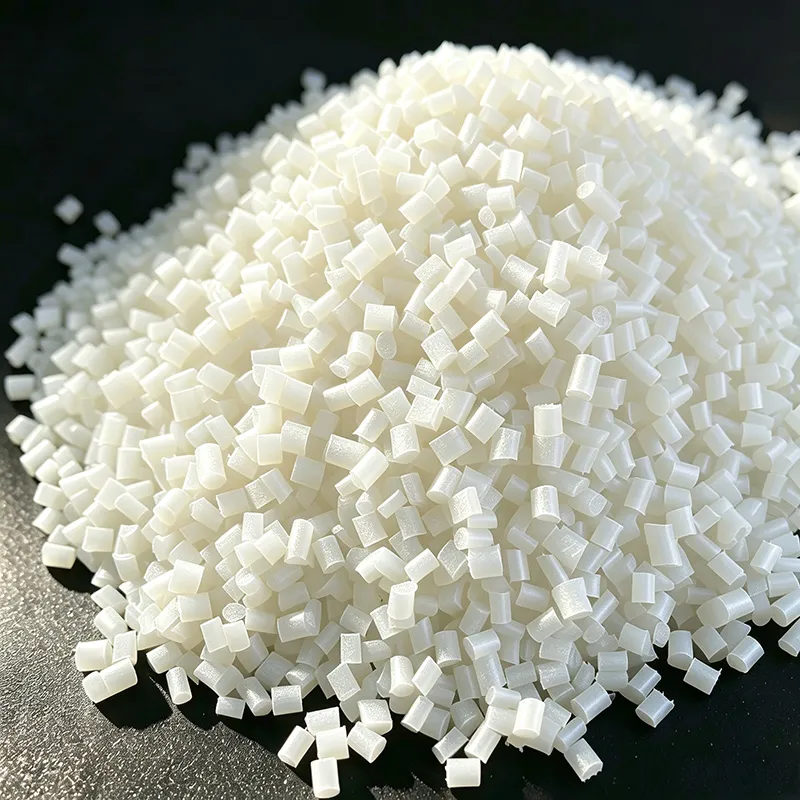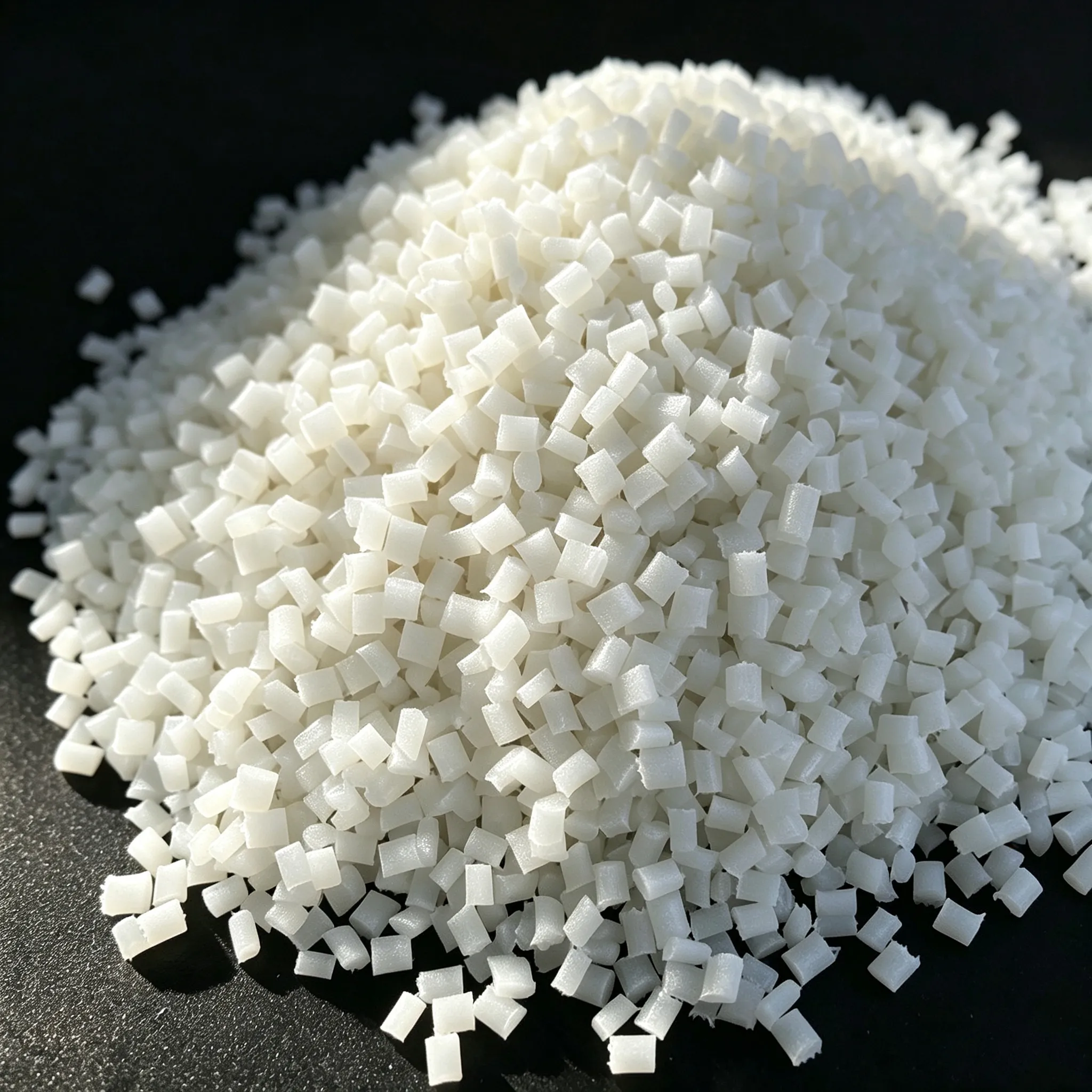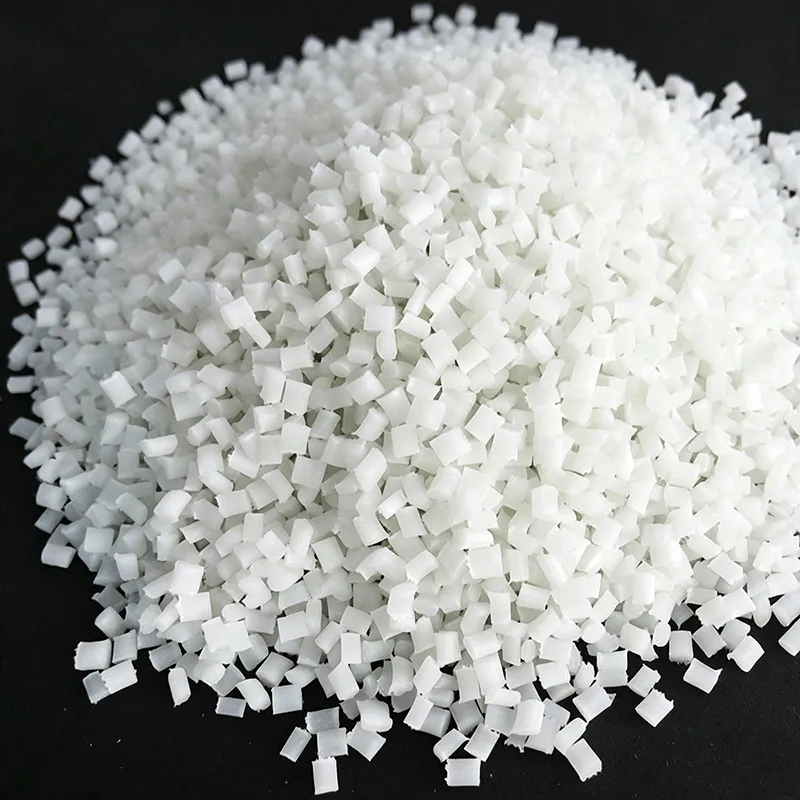
Modified Nylon PA66 · High-Modulus 50% GF
PA66 GFE50 · 50% Glass Fiber High-Modulus PA66 Pellets
Premium PA66 compound reinforced with 50% chopped E-glass fiber for maximum stiffness and dimensional stability. Tensile strength reaches 220 MPa and flexural modulus 13,500 MPa — roughly double the modulus of a standard 30% GF PA66 and approaching cast aluminum stiffness-to-weight ratio. Designed for metal-replacement structural components where high load-bearing capacity, low creep and tight dimensional tolerance are required: precision gears, bearing cages, pump impellers, conveyor sprockets and load-bearing brackets. Black standard with carbon black for UV and surface abrasion resistance.
| Tensile Strength (ISO 527) | 220 MPa |
|---|---|
| Flexural Modulus (ISO 178) | 13,500 MPa |
| HDT @ 1.82 MPa (ISO 75/Af) | 255 °C |
| HDT @ 0.45 MPa (ISO 75/Bf) | 262 °C |
| Notched Izod Impact, 23°C (ISO 180/1A) | 10 kJ/m² |
| Density (ISO 1183) | 1.57 g/cm³ |
| Mold Shrinkage — Flow (ISO 294-4) | 0.20 % |
| Certifications | ISO 9001, ROHS 2.0, REACH |
Product Overview & Key Features
PA66 GFE50 is a high-modulus engineering plastic compound produced by Juhai Plastics using a medium-viscosity premium PA66 base resin reinforced with 50% high-quality silane-sized chopped E-glass fibers compounded on our co-rotating twin-screw extrusion line. The 50% glass loading pushes PA66 to its practical stiffness ceiling — at this loading, the compound's flexural modulus reaches 13.5 GPa, which is approximately 78% of cast aluminum's stiffness (70 GPa) at only 58% of aluminum's density (2.7 g/cm³). For structural components that need metal-like rigidity without metal's weight, cost, or corrosion issues, PA66 GFE50 delivers the highest stiffness-to-weight ratio in the Juhai polyamide portfolio.
Core Performance Advantages
Highest Modulus in the PA66 Range: Flexural modulus of 13,500 MPa and tensile modulus of 15,000 MPa — 65% higher than 30% GF PA66 and nearly 3× the modulus of unreinforced PA66. Ideal for thin-wall structural ribs that must not deflect under continuous load.
Tensile Strength of 220 MPa: Matches or exceeds low-grade cast aluminum (e.g., AlSi9Cu3 at ~220 MPa) in tensile, allowing direct material substitution for lightly-loaded structural brackets and housings.
HDT 255°C at 1.82 MPa: Near the PA66 melting point (262°C). Continuous use at 150–160°C under load is possible without creep failure, and short-term peak excursions to 220°C are tolerated.
Ultra-Low Shrinkage & Dimensional Stability: Flow-direction shrinkage of 0.20% is among the lowest of any thermoplastic, allowing tight-tolerance features (bearing bores, gear pitch circles, locating pins) to be molded directly without secondary machining.
High Fatigue & Creep Resistance: The 50% fiber network carries long-term static and cyclic loads with minimal creep — gear teeth and sprocket lobes maintain dimensional accuracy over millions of cycles.
Carbon-Black Surface Protection: Standard black color with 2.0% carbon black provides UV resistance for outdoor conveyor and pump applications and improves surface abrasion resistance vs natural PA66.
Cost Tier Positioning
PA66 GFE50 is positioned as a Premium cost-tier PA66 compound, reflecting the high 50% glass fiber loading (glass fiber is cheaper than PA66 resin, but the high loading increases compounding cost due to reduced throughput and accelerated screw wear). Compare with our Standard-tier PA66 BFE04 (30% GF premium PA66, the general-purpose workhorse) and our Economy-tier PA6 GBA35 (35% GF economy PA6 for cost-sensitive structural use). For flame-retardant electrical applications requiring high CTI, see PA66 FR-V0 under Related Products below.
Recommended Applications
Precision Gears
Power tool reduction gears, appliance transmission gears, and small-module gears where 13.5 GPa modulus prevents tooth deflection under torque and 0.20% shrinkage holds pitch-circle accuracy.
Bearing Cages
Roller and ball bearing cages for industrial and automotive bearings. High stiffness maintains roller spacing at high RPM; low friction PA66 matrix needs no additional lubrication for many designs.
Pump Impellers & Housings
Centrifugal pump impellers and volute casings for water and chemical pumps. Resists cavitation erosion better than PA6 GF grades; 255°C HDT handles hot-water recirculation pump service.
Structural Brackets (Metal Replacement)
Load-bearing brackets replacing die-cast aluminum in automotive, appliance and industrial equipment. 220 MPa tensile + 13.5 GPa modulus at 58% of aluminum density.
Conveyor Sprockets & Rollers
Conveyor chain sprockets, idler rollers and wear strips. Carbon-black surface handles outdoor UV; 0.20% shrinkage keeps sprocket tooth pitch accurate for meshing with steel chains.
Motor & Fan Components
Electric motor commutator end brackets, fan hubs and blade roots where high stiffness resists centrifugal force and 255°C HDT withstands winding heat.
Complete Mechanical & Physical Properties
All values tested per ISO standards using 4 mm injection-molded ISO multipurpose test specimens conditioned at 23°C / 50% RH for 16 hours unless otherwise noted. Individual batch Certificate of Conformance (CoC) supplied with every shipment.
Mechanical Properties (Unaged)
| Property | Test Standard | Value |
|---|---|---|
| Tensile Strength | ISO 527 | 220 MPa |
| Tensile Modulus of Elasticity | ISO 527 | 15,000 MPa |
| Elongation at Yield | ISO 527 | 1.8 % |
| Elongation at Break | ISO 527 | 2.0 % |
| Flexural Strength | ISO 178 | 335 MPa |
| Flexural Modulus | ISO 178 | 13,500 MPa |
| Notched Izod Impact (1A), 23°C | ISO 180 | 10 kJ/m² |
| Unnotched Izod Impact (1U), 23°C | ISO 180 | 45 kJ/m² |
| Charpy Notched Impact (1eA), 23°C | ISO 179 | 8 kJ/m² |
| Rockwell Hardness (R Scale) | ISO 2039-2 | R 121 |
| Compressive Strength | ISO 604 | 190 MPa |
| Shear Strength | ISO 3501 | 105 MPa |
Thermal Properties
| Property | Test Standard | Value |
|---|---|---|
| Heat Deflection Temperature @ 1.82 MPa | ISO 75/Af | 255 °C |
| Heat Deflection Temperature @ 0.45 MPa | ISO 75/Bf | 262 °C |
| Vicat Softening Temp (B/50 Load) | ISO 306 | 256 °C |
| Melting Peak (DSC, 10°C/min) | ISO 11357 | 262 °C |
| Coefficient of Linear Thermal Expansion (Flow) | ISO 11359-2 | 2.2 × 10⁻⁵ °C⁻¹ |
| Coefficient of Linear Thermal Expansion (Cross) | ISO 11359-2 | 6.5 × 10⁻⁵ °C⁻¹ |
| Long-Term Continuous Use Temp (Air, no load) | In-house / ISO 2578 extrap. | 150 °C |
| Short-Term Peak Temperature (cumul. < 100 h) | — | 220 °C |
Physical, Electrical & Other Properties
| Property | Test Standard | Value |
|---|---|---|
| Density | ISO 1183 | 1.57 g/cm³ |
| Melt Volume-Flow Rate (MVR) 280°C, 5.0 kgf | ISO 1133 | 16 cm³/10 min |
| Mold Shrinkage — Flow Direction | ISO 294-4 | 0.20 % |
| Mold Shrinkage — Cross Direction | ISO 294-4 | 0.70 % |
| Water Absorption (24 h, 23°C immersion) | ISO 62 | 0.55 % |
| Equilibrium Water Absorption (50% RH) | ISO 62, long term | ~ 1.8 % |
| Comparative Tracking Index CTI | IEC 60112 | ≥ 500 V (Performance Level 1) |
| Surface Resistivity | IEC 60093 | 1 × 10¹⁵ Ω/sq |
| Volume Resistivity | IEC 60093 | 1 × 10¹⁴ Ω·cm |
| Dielectric Strength (short-time, 2 mm) | IEC 60243-1 | 16 kV/mm |
Quality Control & Manufacturing Test Methodology
Every lot of PA66 GFE50 passes through our ISO 9001 stage-gate quality process before release. Because the 50% glass fiber loading is the critical performance variable — a ±2% swing in GF content changes modulus by ~600 MPa and shrinkage by 0.02% — we test glass content on every production batch using loss-on-ignition (LOI), not just on a periodic basis.
Lot Release Testing Matrix (Performed on Every 1,000 kg Batch)
| Test Item | Test Standard / Method | Frequency | Specification Limit (Pass = Release) |
|---|---|---|---|
| Melt Volume Flow Rate (MVR) @ 280°C / 5 kg | ISO 1133-1 | 100% of lots | 13 – 19 cm³/10 min (±18% target 16) |
| Density (granule) | ISO 1183-1 (A method) | 100% of lots | 1.555 – 1.585 g/cm³ |
| Moisture Content (as-packaged) | Karl Fischer titration | 100% of lots | < 0.15 % (customer dries to < 0.06% before molding) |
| Glass Fiber Content (combustion / LOI) | ISO 3451-1 | 100% of lots | 48.5 – 51.5 % by weight |
| Unaged Tensile Strength (ISO bar) | ISO 527-1/-2, 1 mm/min | 100% of lots, 5 bars average | ≥ 210 MPa (CpK ≥ 1.33 vs 220 nominal) |
| Unaged Tensile Modulus | ISO 527 with extensometer | 100% of lots | ≥ 14,200 MPa |
| Notched Izod Impact @ 23°C | ISO 180/1A, 10 specimens | 100% of lots | ≥ 8.5 kJ/m² individual, ≥ 9.5 avg |
| HDT @ 1.82 MPa (unaged) | ISO 75-1/Af, flatwise | Every lot, 3 specimens | ≥ 250 °C (CpK ≥ 1.3 vs 255 nominal) |
| Mold Shrinkage — Flow (60×60×2 mm plaque) | ISO 294-4 | Every lot | 0.17 – 0.23 % |
| Color L*a*b* (granule, black standard) | CIE LAB D65 10°, 30 mm plaque | 100% of lots vs retention standard | ΔE (CMC 2:1) ≤ 1.0 vs master color plaque |
| ROHS / REACH SVHC Screening | XRF + in-house wet chemistry | 100% of lots; full GC-MS quarterly | Pass per EU 2015/863 and SVHC 248th update |
Statistical Process Control and CpK Targets
Tensile strength: Nominal 220 MPa, lower spec 210 MPa → minimum CpK ≥ 1.33 on every lot.
Tensile modulus: Nominal 15,000 MPa, lower spec 14,200 MPa → CpK ≥ 1.33.
Glass fiber content: Nominal 50%, spec 48.5–51.5% → CpK ≥ 1.50 (tightly controlled because GF content dominates all mechanical and shrinkage properties).
HDT @ 1.82 MPa: Nominal 255°C, lower spec 250°C → CpK ≥ 1.30.
Full SPC package including X-bar R charts, histogram and CpK report for the last 20 production lots available on request.
Processing & Handling Guidelines
Injection Molding Parameters
PA66 GFE50's 50% glass fiber loading demands a more robust molding setup than 30% GF grades. The melt is viscous and abrasive, and fiber breakage in the screw must be minimized to preserve the high modulus the grade is designed for. Observe the settings below.
| Process Parameter | Recommended Range | Notes / Limits |
|---|---|---|
| Pre-Drying (MANDATORY) | 90 °C × 4 hours; dehumidifying dryer to < 0.06% moisture | Stricter than 30% GF PA66 (≤ 0.08%). The higher fiber surface area concentrates any moisture into more splay sites. Use -40°C dew-point dryer. |
| Barrel Temp — Rear / Middle / Front | 265 °C / 280 °C / 290 °C | Gradual profile; never exceed 295°C in any zone. PA66 degrades rapidly above 300°C. |
| Nozzle Temperature | 285 - 292 °C | Slightly lower than front zone to prevent drooling. Never exceed 295°C. |
| Maximum Barrel Residence Time | < 5 minutes at ≤ 290 °C | High GF melt holds heat; long residence causes PA66 hydrolysis and chain scission, dropping tensile and impact. Use the smallest machine that fills the shot. |
| Mold Temperature | 80 - 110 °C | 90°C+ recommended for optimal PA66 crystallization and GF wet-out; 100–110°C for Class-A surface on visible parts. |
| Injection Pressure | 100 - 160 MPa | High GF melt requires higher injection pressure. Thick ribs and bosses may need the upper end. |
| Holding Pressure | 60 - 80% of injection pressure | Holding time: 15-30 s depending on wall thickness. Critical for low-shrinkage accuracy. |
| Screw Back-Pressure | 4 - 8 bar | Moderate; avoid >10 bar which over-shears and shortens retained fiber length, reducing modulus. |
| Screw Speed (RPM) | 60 - 100 rpm | Low-to-moderate speed minimizes fiber attrition and shear-heat spike. |
| Screw / Barrel Material | Through-hardened tool steel (HRC 58+) or bimetallic barrel (WC overlay) | MANDATORY. 50% GF is highly abrasive; nitrided barrels wear within 150k cycles and chrome plating fails within 50k. Budget for screw refurbishment every 80–120k cycles. |
| Regrind Fraction | ≤ 15 % | Lower than 30% GF grades because regrinding further shortens already-short fibers; >15% regrind reduces modulus below spec. Dry regrind separately before blending. |
| Purge Between Material Changes | Natural unfilled PA66 or commercial PP-based purge compound | Do NOT purge GFE50 with unfilled PP or PE directly, as residual glass fiber will contaminate the next run. |
Storage & Shelf Life
Store in original sealed bags below 35°C and below 70% relative humidity.
Keep away from direct sunlight and sources of heat or open flame.
Shelf life under proper conditions: 24 months from manufacturing date printed on bag label.
Once opened, use contents within 3 weeks or re-seal with desiccant packs to prevent pre-moisture pickup (PA66 absorbs moisture faster than PA6).
Do not mix GFE50 pellets with lower-GF PA66 grades in the same gaylord or dryer hopper — even 5% of a 30% GF grade will lower the overall GF content and reduce modulus below spec.
Injection Molding Troubleshooting Guide
PA66 GFE50's 50% glass fiber loading creates specific defect modes that are rare or absent in 30% GF grades. Use the table below as a first-pass troubleshooting reference.
| Defect / Symptom | Most Likely Root Cause(s) | Step-by-Step Corrective Action |
|---|---|---|
| Splay marks (silver streaks) concentrated near the gate and along rib bases | 1) Insufficient pre-drying, residual moisture > 0.06%; 2) Too-rapid injection speed through small gate; 3) Excessive barrel temperature causing hydrolytic degradation of PA66. | Step 1: Re-measure granule moisture with Karl Fischer at the machine throat. If >0.06%: extend dryer 2 more hours at 90°C, confirm dew-point ≤ -40°C. Step 2: Drop injection speed 20% in first stage. Step 3: Lower front/nozzle zone temp by 5°C; verify no zone exceeds 295°C. Step 4: Cap regrind at ≤15% and dry regrind separately. |
| Tensile modulus on molded parts measures 10–15% below the 13.5 GPa nominal | 1) Excessive fiber breakage from too-high screw speed or back-pressure; 2) Regrind fraction >15% further shortening fibers; 3) Barrel temperature too low causing incomplete fiber wet-out. | Step 1: Reduce screw RPM to 60–70 and back-pressure to 4–5 bar. Step 2: Confirm regrind fraction ≤15%; if using regrind, test a 100%-virgin sample for comparison. Step 3: Check that middle and front zones are at 280/290°C minimum — low melt temp prevents full fiber wet-out. Step 4: Measure fiber length in the molded part (ash-out + microscopy); average retained fiber should be ≥ 0.15 mm. |
| Excessive wear on screw and barrel (visible metal powder in melt, rising MVR over time) | 1) Screw/barrel not through-hardened or bimetallic; 2) Running with too-high back-pressure increasing abrasive contact; 3) Glass fiber content above spec (unlikely if from Juhai, but verify via LOI). | Step 1: Verify screw/barrel is HRC 58+ through-hardened or WC bimetallic — replace if nitrided or chrome-plated only. Step 2: Lower back-pressure to 4 bar. Step 3: Run LOI test on current lot to confirm GF is 48.5–51.5%. Step 4: Schedule screw/barrel inspection every 50k cycles; replace barrel liner when clearance exceeds 0.15 mm. |
| Warpage on flat structural bracket or gear blank | 1) High anisotropy (0.20% flow vs 0.70% cross shrinkage); 2) Holding pressure switched off too early; 3) Unbalanced mold temperature. | Step 1: Set both mold halves to 90–100°C using separate temp controllers. Step 2: Extend hold time; verify by short-shot study that gate does not freeze before holding peak. Step 3: For parts >150 mm across, use a fan or diaphragm gate to align fiber orientation uniformly. Step 4: Apply steel shrinkage compensation of 0.20% in flow and 0.70% in cross direction uniformly. |
| Brown / amber discoloration streaks at last-fill or near nozzle | 1) Barrel residence too long (>5 min) at high temp; 2) Dead spots in barrel/nozzle tip; 3) Front zone temp >295°C. | Step 1: Calculate residence time — must be < 300 s at ≤290°C; reduce shot size or move to smaller machine if over. Step 2: Drop front/nozzle to 285/288°C, purge 10 full shots of natural PA66. Step 3: Inspect nozzle tip and torpedo for coked material. Step 4: Install screw-idle timer that lowers rear-zone temp 10°C during downtime > 2 min. |
| Gear tooth pitch dimension out of tolerance after molding | 1) Shrinkage variation from inconsistent hold pressure or cycle time; 2) Mold temperature drift; 3) GF content variation between lots causing shrinkage shift. | Step 1: Verify hold pressure and hold time are repeatable (±2% machine capability). Step 2: Confirm mold temp stable at ±2°C. Step 3: Check the CoC for each lot's GF content — a 1% GF swing changes flow shrinkage by ~0.01%. Step 4: For precision gears, prototype with the exact production lot at final parameters; gear shrinkage compensation is typically 0.20% on the pitch circle. |
Certifications, Compliance & Customer Reviews
Material Certifications and Compliance Statements
PA66 GFE50 is manufactured under our ISO 9001:2015 certified quality system at the Ningbo Juhai Lianghui production site. All production lots are tested against mandatory regional regulatory requirements; certificates and Letters of Compliance (LoC) are available for download on request, or automatically shipped with every commercial invoice.
ISO 9001:2015
Quality management system — full production line, incoming inspection and final lot release certified by CNAS accredited third-party auditor. Certificate No. available on request.
ROHS 2.0 (EU 2015/863)
Restriction of 10 hazardous substances (Pb, Cd, Hg, Cr VI, PBB, PBDE, DIBP, DBP, BBP, DEHP). Every lot tested by XRF; full GC-MS scan performed quarterly. LoC provided per shipment.
REACH SVHC (EU)
Compliant with the 248th update of the Candidate List of Substances of Very High Concern. Annual third-party screening report available; below 0.1% w/w threshold for all listed SVHC.
IEC 60112 CTI ≥ 500 V
Comparative Tracking Index PLC 1 tested per IEC 60112 Solution A on 3 mm plaques. Suitable for non-current-carrying structural components in electrical assemblies.
IMDS / PPAP Ready
Material data entry into IMDS system for automotive programs supported. Level-3 PPAP submission package (SPC, flow-down, CoC history, PFMEA) available for qualifying production parts.
Lot GF Content Verification
Every lot ships with a CoC including glass fiber content (LOI), tensile strength, modulus, HDT and MVR — traceable to the exact compounding batch and raw-material lot codes.
Verified Customer Reviews & Case Studies
Quality Guarantee, Warranty & Technical Support Commitment
Because PA66 GFE50 is specified into precision and structural components where stiffness and dimensional accuracy are critical, we back the material with a written material-performance warranty. The commitments below apply to every commercial PA66 GFE50 lot ordered through our Ningbo sales office and delivered against a signed Juhai sales order confirmation.
| Standard Defect Warranty | 12 months from date of shipment against manufacturing defects (incorrect GF content, wrong color, contamination, out-of-spec MVR / tensile / HDT that failed our QC but was shipped in error). 100% lot replacement + reimbursement of documented freight costs for a confirmed non-conforming lot. |
|---|---|
| Glass Fiber Content Guarantee | Written guarantee that every lot falls within 48.5–51.5% glass fiber by weight (LOI). If your independent laboratory test shows GF content outside this range, we will refund 100% of the material purchase price for the affected lot or supply replacement material free of charge, at the buyer's option. |
| Lot-to-Lot Property Consistency Warranty | ± 4% maximum variation on nominal tensile strength, tensile modulus, HDT @ 1.82 MPa, and MVR across consecutive purchased lots within one 12-month blanket order. If any single lot falls outside ± 4% vs the baseline lot you qualified, Juhai will absorb the cost of your re-qualification testing up to USD 3,500 per incident. |
| Dimensional Shrinkage Stability Guarantee | Flow-direction mold shrinkage guaranteed within 0.17–0.23% on 60×60×2 mm plaques per ISO 294-4 for every lot. This supports precision gear and bearing-cage tooling compensation. |
| Regulatory Compliance Warranty | Material manufactured and shipped will meet ROHS 2.0 (EU 2015/863) and EU REACH SVHC substance thresholds at the time of manufacture. |
| Engineering Technical Support (Response SLA) | Engineering support hotline + email support 08:00–18:00 Beijing / Shanghai GMT+8, Mon–Sat. Urgent production-stoppage molding issues receive a first-response technical email within 4 hours. Molding process optimization, gear-tooth deflection FEA, and trial material blending recommendations — all free of charge for active customers. |
| Sample and Datasheet Support | Free 2 kg evaluation sample of standard black PA66 GFE50 available for genuine OEM / Tier-1 / industrial molder evaluations. Full PDF datasheet including shrinkage curves, fatigue data, and recommended gear-tooth design guide sent within 24 hours of first inquiry. |
Packaging, Shipping & MOQ
| Standard Packaging | 25 kg heat-sealed kraft / PE composite export bag with inner aluminum moisture barrier. Bags clearly marked SKU PA66-GFE50, lot number, manufacture date, and glass-fiber lot code for traceability. |
|---|---|
| Pallet Configuration | 40 bags per standard ISPM-15 fumigated export pallet = 1,000 kg (1 MT) per pallet; stretch-wrapped with four plastic corner protectors and steel pallet strapping. |
| MOQ — Standard Black Color | 1,000 kg (1 full pallet / 40 bags × 25 kg). Smaller 100 kg trial bags available on request for qualifying evaluation programs. |
| MOQ — Natural or Custom Color | 5,000 kg (5 pallets). Custom colors may affect UV and surface properties; consult engineering before specifying. |
| Stock Lead Time | 3-5 working days after receipt of payment (EXW / FOB Ningbo). |
| Custom GF Content MOQ | 10,000 kg (10 pallets) for 40% or 55% glass fiber variants, or non-black heat-stabilized package. |
| 20 ft FCL Loading | ~ 20,000 kg (20 pallets of 1 MT) — palletized. 22 MT loose-loaded without pallets on request. |
| 40 ft HC FCL Loading | ~ 27,000 kg (27 pallets of 1 MT) — palletized. |
| Documentation Provided | Commercial Invoice, Packing List, Bill of Lading / AWB, Certificate of Origin (Form F / Form A on request), Certificate of Conformance (CoC including GF content, tensile, modulus, HDT for the lot), ROHS 2.0 / REACH SVHC Compliance Letter, MSDS on request. |
Grade Selection Matrix — Juhai PA66 Structural Family
Before committing to PA66 GFE50, use this side-by-side comparison with the other Juhai PA66 and PA6 structural grades that most frequently compete with 50% GF PA66 in metal-replacement and high-stiffness applications. All grades use Economy / Standard / Premium tier positioning as noted.
| Property / Selection Criterion | PA66 GFE50 This Grade · High-Modulus 50% GF | PA66 BFE04 Premium 30% GF PA66 | PA66 FR-V0 25% GF Flame Retardant | PA6 GBA35 Economy 35% GF PA6 |
|---|---|---|---|---|
| Cost Tier | Premium (highest GF PA66) | Premium (-12–18% vs GFE50) | Premium (+8–15% vs BFE04 due to FR) | Economy (-35–40% vs GFE50) |
| Base Resin & GF | Premium PA66 + 50% E-glass | Premium PA66 + 30% E-glass | PA66 + 25% E-glass + FR package | Medium-visc PA6 + 35% E-glass |
| Tensile Strength | 220 MPa | 190 MPa | 155 MPa | 168 MPa |
| Flexural Modulus | 13,500 MPa | 8,100 MPa | 6,800 MPa | 8,700 MPa |
| Notched Izod Impact @ 23°C | 10 kJ/m² | 18 kJ/m² | 12 kJ/m² | 15 kJ/m² |
| HDT @ 1.82 MPa | 255 °C | 250 °C | 240 °C | 200 °C |
| Density | 1.57 g/cm³ | 1.38 g/cm³ | 1.40 g/cm³ | 1.40 g/cm³ |
| Mold Shrinkage (Flow) | 0.20 % (lowest) | 0.30 % | 0.32 % | 0.32 % |
| Flame Retardant (UL94) | V-2 (inherently) | V-2 | V-0 @ 1.5 mm | V-2 |
| CTI | ≥ 500 V | ≥ 550 V | ≥ 600 V | ≥ 500 V |
| Best Application Fit | Precision gears, bearing cages, pump impellers, metal-replacement brackets | General structural brackets, automotive under-hood, connector housings | EV HV connectors, MCCB housings, circuit breaker parts | Cost-sensitive structural parts, pulleys, industrial components below 140°C |
| Approximate Price Point (EXW) — Reference Only | USD 2.65 / kg (50% GF PA66) | USD 2.52 / kg (30% GF PA66) | USD 2.78 / kg (FR PA66) | USD 1.68 / kg (35% GF PA6) |
| Page / Link on This Site | (This page) | product-pa66-bfe04.html | product-pa66-fr-v0.html | product-pa6-gba35.html |
When to Select PA66 GFE50 vs. Alternatives — Decision Tree Summary
✅ Choose GFE50 if (a) your part needs the highest possible stiffness and tensile from a polyamide, (b) dimensional accuracy (low shrinkage) is critical for gears, bores or locating features, (c) you are replacing die-cast aluminum or zinc in a lightly-loaded structural part, and (d) the part does not require UL94 V-0 flame retardancy.
🔀 Step down to PA66 BFE04 if you need 30% GF PA66 performance with higher impact (18 kJ/m²) and lower cost — for general structural brackets that do not require 13.5 GPa modulus.
🔀 Switch to PA66 FR-V0 if the part is in an electrical enclosure requiring UL94 V-0 and CTI 600V — the FR package lowers modulus to 6.8 GPa but provides mandatory flame safety.
🔀 Save cost with PA6 GBA35 if the operating temperature stays below 140°C and 8.7 GPa modulus is sufficient — GBA35 delivers ~64% of GFE50's modulus at roughly 63% of the price.
Request Custom Quote, Sample or Datasheet
Fill in the form below for PA66 GFE50 or any other grade. Our technical sales engineer — who handles precision gear and metal-replacement programs specifically — will contact you within 24 hours with the full PDF datasheet (including fatigue curves, shrinkage data, and gear-tooth design guide), EXW / FOB / CFR pricing, shipment lead time, and sample logistics. Free 2 kg samples are available for genuine evaluation purposes (freight collect for international shipments).