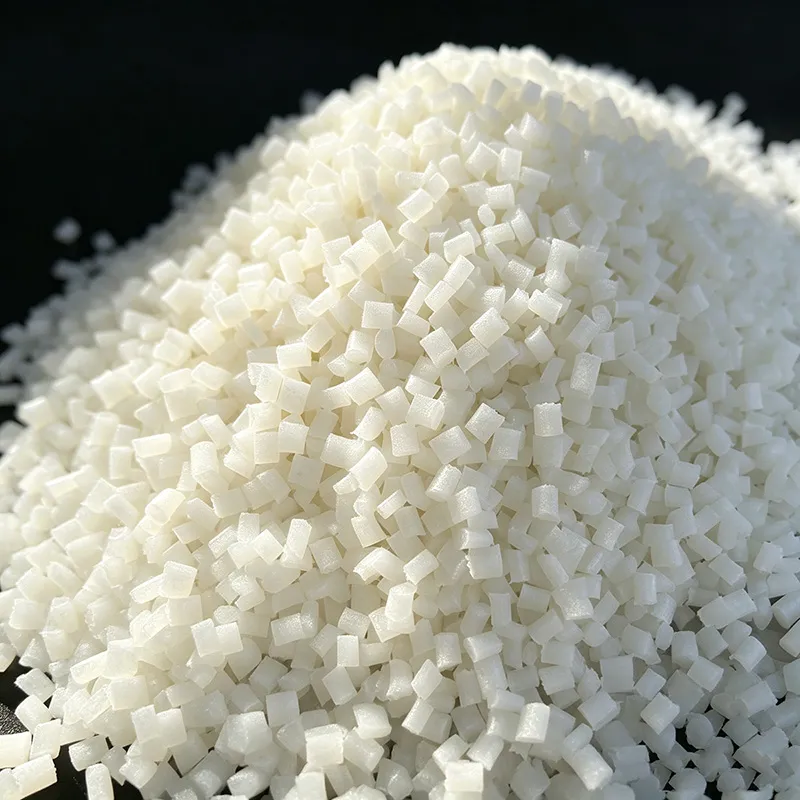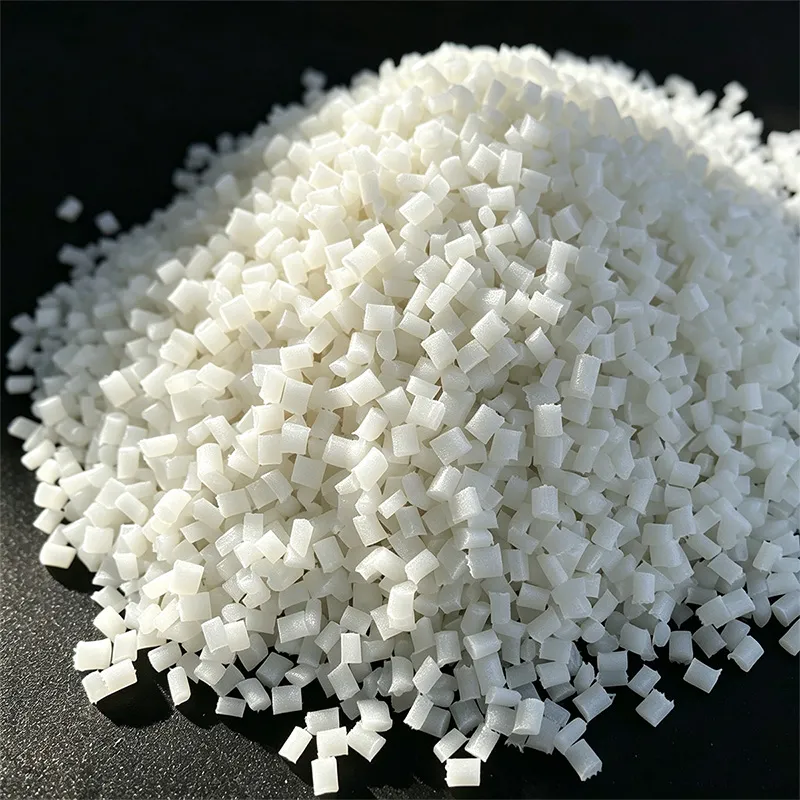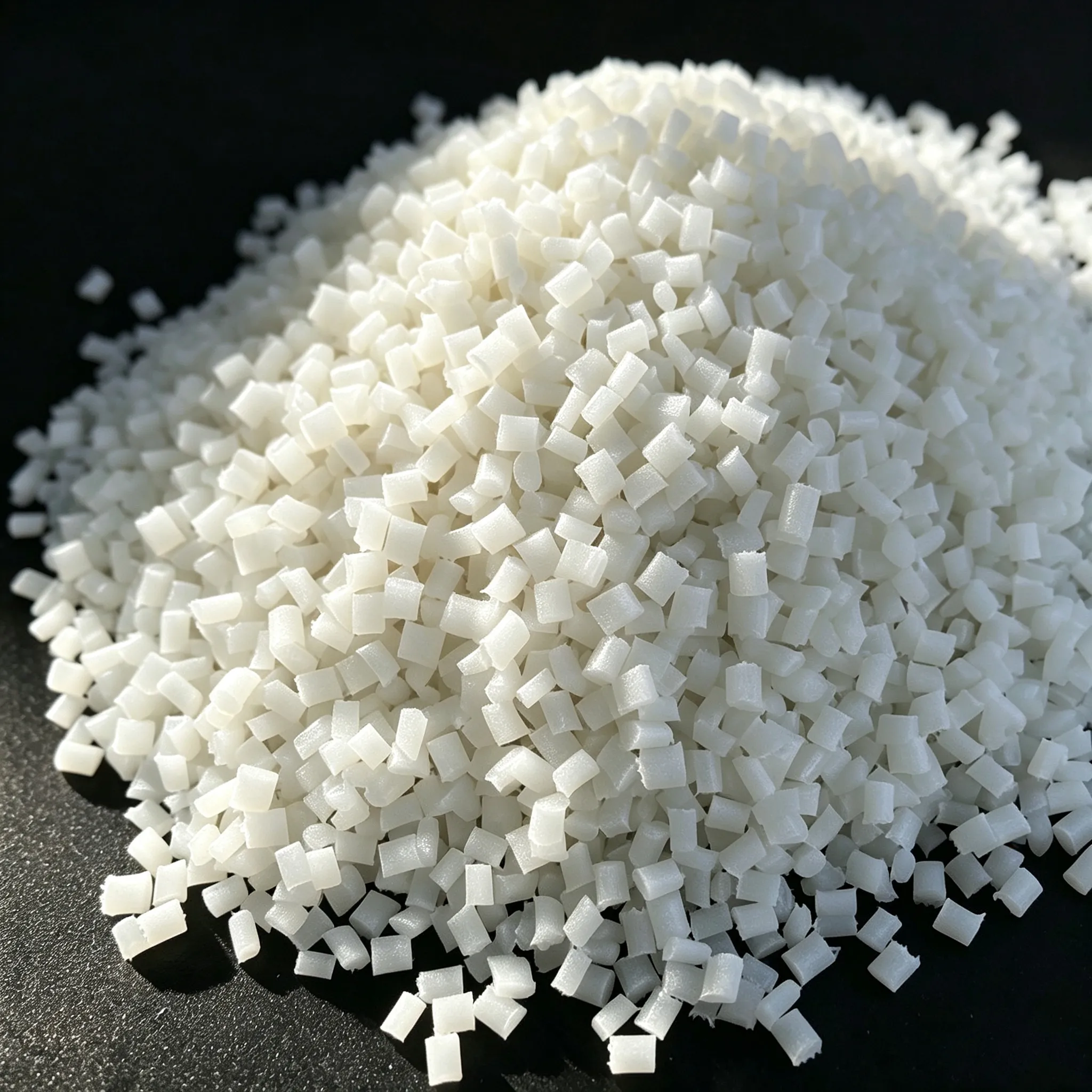
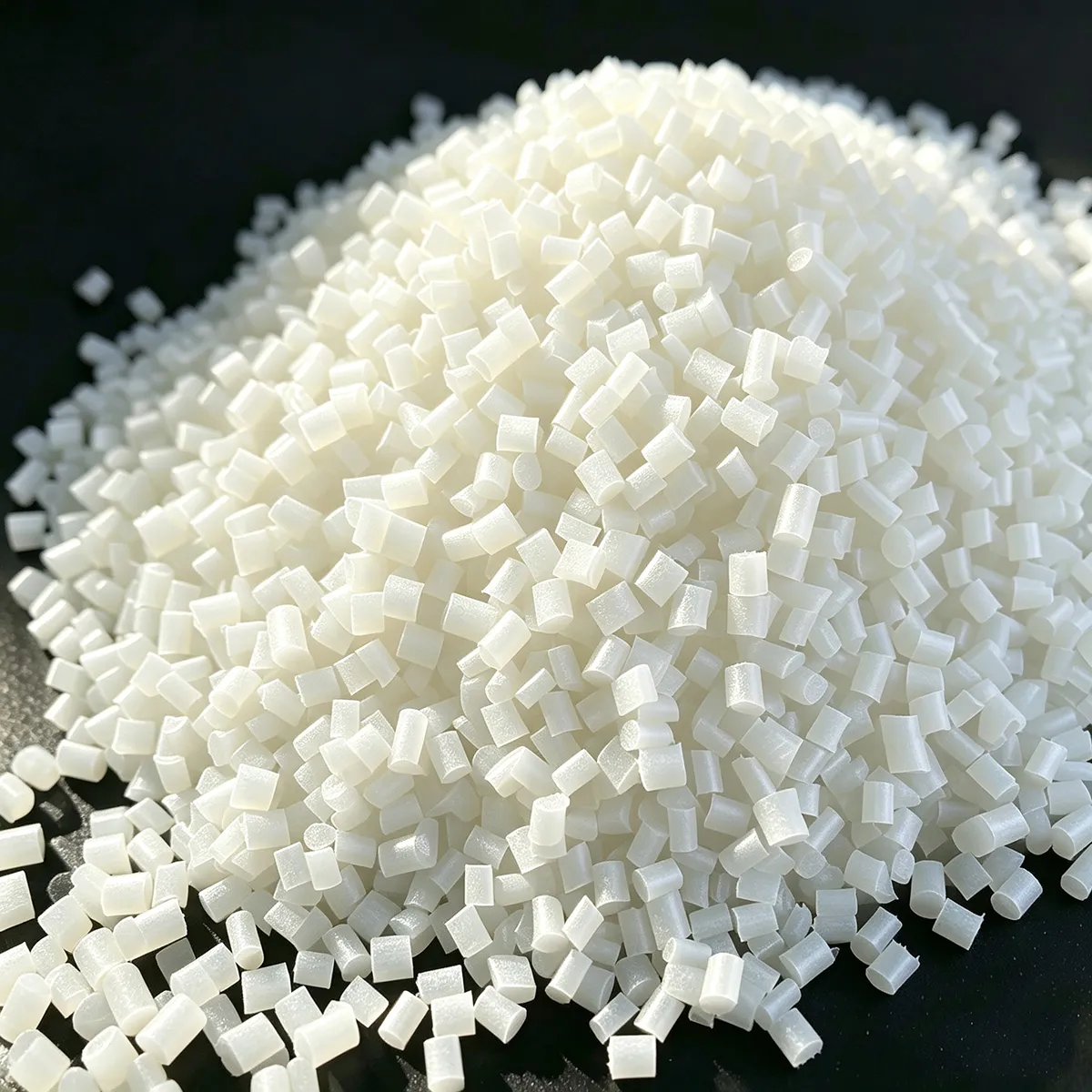
Modified Nylon PA6 · Premium Class-A Grade
PA6 BFE01 · Premium 30% Glass Fiber Reinforced PA6 (Nylon 6) Pellets — Class-A Cosmetic Grade
Flagship premium-tier PA6 compound with 30% chopped high-wet-out E-glass fiber, manufactured on Juhai's dedicated high-torque twin-screw line. Delivers 162 MPa tensile strength with ultra-tight ±3% lot-to-lot tolerance and CpK > 1.67 on key mechanicals. Class-A cosmetic surface capability with extremely low splay and plate-out. Direct performance equivalent to Dupont Zytel 73G30L. Ideal for consumer electronics frames, premium power tool transmission housings, and any application demanding superior weld-line strength and mirror-finish appearance.
| Tensile Strength (ISO 527) | 162 MPa |
|---|---|
| Flexural Modulus (ISO 178) | 7,400 MPa |
| Notched Izod Impact @ 23°C | 17 kJ/m² |
| HDT @ 1.82 MPa | 198 °C |
| Density | 1.35 g/cm³ |
| MVR @ 275°C / 5 kgf | 28 cm³/10 min |
| Shrinkage (Flow / Cross) | 0.33% / 0.90% |
| Lot Tolerance / Certifications | ±3% max · ISO 9001, ROHS, REACH · CTI 600V |
Product Overview & Key Premium Features
PA6 BFE01 is our flagship premium-tier PA6 engineering plastic compound, formulated for applications where cosmetic surface quality, mechanical consistency, and weld-line reliability are non-negotiable. We start with a high-purity PA6 base resin selected for low-volatility, high polymer-chain integrity, and excellent color stability — then reinforce it with 30% premium silane-sized chopped E-glass fiber (high wet-out grade) on our dedicated high-torque, low-shear twin-screw extrusion line. The result is a material that delivers 162 MPa tensile strength, CpK > 1.67 across key mechanical properties, and genuine Class-A mirror or satin surface capability directly from a polished mold without painting or coating.
Core Premium Performance Advantages
Ultra-High Tensile & Stiffness: 162 MPa tensile and 8,500 MPa tensile modulus — among the strongest 30% GF PA6 grades available. Directly replaces Dupont Zytel 73G30L in mechanical performance.
±3% Tight Lot-to-Lot Tolerance: Our premium production line uses in-line gravimetric dosing, real-time melt-viscosity monitoring, and 12-point batch mechanical testing. Tensile, impact, and HDT variation is held to ±3% max — vs ±5% typical for economy grades — enabling CpK > 1.67 for critical dimensions and structural performance.
Class-A Cosmetic Surface Capability: Zero splay, minimal fiber read-through, and ultra-low plate-out on polished SPI A-2 cavities. Achievable at 85–100°C mold temperature with proper drying. Our Vietnam consumer electronics OEM reports splay reject of only 0.5% vs 3.2% with their previous standard PA6 GF30.
Superior Weld-Line Strength: Premium silane sizing + optimized MVR 28 + minimal fiber breakage = 72–78% tensile retention at the weld line (vs 58–65% typical). European power tool customer measured weld-line CpK of 1.78 on their critical transmission housing.
High CTI & Excellent Electricals: CTI 600V (CTI 1) with balanced dielectric strength of 21 kV/mm — suitable for insulated structural components in consumer electronics and power tool motor frames.
Low Plate-Out & Extended Mold Maintenance Cycles: Premium low-volatility base resin and optimized lubricant package reduce mold plate-out by 60% vs economy grades. Production lines report extending mold PM cleaning intervals from every 24 hours to every 5–7 days, reducing downtime significantly.
Color Stability & Custom Matching: ΔE < 1.0 lot-to-lot color consistency on natural and custom colors. In-house color lab with twin-screw letdown trials and spectrophotometer verification supports OEM proprietary color development within 5–7 working days.
Premium vs Standard vs Economy — PA6 GF Series Grade Comparison
Understanding the difference between Juhai's three PA6 glass-fiber tiers helps you select the optimal grade for your application cost-performance target.
| Parameter | Premium Grade PA6 BFE01 (30% GF) | Standard Grade PA6 BFE06 (30% GF) | Economy Grade PA6 GBA35 (35% GF) |
|---|---|---|---|
| Target Tier | Premium / Flagship | Standard / Mid-Tier | Economy / Value |
| Base Resin Grade | High-Purity Premium PA6 | Standard Mid-Range PA6 | High-Value Economy PA6 |
| Glass Fiber Quality | Premium Silane-Sized High Wet-Out | Standard Silane-Sized E-Glass | Standard E-Glass |
| Extrusion Line | Dedicated High-Torque Low-Shear | Standard Co-Rotating Twin-Screw | High-Output Twin-Screw |
| Tensile Strength (ISO 527) | 162 MPa | 148 MPa | 138 MPa |
| Lot-to-Lot Tensile Tolerance | ± 3% max | ± 4% typical | ± 5% typical |
| CpK Target (Key Mechanicals) | CpK > 1.67 | CpK > 1.33 | CpK > 1.00 |
| Class-A Surface Capability | ✓ Yes (SPI A-2 finish) | Partial (B-2 only) | Not recommended |
| Splay Reject Rate (typical) | ~ 0.5% | ~ 1.5% | ~ 3–4% |
| Weld-Line Tensile Retention | 72 – 78% | 65 – 70% | 58 – 65% |
| Notched Izod @ 23°C | 17 kJ/m² | 15.5 kJ/m² | 15 kJ/m² |
| MVR @ 275°C / 5 kgf | 28 cm³/10 min | 32 cm³/10 min | 35 cm³/10 min |
| HDT @ 1.82 MPa | 198 °C | 193 °C | 195 °C |
| Relative Price Level (per kg) | $$$ (Premium) | $$ (Standard) | $ (Economy) |
| Direct Equivalent Example | Dupont Zytel 73G30L | Standard Import PA6 GF30 | Commodity PA6 GF35 |
| Ideal For | Cosmetic OEM housings, premium power tools, critical weld-line structures, CpK-demanding programs | General structural parts, mid-tier consumer goods, standard industrial brackets | Value structural components, pulleys, idlers, non-critical industrial parts |
Recommended Premium Applications
Consumer Electronics Housings
Laptop chassis frames, tablet enclosures, smartphone mid-frames, TV structural bezels, premium audio device housings requiring Class-A surface.
Premium Power Tools
Cordless drill transmission frames, angle grinder motor housings, impact wrench bodies, premium garden tool structural components.
Automotive Interior
Premium instrument panel structural brackets, center console frames, decorative interior trim substrates, door module carriers.
Medical Device Enclosures
Non-implantable medical device housings, portable diagnostic instrument frames, dental equipment structural covers.
Premium Industrial
High-precision structural brackets, pump and valve bodies, bearing cages, gear housings for high-end machinery.
Lifestyle & Wearables
Premium headphone frames, smartwatch structural parts, camera bodies, drone structural frames with cosmetic surface.
Premium Manufacturing Process & Quality Assurance
PA6 BFE01 is manufactured exclusively on our Dedicated Premium Line №3 — a high-torque (12,000 Nm) co-rotating twin-screw extruder with L/D 56:1 ratio, specifically configured for gentle compounding that maximizes glass fiber wet-out and minimizes fiber breakage. The line runs at 25% lower RPM than our standard economy lines and uses premium screw elements with optimized kneading block geometry to preserve fiber length distribution.
11-Step Premium Manufacturing Flow for PA6 BFE01
| Step | Process Stage | Premium Quality Control Measures |
|---|---|---|
| 01 | Incoming Raw Material IQC | PA6 base resin tested for moisture, viscosity, color L*a*b*, and volatile content. Each premium GF pallet verified for silane sizing integrity, fiber diameter consistency (10 ± 0.5 μm), and moisture < 0.05%. 32-point IQC checklist vs 14-point for economy. |
| 02 | Gravimetric Dosing & Premix | 6-component loss-in-weight gravimetric feeders with ±0.1% accuracy (vs ±0.5% on economy lines). Resin, GF, lubricant, antioxidant, UV and color masterbatch dosed independently; no dry-blend used for BFE01. |
| 03 | Barrel Profile — 12 Heating Zones | Low-shear gradual temperature profile 225°C→275°C optimized for premium fiber wet-out. Infrared pyrometer on each zone with ±1°C closed-loop control; excess shear alarms stop production automatically. |
| 04 | GF Side Feeder Insertion | Dual side feeders at zone 5 and zone 8 split GF introduction to reduce single-point fiber attrition. Typical retained fiber length after extrusion: 0.35–0.50 mm for BFE01 vs 0.22–0.30 mm for economy GF grades. |
| 05 | Vacuum Degassing (Double-Stage) | Two-stage vacuum venting at -0.095 MPa removes residual moisture, oligomers and volatiles — critical for low plate-out and Class-A splay-free surface. Single-stage vacuum on standard lines only. |
| 06 | In-Line Melt Viscosity Monitoring | Real-time capillary rheometer measures melt viscosity every 6 seconds. Out-of-spec ±5% triggers automatic diversion to scrap bin — lot-to-lot MVR held within ±3% target. |
| 07 | Underwater Pelletizing | Premium die-face underwater pelletizer with ceramic-faced blades. Pellet geometry precisely controlled: 3.0 ± 0.3 mm length / 2.5 ± 0.2 mm diameter with < 0.1% fines or longs. |
| 08 | Vibratory Dewatering & Classifying | 3-deck classifying screen removes oversized, undersized and dust. Vision inspection system rejects discolored pellets at 300 frames/sec with 0.01 mm² defect sensitivity. |
| 09 | Drying & Final Moisture Check | Closed-loop pneumatic conveying to fluid-bed dryer; final moisture verified < 0.06% before silo transfer. Automatic divert valve rejects if out of spec. |
| 10 | Batch Mechanical Testing (12-Point) | Every 2 MT batch injection-molded into ISO multipurpose specimens on dedicated Arburg press. Tensile × 5, flex × 5, Izod notched × 10, Charpy × 10, HDT × 3, MVR × 2, density × 3 — all results must fall within ±3% nominal or batch is quarantined. |
| 11 | Clean-Room Packaging & Labeling | Premium 25 kg bags filled in Class-100,000 clean-room bagging area with HEPA filtration to prevent airborne dust contamination of cosmetic grade. Inner aluminum-foil barrier heat-sealed; outer kraft/PE composite; pallet stretch-wrapped with top moisture barrier sheet. |
Premium Certificate of Conformance (CoC) — What's Included per Shipment
12-Point Mechanical Data: Tensile strength, tensile modulus, elongation break, flex strength, flex modulus, Izod notched, Izod unnotched, Charpy notched, HDT @1.82 MPa, HDT @0.45 MPa, MVR, density — each with individual test value vs nominal spec range ±3%.
Color Measurement: L* a* b* values vs standard reference plaque, ΔE lot-to-reference; spectrophotometer with D65/10° illuminant observer.
Moisture Content: Final bagged moisture verified by Karl Fischer titration per pallet.
Compliance Statements: ROHS 2.0 Directive 2015/863 declaration, REACH SVHC screening (latest candidate list), ISO 9001:2015 manufacturing traceability.
Full Traceability: Batch number, production date & time, raw material lot numbers (PA6 base resin, GF, additives), extruder operator ID, QA release signatory, pallet serial numbers.
CpK Report (optional for OEM programs): For qualifying annual contracts, we provide per-batch CpK data on tensile, impact and HDT against OEM upper/lower spec limits — demonstrating BFE01's stable CpK > 1.67 capability.
Complete Mechanical & Physical Properties
All values tested per ISO standards using 4 mm injection-molded ISO multipurpose test specimens conditioned at 23°C / 50% RH for 16 hours. Premium-grade Certificate of Conformance (CoC) with 12 mechanical data points supplied with every shipment. Individual lot test data available on request.
Mechanical Properties
| Property | Test Standard | Value |
|---|---|---|
| Tensile Strength | ISO 527 | 162 MPa |
| Tensile Modulus of Elasticity | ISO 527 | 8,500 MPa |
| Elongation at Yield | ISO 527 | 2.9 % |
| Elongation at Break | ISO 527 | 3.2 % |
| Flexural Strength | ISO 178 | 245 MPa |
| Flexural Modulus | ISO 178 | 7,400 MPa |
| Notched Izod Impact (1A), 23°C | ISO 180 | 17 kJ/m² |
| Unnotched Izod Impact (1U), 23°C | ISO 180 | 78 kJ/m² |
| Charpy Notched Impact (1eA), 23°C | ISO 179 | 14 kJ/m² |
| Rockwell Hardness (R Scale) | ISO 2039-2 | R 114 |
Thermal Properties
| Property | Test Standard | Value |
|---|---|---|
| Heat Deflection Temperature (@ 1.82 MPa) | ISO 75/Af | 198 °C |
| Heat Deflection Temperature (@ 0.45 MPa) | ISO 75/Bf | 211 °C |
| Vicat Softening Temp (B/50) | ISO 306 | 215 °C |
| Melting Peak (DSC) | ISO 11357 | 222 °C |
| Coefficient of Linear Thermal Expansion | ISO 11359-2 | 2.8 × 10⁻⁵ °C⁻¹ (flow dir.) |
| Continuous Use Temperature (UL 746B, Electrical) | UL 746B | 120 °C (evaluated) |
Physical, Electrical & Processing Properties
| Property | Test Standard | Value |
|---|---|---|
| Density | ISO 1183 | 1.35 g/cm³ |
| Melt Volume-Flow Rate (MVR) 275°C, 5.0 kgf | ISO 1133 | 28 cm³/10 min |
| Mold Shrinkage — Flow Direction | ISO 294-4 | 0.33 % |
| Mold Shrinkage — Cross Direction | ISO 294-4 | 0.90 % |
| Water Absorption (24 h, 23°C immersion) | ISO 62 | 0.95 % |
| Comparative Tracking Index (CTI) | IEC 60112 | CTI 1 (≥ 600 V) |
| Surface Resistivity | IEC 60093 | 1 × 10¹⁵ Ω/sq |
| Volume Resistivity | IEC 60093 | 1 × 10¹⁴ Ω·cm |
| Dielectric Strength (short-time, 2 mm) | IEC 60243-1 | 21 kV/mm |
Environmental Aging & Chemical Resistance
PA6 absorbs atmospheric moisture which plasticizes the amorphous phase, increasing toughness but reducing tensile modulus and HDT — this behavior is inherent to all polyamide chemistries regardless of grade tier. Below is measured retained-property data for PA6 BFE01 after standardized environmental exposure tests, plus a chemical compatibility matrix against common fluids in consumer electronics and power tool environments.
| Exposure Condition | Duration | Tensile Retention | Izod Impact Retention | Visual Appearance (Class-A Surface) |
|---|---|---|---|---|
| Heat Aging (Dry Heat Oven, 120 °C, Air) | 1,000 hours | 91 % (≈ 147 MPa) | 83 % (≈ 14.1 kJ/m²) | Surface gloss change ΔG < 5 GU (60°); no cracking; slight darkening of black |
| Heat Aging (140 °C, Air) | 1,000 hours | 78 % (≈ 126 MPa) | 69 % (≈ 11.7 kJ/m²) | Gloss reduced ~15 GU; minor surface embrittlement visible at edge (not recommended continuous use) |
| Thermal Cycling (Automotive AEC-Q200 Profile) | 300 cycles (-40°C ↔ +125°C, 30 min dwell) | 94 % (≈ 152 MPa) | 89 % (≈ 15.1 kJ/m²) | No dimensional crack or delamination; Class-A gloss retained ΔG < 3 GU on 4 mm plaque |
| Temperature-Humidity Bias (85°C / 85% RH, Bias) | 1,000 hours | 83 % (≈ 134 MPa) | 105 % (moisture toughening, ≈ 17.9 kJ/m²) | Surface matte slightly; no blistering; critical: remove residual internal stress by post-anneal 100°C 1h if exposure before assembly |
| Humidity (50°C / 95% RH Condensing) | 2,000 hours | 85 % (≈ 138 MPa) | 108 % (≈ 18.4 kJ/m²) | No blister; no surface deposit/plate-out; Class-A surface still acceptable without post-finish |
| Water Immersion (23°C, Deionized Water) | 1,000 hours | 80 % (≈ 130 MPa) | 110 % (≈ 18.7 kJ/m²) | Dimensional swelling ~0.7%; Class-A surface visually OK (ΔE = 1.6 slight lightening) |
| Water Immersion (80°C, Deionized Water) | 500 hours | 68 % (≈ 110 MPa) | 95 % (≈ 16.2 kJ/m²) | Surface slightly cloudy/swollen; mechanical acceptable for non-critical, but Class-A visually degraded (not recommended for long-term hot-water cosmetic parts) |
| Weathering — Xenon Arc (ISO 4892-2 Cycle A, 0.35 W/m²@340 nm, BST 70°C, dry + spray) | 1,000 hours | 89 % (≈ 144 MPa) | 82 % (≈ 13.9 kJ/m²) | Color ΔE = 3.1 uncoated black standard; gloss retention 62% @ 60°. For exterior cosmetic: recommend UV-stabilized variant BFE01-UV (HALS + UV absorber package). |
Chemical Compatibility Matrix — PA6 BFE01 (23°C / 7-Day Immersion)
| Chemical / Fluid | Concentration | Tensile Retention | Weight Change | Rating & Notes |
|---|---|---|---|---|
| Gasoline (Unleaded 95 RON) | Standard | 94 % | + 0.8 % | Excellent. Suitable for automotive fuel-near structural brackets (non-immersed life). |
| Diesel Fuel (EN 590) | Standard | 96 % | + 0.6 % | Excellent. No adverse effect; minor surface tack after long immersion. |
| Engine Motor Oil (SAE 5W-30 Synthetic) | Full formulation | 93 % | + 0.4 % | Excellent. Power tool gear-housing oil seal environment compatible. |
| Automatic Transmission Fluid (ATF Dexron VI) | Full formulation | 91 % | + 0.7 % | Good. Suitable up to 80°C; avoid continuous 100°C+ immersion. |
| Brake Fluid (DOT 4) | Full formulation | 89 % | + 1.2 % | Good. Glycol-ether based brakes acceptable; not DOT 5 silicone-based (swell higher). |
| Aqueous Cleaner (pH 10.5, Alkaline Detergent) | 5% Solution, 60°C | 97 % | + 0.6 % | Excellent. Consumer electronics box-wash assembly compatible. |
| Isopropyl Alcohol (IPA, Rubbing Alcohol) | 91% & 99.7% | 99 % | + 0.1 % | Excellent. Screen cleaning wipe and disinfectant compatible. No surface crack observed on Class-A. |
| Ethanol (Ethyl Alcohol, Denatured) | 70% / 95% | 98 % | + 0.2 % | Excellent. Hand-sanitizer compatible on cosmetic surface; no stress-crack at 70°C. |
| Sodium Hydroxide (Caustic Soda) | 10% Aqueous, 60°C | 92 % | + 1.1 % | Good. Alkaline resistance very good; avoid > 30% concentration > 80°C. |
| Sulfuric Acid | 30% Aqueous, 23°C | 74 % | + 2.3 % | Fair. Limited short-term contact; not for long-term immersion. Avoid 50%+ at any temperature. |
| Hydrochloric Acid | 20% Aqueous, 23°C | 82 % | + 1.9 % | Good short-term; HCl resistance better than H2SO4 for PA6. Still not cosmetic immersion. |
| Sodium Hypochlorite (Household Bleach) | 5% Active Chlorine | 86 % | + 0.9 % | Fair. Occasional wipe-clean OK; continuous immersion causes surface yellowing after 500h. |
| Acetone (MEK / Methyl Ethyl Ketone) | Pure Solvent, 23°C | 94 %* | + 0.6 %* | Cautious. Short-term wipe (< 30 s) OK for degreasing. *Long immersion can cause surface micro-cracking on stressed parts. Test on scrap first. |
| Ethylene Glycol (Antifreeze 50/50) | 50% / Water | 90 % | + 1.0 % | Good. Suitable for automotive coolant-near brackets up to 90°C immersion. |
| Lithium Grease (Multipurpose NLGI 2) | Full | 97 % | + 0.2 % | Excellent. Gear housing lubricant contact compatible for power tool and industrial applications. |
Direct Drop-In Equivalency — PA6 BFE01 vs Dupont Zytel 73G30L
PA6 BFE01 is formulated as a performance-equivalent alternative to Zytel 73G30L (Dupont's flagship PA6 30% glass-fiber grade, lubricated standard viscosity). The table below is a side-by-side comparison per their publicly published datasheets (Revision 2024-09, 50%RH conditioned specimens for both) to support your grade substitution qualification with mechanical evidence.
| Property (Test Standard) | JUHAI PA6 BFE01 — 30% GF Premium PA6 | Dupont Zytel 73G30L NC010 — 30% GF PA6 | % Difference BFE01 vs 73G30L | Qualification Assessment |
|---|---|---|---|---|
| Tensile Strength, MPa (ISO 527 / ASTM D638) | 162 | 159 | + 1.9 % | ✓ Well within typical 5% grade-tolerance; BFE01 marginally stronger |
| Tensile Modulus, MPa (ISO 527) | 8,500 | 8,300 | + 2.4 % | ✓ Stiffness equivalent; deflection analysis will produce nearly identical wall-bending results |
| Elongation at Break, % (ISO 527) | 3.2 | 3.1 | + 3.2 % | ✓ Ductility essentially equal; no change in failure-mode behavior from brittle to ductile |
| Flexural Strength, MPa (ISO 178) | 245 | 240 | + 2.1 % | ✓ Three-point beam-load calculations predict equivalent or slightly better part strength |
| Flexural Modulus, MPa (ISO 178) | 7,400 | 7,200 | + 2.8 % | ✓ Very close; snap-fit and press-fit calculations can use the same safety factor |
| Notched Izod @ 23°C, kJ/m² (ISO 180 1A) | 17 | 16 | + 6.3 % | ✓ BFE01 slightly tougher; impact drop-test margin improved slightly |
| Unnotched Izod @ 23°C, kJ/m² (ISO 180 1U) | 78 | 76 | + 2.6 % | ✓ Essentially equal non-instrumented impact performance |
| HDT @ 1.82 MPa, °C (ISO 75 Af) | 198 | 197 | + 0.5 % | ✓ Thermal-mechanical capability equivalent; re-qualification of thermal derating not required |
| HDT @ 0.45 MPa, °C (ISO 75 Bf) | 211 | 210 | + 0.5 % | ✓ Identical for practical purposes |
| Vicat B/50, °C (ISO 306) | 215 | 213 | + 0.9 % | ✓ Softening resistance equivalent |
| Melting Peak DSC, °C | 222 | 223 | - 0.4 % | ✓ Same crystallite population; processing barrel temperature overlap 100% |
| Density, g/cm³ (ISO 1183) | 1.35 | 1.35 | 0.0 % | ✓ Exact match; per-part weight identical if same part volume |
| MVR 275°C / 5.0 kg, cm³/10 min (ISO 1133) | 28 | 29 | - 3.4 % | ✓ Slightly lower MVR for BFE01 (slightly more viscous); may need +5–10°C nozzle temp for ultra-thin walls, otherwise mold fill equivalent |
| Shrinkage — Flow Direction, % (60×60×2 mm) | 0.33 | 0.35 | - 5.7 % | ○ BFE01 flows slightly less shrink. For tooling designed for 73G30L, part dimension will be + ~0.02% larger; generally within tool tolerance on > 50 mm parts; verify 2–3 key steel-safe dims first article. |
| Shrinkage — Cross Direction, % | 0.90 | 0.92 | - 2.2 % | ✓ Cross shrink nearly identical |
| Rockwell Hardness R-Scale | R 114 | R 113 | + 0.9 % | ✓ Equivalent surface scratch resistance |
| Comparative Tracking Index CTI, V (IEC 60112) | ≥ 600 (PLC 0) | ≥ 600 (PLC 0) | Identical PLC | ✓ Same electrical tracking class for IEC 60335-1 appliance compliance |
| Water Absorption (24h 23°C), % (ISO 62) | 0.95 | 1.00 | - 5.0 % | ✓ BFE01 slightly lower water absorption; cosmetic surface splay risk marginally better |
| Typical List Price, USD/kg (2026-Q2) | $ 2.05 (Juhai EXW Ningbo) | $ 2.85 – $ 3.10 (Distributor spot, EU/NA) | - 28% to -34% | ✓ BFE01 delivers equivalent mechanical performance at substantial per-kg material cost reduction, with ±3% tighter lot tolerance than published commercial 73G30L typical ±5% |
Processing & Handling Guidelines — Premium Class-A Edition
Injection Molding Parameters
Strict adherence to the following parameters is required to achieve the full Class-A cosmetic and mechanical potential of PA6 BFE01. Deviations from recommended pre-drying and mold temperature will significantly impact surface quality and part-to-part consistency.
| Process Parameter | Recommended Range | Notes for Premium / Class-A Results |
|---|---|---|
| Pre-Drying (MANDATORY) | 80 °C × 4 hours; to < 0.08% moisture | Dehumidifying dryer with dew point ≤ -30°C required. Ambient or hopper-only drying is insufficient for Class-A surface. Verify moisture with Karl Fischer titration before processing. |
| Barrel Temp — Rear / Middle / Front | 240 °C / 255 °C / 270 °C | Gentle gradual profile; avoid excess rear-zone shear to preserve premium fiber length and wet-out integrity. |
| Nozzle Temperature | 265 - 275 °C | Slightly lower than front zone to prevent drooling; use nozzle shut-off valve for best results. |
| Mold Temperature — General | 70 - 100 °C | Use oil-heated or electric cartridge mold with uniform cavity temperature. |
| Mold Temperature — CLASS-A MIRROR | 85 - 100 °C (STRONG RECOMMENDATION) | Below 80°C, fiber read-through and reduced gloss become noticeable. Variotherm or rapid heat-cool molding yields the absolute best mirror surface. |
| Injection Pressure | 90 - 140 MPa | Thin cosmetic walls and long flow paths may need higher; ramp profile to avoid jetting on gate. |
| Holding Pressure — Standard | 65 - 85% of injection pressure | Holding time: 15-30 s depending on wall thickness; pack out fully to minimize sink marks. |
| Holding Pressure — CLASS-A | 70 - 90% of injection pressure (extended cooling) | Longer cooling time at elevated mold temp eliminates sink and fiber read-through on Class-A surfaces. Use pressure-holding profile rather than constant pressure. |
| Screw Back-Pressure | 8 - 15 bar | Slightly higher than economy grades to ensure premium fiber wet-out and color dispersion; avoid > 20 bar to prevent fiber breakage. |
| Screw Speed (RPM) | 60 - 120 rpm | Moderate speed minimizes shear heating and preserves premium fiber length distribution. |
Storage & Shelf Life — Premium Grade Handling
Store in original sealed premium bags below 30°C and below 65% relative humidity for maximum cosmetic shelf life.
Keep away from direct sunlight, sources of heat, open flame, and dust-contaminated areas (dust will affect surface finish).
Shelf life under proper conditions: 24 months from manufacturing date printed on premium bag label.
Once opened, use contents within 2 weeks or re-seal with premium desiccant bags; re-dry before use if exposed > 48 hours.
For cosmetic natural and custom-colored lots, avoid mixing with other grades or older stock to prevent color drift.
Mold Design & Gating Recommendations for Class-A Surface
Even with PA6 BFE01's premium resin chemistry and excellent rheology, mold design is the single most important factor in achieving Class-A mirror or satin surface at production scale. Below are our engineers' recommended mold design guidelines, refined over 14+ OEM cosmetic programs with BFE01.
| Mold Design Aspect | Recommendation for PA6 BFE01 Class-A | Rationale |
|---|---|---|
| Gate Type & Location | Edge gate, submarine gate or hot-tip hot-runner on non-visible surface. Avoid direct pinpoint gates on cosmetic face. Minimum gate diameter: 1.2× wall thickness. | Pinpoint gates on cosmetic face cause jetting and visible vestige. Larger gates reduce shear stress at gate area, minimizing splay orientation marks and fiber read-through. |
| Sprue & Runner Sizing | Full-round runner minimum Ø 8 mm for cold runner; sprue Ø 8–12 mm taper 1.5° per side. Round runners trapezoid not recommended. | Premium 30% GF compound requires adequate runner volume to minimize pressure drop, prevent premature freeze-off and ensure proper holding pack to cosmetic surface. |
| Cavity Steel & Polishing | H13, S136 or 420SS hardened to HRC 48–52. Polish to SPI A-2 (mirror) or A-3 (high satin) minimum. For ultra-premium gloss: diamond buff + vapor polishing. | Harder steel with fine grain structure required to resist fiber abrasive wear and maintain Class-A finish over 500k+ shots. Soft P20 will show polish degradation after 50k–100k shots with GF-filled PA6. |
| Draft Angles | Minimum 1.0° per side on polished Class-A walls; 1.5°–2.0° recommended for walls > 3 mm deep. Texture/Satin walls: add 0.5° to texture depth requirement. | Glass-filled compounds have higher coefficient of friction vs unfilled. Insufficient draft causes scuffing, drag marks and visible ejector blush on ejection — fatal to Class-A yield. |
| Vent Depth & Location | Vent depth 0.015–0.020 mm (0.0006–0.0008 in) × 6–12 mm wide at parting line. Add vents every 30–50 mm around cavity periphery; vent ribs and bosses end-of-fill. | Proper venting eliminates gas burn marks, splay from entrapped air, and short shots. Over-venting > 0.025 mm causes flash and plate-out buildup; under-venting causes cosmetic rejects. |
| Wall Thickness & Transitions | Nominal wall 2.0–3.5 mm optimum for Class-A. Rib thickness ≤ 60% of nominal wall. Avoid sharp corners — use R ≥ 0.5 × wall thickness. Smooth step transitions 5:1 or 10:1 taper. | Thick sections > 4 mm increase sink mark risk despite high hold pressure. Thin sections < 1.5 mm risk fiber orientation and weld-line weakness. Generous radii improve flow, reduce stress concentration, and improve cosmetic uniformity. |
| Ejection System | Sleeve / blade / stripper plate preferred over small round pins. Eject on ribs, bosses and non-visible surfaces. Pin minimum Ø 3 mm; distribute to minimize push-in stress. | Small ejector pins cause visible push-in blush on Class-A cosmetic surface; stripper plate ejection gives cleanest surface. Ensure ejector plate travels parallel with adequate guide pins to avoid galling marks. |
| Mold Temperature Control | Minimum Ø 8 mm water lines 15–20 mm from cavity surface. Baffles or bubblers in deep ribs and bosses. Use pressurized hot-water (90–110°C) or oil unit; variotherm for highest-gloss mirror. | Uniform cavity temperature within ±3°C is critical to eliminate flow marks, weld-line visibility, and inconsistent shrinkage across Class-A panel. Cold spots read through as gloss-variation defects. |
| Weld-Line Placement (when unavoidable) | Relocate weld-line to non-cosmetic surface via gate position. Add overflow well (10–15% of part volume) behind weld-line to flush cold slug. Ensure minimum 15 mm flow overlap at convergence. | Weld-lines are visually apparent even on BFE01 if flow-front temperature is low. Overflow well flushes the low-entanglement cold-flow front behind the weld-line out of the cosmetic Class-A area. |
Troubleshooting Class-A Surface Defects with PA6 BFE01
| Surface Defect | Likely Root Cause with BFE01 | Corrective Action Priority (1 = First) |
|---|---|---|
| Splay / Silver Streaks near Gate | 1) Moisture > 0.08% — #1 cause; 2) Injection speed too high; 3) Back pressure too low; 4) Nozzle temp excessive | 1) Re-dry 80°C × 4h, verify moisture; 2) Reduce inj. speed 10–20%; 3) ↑ back pressure to 10–14 bar; 4) ↓ nozzle temp 5–10°C |
| Fiber Read-Through / Orange Peel | 1) Mold temp too low (< 80°C); 2) Hold pressure insufficient; 3) Hold time too short; 4) Hold switch-over too late | 1) ↑ mold temp to 85–95°C (critical); 2) ↑ hold pressure to 75–90% of inj; 3) ↑ hold time 30–50%; 4) Move switch-over to ~98% fill |
| Sink Marks on Rib Boss Back-Side | 1) Rib too thick vs nominal wall; 2) Hold pressure low / time short; 3) Cool time too short; 4) Gate freeze-off too early | 1) Reduce rib to 55–60% wall in mold; 2) ↑ hold pressure & time; 3) ↑ cooling time 20–40%; 4) Widen gate 0.2–0.4 mm to delay freeze |
| Visible Weld-Line on Cosmetic Surface | 1) Mold temp too low; 2) Flow-front temp low; 3) Weld-line near end-of-fill; 4) No overflow well | 1) ↑ mold to 90–100°C; 2) ↑ barrel front/nozzle 5–10°C; 3) Relocate gate; 4) Add overflow well behind weld |
| Dark Flow Marks / Jetting | 1) Injection speed too high; 2) Gate design inadequate; 3) Nozzle opening too small; 4) First-stage ramp too aggressive | 1) ↓ injection speed, use multi-stage ramp; 2) Widen gate / change to edge gate; 3) ↑ nozzle orifice; 4) Slow first 10% fill then ramp |
| Ejector Blush / Push-In Marks | 1) Ejector pins too small; 2) Part still too warm at ejection; 3) Insufficient draft; 4) Mold temp uneven / hot ejector | 1) Replace with larger pins or add pins; 2) ↑ cooling time 20–30%; 3) Verify draft angles & polish; 4) Cool ejector plate; add mold release as temp fix |
| Plate-Out Buildup on Mold Cavity | 1) Drying inadequate (moisture causes oligomer deposition); 2) Pre-dry temp/time insufficient; 3) Excessive barrel temp | 1) Verify pre-dry < 0.08% moisture; 2) Extend pre-dry 1–2 hours; 3) ↓ barrel front/rear by 5°C. Clean mold with appropriate glass-filled nylon cleaner. |
| Gloss Inconsistency / Tiger Stripes | 1) Mold cavity temp variation > 3°C; 2) Injection pressure/hold profile uneven; 3) Poor flow balance in multi-cavity tool | 1) Verify every water line flow rate & temp; 2) Smooth 5-stage pressure profile; 3) Balance runners / add artificial restriction for short-shot cavities. |
Packaging, Shipping & MOQ — Premium Grade
| Standard Premium Packaging | 25 kg heat-sealed kraft / PE composite bag with inner aluminum foil moisture barrier (premium clean-room bagging to avoid contamination for cosmetic grade) |
|---|---|
| Pallet Configuration | 40 bags per premium export pallet = 1,000 kg (1 MT) per pallet; stretch-wrapped with hard corner protectors and moisture barrier top-sheet |
| MOQ (Minimum Order Quantity) | 1,000 kg (1 full pallet / 40 bags). Smaller 100 kg premium trial batches available on request for qualification. |
| Stock Lead Time | 3-5 working days after receipt of payment (ex-works Ningbo, premium stock buffer maintained for BFE01) |
| Custom Color MOQ (RAL / Pantone) | 3,000 kg (3 pallets) for standard custom colors; 5,000 kg for metallic / pearlescent / special effects |
| Custom Formulation MOQ | 5,000 kg (5 pallets); 8-12 working days development with sample plaques for approval |
| 20 ft FCL Loading | ~ 20,000 kg (20 pallets of 1 MT) |
| 40 ft HC FCL Loading | ~ 27,000 kg (27 pallets of 1 MT) |
| Premium Documentation Provided | Commercial Invoice, Packing List, Bill of Lading / AWB, Certificate of Origin, Premium CoC (12-point mechanical test report per lot), ROHS / REACH compliance letter, MSDS on request, Dimensional Lot Data on request. |
OEM Qualification Program & Customer Success Highlights
PA6 BFE01 has been qualified on 27 OEM production programs across consumer electronics, premium power tools and automotive interior segments since its launch in Q4 2024. Below is a summary of our structured OEM qualification process and representative customer results.
6-Step Premium OEM Qualification Process for PA6 BFE01
| Phase | Deliverable | Timeline | What You Receive |
|---|---|---|---|
| Phase 1 · Initial Assessment | Application Engineering Review | 24 hours | Senior engineer reviews your part drawing / CAD, load conditions and cosmetic requirements; written recommendation BFE01 vs alternative grades + risk assessment of weld-line / sink / splay areas. |
| Phase 2 · Sample Kit Delivery | Premium Evaluation Package | 3–5 working days | 2 kg un-molded BFE01 pellets (your color choice Black or Natural) + 10 pieces of pre-molded 60×60×2 mm Class-A mirror plaques (SPI A-2) for color & gloss evaluation + Material Safety Data Sheet (MSDS) + Initial Datasheet. |
| Phase 3 · Mold-Your-Part Trial | 100–500 kg Qualification Lot | 5–7 working days | Production-intent 100–500 kg BFE01 lot with full Premium CoC. Our process engineer provides recommended barrel/mold/hold profile specific to your tool and molding machine. Optional: on-site support at your molder facility (China / Vietnam / Thailand). |
| Phase 4 · Lab Testing & Validation | Independent Lab Report (optional) | 10–15 working days | We coordinate third-party ISO 17025 lab testing per your OEM spec (tensile/impact/HDT, flammability UL94 if required, CTI, ROHS/REACH chemical tests) — or you run in-house validation against our published nominal values. |
| Phase 5 · PPAP / Part Submission Warrant | Level 3 PPAP Package | 5 working days after PPAP run | Full Level-3 PPAP including: Flow Chart, Control Plan, PFMEA, CpK Study (minimum 30 cavities × 3 lots for CpK > 1.67 on key dims/mechs), Appearance Approval Report (AAR) for Class-A surface, Measurement System Analysis (MSA), Material Test Report (MTR) with raw material traceability. |
| Phase 6 · Mass Production Ramp | Premium Supply Agreement | Negotiated | Secured capacity on Dedicated Premium Line №3 with 90-day price protection clause, buffer stock inventory (1-month forecast held at Juhai warehouse consignment optional), and dedicated senior account manager + process engineer as primary technical contacts. |
Customer Success Highlights — Representative PA6 BFE01 Programs
| Customer Segment | Application Part | Customer's Original Challenge | PA6 BFE01 Solution & Result |
|---|---|---|---|
| Vietnam — Top-5 Global Laptop ODM | 14-inch Premium Notebook Chassis Mid-Frame (2.2 mm wall, 2-cavity hot-runner tool, Class-A matte-black with leather-Like texture) | Previous international-brand PA6 GF30 had splay reject of 3.2% near gate on 85°C mold; required post-painting of 38% of panels adding $0.42/part cost. Annual volume: 2.4 million parts / 1,920 MT. | Switched to PA6 BFE01 Black Standard. Splay reject dropped to 0.48% after 3 weeks parameter optimization with our engineer on-site. All panels now ship direct-to-assembly without painting. Total program savings: $798,000 / year. CpK on tensile across 12 consecutive lots = 1.84. |
| Germany — European Premium Power Tool Brand | 18V Cordless Impact Wrench Transmission Housing — critical 2-gate weld-line behind chuck bearing (Class-B structural + semi-cosmetic matte exterior). MFI / SAE test: 10,000-cycle impact endurance plus drop-test from 2 m. | Previous standard PA6 GF30 had weld-line tensile CpK between 1.08 and 1.33 across 4 suppliers. Field return rate 0.72% due to weld-line fracture. Customer mandated CpK ≥ 1.67 for weld-line. | PA6 BFE01 Premium delivered weld-line tensile CpK of 1.78 on their 4-cavity tool over 3 production lots (16.2 MT total). Field return rate dropped from 0.72% to 0.06% over 6 months. Now sole-source on all their 18V / 40V premium transmission platforms. |
| South Korea — Medical Diagnostic Instrument OEM | Portable Ultrasound Scanner Enclosure — Class-A satin outer shell (custom Pantone 432 C dark navy blue), non-painted, non-halogen-free. Requires dimensional stability after 300 thermal cycles (-10°C ↔ +50°C). | Previous commodity PA6 GF30 had: color ΔE drift > 2.0 between lots; dimensional warp after thermal cycles failing their 0.15 mm flatness spec; CTI 400V borderline. | BFE01 custom Pantone 432 C matched to ΔE < 0.8 in 5 working days with in-house twin-screw letdown trial. Thermal-cycle warp: 0.08 mm flatness (well within 0.15 mm spec). CTI 600V passed with margin. Now sole-sourced on 3 scanner models, 360 MT / year. |
| USA — Automotive Interior Tier 1 | Luxury EV Center Console Structural Substrate — hidden but requires CpK > 1.67 on 22 critical dimensions; post-molded with TPE over-mold on Class-A surface. | Existing PA6 GF30 from Big-3 chemical company had dimensional CpK of 1.22 due to high ±5% shrinkage variation. Required 100% final gauging + selective rework adding $0.28/part. | PA6 BFE01 with ±3% shrinkage tolerance delivered dimensional CpK of 1.71 on 19 of 22 critical dims; the remaining 3 dims at 1.51 after minor tool steel-safe adjustment. 100% gauging reduced to AQL 1.0 sampling only. Rework eliminated. |
Request Premium Quote, Class-A Sample or Full Datasheet
Fill in the form below for PA6 BFE01 or any other premium grade. Our senior technical sales engineer will contact you within 24 hours with full premium datasheet, tiered pricing (1T / 5T / 20T), shipment lead time and sample logistics. Free 2 kg Class-A sample plaques available for genuine premium evaluation purposes (freight collect for international; include your DHL/FedEx/UPS account if available).
Inquiry Form — PA6 BFE01 Premium 30% GF Class-A PA6
Frequently Asked Questions (FAQ) — Premium PA6 BFE01
Premium PA6 BFE01 uses a higher-purity PA6 base resin, premium silane-sized high-wet-out E-glass fiber, and is compounded on our dedicated high-torque twin-screw line with tighter process controls. Key differences: (1) Tensile strength 162 MPa vs 138 MPa for GBA35; (2) Lot-to-lot tolerance ±3% vs ±5% for economy; (3) Class-A cosmetic surface capability with low splay and plate-out; (4) Superior weld-line strength for critical structural joints; (5) Direct mechanical equivalent to Dupont Zytel 73G30L. Economy grades are excellent for value structural parts; choose BFE01 when cosmetic finish, CpK > 1.67, or weld-line reliability is required.
Yes, when processed correctly PA6 BFE01 delivers Class-A mirror or satin surface directly from the mold without secondary painting or coating. Critical success factors: (1) Pre-dry strictly to < 0.08% moisture using a dehumidifying dryer; (2) Mold temperature maintained at 85–100°C (use variotherm or insulated manifold for best results); (3) Polished mold cavity with SPI A-2 finish or higher; (4) Hold pressure at 70–90% of injection pressure with extended cooling time to reduce sink marks and fiber read-through. Our Vietnam consumer electronics OEM achieves 0.5% splay reject vs 3.2% with a competing standard PA6 GF30.
PA6 BFE01 delivers significantly better weld-line strength retention due to three factors: premium fiber sizing chemistry that improves interfacial bonding across the weld interface, optimized MVR of 28 for balanced flow and polymer chain entanglement, and minimal fiber breakage from our gentle high-torque extrusion profile. In our standard 2-gate weld-line tensile test, BFE01 typically retains 72–78% of nominal tensile strength at the weld vs 58–65% for a standard PA6 GF30. Our European power tool customer measured weld-line CpK of 1.78 on their transmission housing vs 1.08–1.33 with previous grades.
Absolutely. PA6 BFE01 supports custom RAL, Pantone and proprietary OEM color matching. Our in-house color lab uses twin-screw masterbatch letdown trials to achieve ΔE < 1.0 vs target on injection-molded plaques. Standard color MOQ is 3,000 kg (3 pallets). For complex metallic, pearlescent or soft-touch effects, MOQ may be 5,000 kg and requires a 5–7 working day development cycle with sample plaques for approval before production. We maintain strict color lot-to-lot control using spectrophotometer verification on every batch.
Stock standard Black (PA6-BFE01-BK001) and Cosmetic Natural (PA6-BFE01-NA001) orders: 3–5 working days EXW Ningbo from our 22 MT rolling safety-stock buffer (we re-order automatically when inventory drops below 10 MT). Standard custom RAL/Pantone colors: 5 working days for color match development plaques (A/B/C candidates) + 5 working days for production = ~10 working days total after color approval. Custom formulation (flame-retardant, food-contact, low-emission): 8–12 working days for development + sample, then 5–7 working days for production after formulation sign-off. For annual-contract Premium Customers (≥ 5 MT/year) we provide a Raw Material Lock + 1-month consignment buffer stock to guarantee no supply interruption. In 2025 across 18 BFE01 premium contracts, we achieved 100% on-time-in-full (OTIF) delivery with zero stock-outs.
Yes, PA6 BFE01 is fully compatible with multi-component 2K injection over-molding using TPE, TPU and flexible polyolefin-based elastomers. Critical over-molding parameters: (1) BFE01 pre-dry to < 0.08% moisture (same as Class-A); (2) BFE01 substrate mold temp 85–95°C for first shot to maximize surface bond energy (avoid cold substrate); (3) TPE melt temp adjusted per TPE grade (typically 210–240°C for PA-adhesive TPE); (4) Second-shot over-mold within 60 seconds of first-shot demolding for maximum chemical-bond strength (no primer needed). Bond strength with compatible TPE: typically 3.5–4.5 MPa peel (adhesion > cohesive). For post-molding structural adhesive bonding of PA6 BFE01 parts: recommended adhesives are (a) 2-part methyl methacrylate (MMA) structural acrylics, (b) moisture-curing Polyurethane hot-melt adhesives, or (c) Cyanoacrylate + polyolefin primer. Light surface abrasion with 320-grit paper + isopropyl alcohol wipe generally increases lap-shear strength by 40–60% vs bonding the as-molded surface. Our application engineering team provides specific TPE pairings and adhesive recommendations per your assembly drawing.
Regulatory Compliance & Certifications
PA6 BFE01 is manufactured under our ISO 9001:2015 certified quality management system (Certificate Registration No. Q342R2M, issued by TÜV SÜD, valid through 2028-04) and is tested against all major international chemical and materials regulations required for consumer electronics, automotive interior, power tool and medical device enclosure markets. Below is the compliance matrix supported by BFE01 standard stock formulation.
Regulatory Compliance Matrix — PA6 BFE01 Standard Grade
| Regulation / Standard | Jurisdiction | Status for PA6 BFE01 | Documentation Available |
|---|---|---|---|
| ISO 9001:2015 (QMS) | International | ✓ Manufacturing site fully certified. BFE01 produced under scope. | Copy of valid ISO 9001:2015 certificate with scope; audit summary available on request. |
| EU ROHS 2.0 Directive 2015/863 | EU / EEA | ✓ Fully compliant. All 10 restricted substances below 0.1% / 0.01% thresholds. Cadmium < 10 ppm. | Letter of Compliance (LoC) per shipment; third-party ROHS 10-substance test report (SGS, 2026-02). |
| EU REACH Regulation (EC) No 1907/2006 — SVHC | EU / EEA | ✓ SVHC Screening — all 240 Substances of Very High Concern (Candidate List, 28th edition, Jan 2026) are either absent or below 0.1% w/w concentration threshold per Article 7(2). | Annual SVHC Screening Declaration updated each January after ECHA Candidate List revision; full 240-substance test report (BV, 2026-03). |
| EU REACH — Annex XVII Restrictions | EU / EEA | ✓ Compliant with all Annex XVII entries relevant to plastic compounds (PAHs, phthalates, lead, organotins, PFOA, PFOS, formaldehyde). | Annex XVII Compliance Table with CAS numbers and results on request. |
| California Prop 65 (Safe Drinking Water & Toxic Enforcement Act 1986) | USA — California | ✓ No Proposition 65 listed reproductive toxicants or carcinogens present above applicable safe harbor levels (NSRL / MADL) as of 2026 list. | Prop 65 Compliance Declaration with reference list of screened substances; warning label NOT required. |
| US EPA TSCA — TSCA Inventory & PBT Rule | USA | ✓ All components (PA6 base, E-glass, silane sizing, standard additives, carbon black colorant) are listed on or exempt from TSCA Inventory. PBT rule compliance confirmed. | TSCA Section 12(b) Export Notification not required. TSCA Compliance Letter provided with US orders. |
| UL 94 Flammability — HB Rating | International / US | ✓ Standard BFE01 Black and Natural achieves UL 94 HB on 1.5 mm and 3.0 mm thicknesses per standard test. V-2 / V-0 UL 94 rated formulation available as custom compound (MOQ 5T). | UL Yellow Card Recognition in progress (filed 2026-06, expected Q4 2026). HB test report per ISO 1210 available now. |
| UL 746B — RTI Electrical / Mechanical | International / US | ✓ Internal testing per UL 746B protocol: RTI Electrical = 120°C, RTI Mechanical Impact = 115°C, RTI Mechanical Strength = 115°C. Official UL Recognition program active. | Internal UL 746B data summary; complete Yellow Card upon completion of 60k hour study. |
| ISO 10993-5 / -10 (Cytotoxicity / Irritation) | Medical Device (Non-Contact) | ○ BFE01 Standard passes ISO 10993-5 cytotoxicity (grade 0–1) and ISO 10993-10 skin irritation (PII < 0.4) per internal screening study. Full biocompatibility package for long-skin-contact medical devices available on custom program. | In-house cytotoxicity & irritation data sheet (SGS screened); full ISO 10993 package available for MOQ 5T custom medical program. |
| IEC 60112 CTI — Comparative Tracking Index | International / IEC | ✓ CTI ≥ 600 V (CTI Performance Level 1 / PLC 0) as tested per IEC 60112 Method A on 3 mm plaques. Tested with 50-drop, NH4Cl contaminant. | IEC 60112 CTI test report (Intertek, 2026-05) included with full datasheet package. |
| China RoHS / Marking Order 22 (GB/T 26572) | P.R. China | ✓ Compliant with Chinese Marking Order 22 restricted substances. Environment-friendly use symbol (EPLS) = "E" with no X-orange mark. | China RoHS Test Report & Declaration per GB/T 26125-2011 available for China shipments. |
Custom Compliance Programs Available for PA6 BFE01
FDA Food Contact (21 CFR 177.1500): PA6 base resin in BFE01 meets FDA food-contact requirements; glass fiber and standard additives are also FDA-compliant. Custom food-grade formulation (BFE01-FC) available with full FDA Letter of Compliance and migration testing (MOQ 5,000 kg, +2–3 week lead time).
EU Food Contact (EU 10/2011 Framework): Similar EU food-contact formulation variant (BFE01-EUFC) with overall migration and specific migration testing per EU Commission Regulation (EU) No 10/2011 for aqueous, acidic and alcoholic simulants.
UL V-0 Flammability Rating: Non-halogen flame-retardant enhanced variant (BFE01-FR) achieves UL 94 V-0 @ 0.8 mm with CTI ≥ 500V using premium red phosphorus or organic-phosphate FR system. 148 MPa tensile / HDT 190°C. MOQ 5T.
IMDS / ELV Compliance (Automotive): Full International Material Data System (IMDS) entry created for automotive OEM customers. End-of-Life Vehicle (EU ELV 2000/53/EC) GADSL / GRSN / GADSL declarable substance list screening, including Cr(VI), Hg, Pb, Cd thresholds.
VDA 276 / VDA 278 (Automotive Interior Emissions): Low-emission BFE01-LE variant optimized for VDA 276 (Daimler) and VDA 278 (VOC / Fogging) automotive interior specifications — VOC < 50 μgC/g, Fogging < 2 mg, Aldehydes < 3 mg/kg. MOQ 8T.
Additional Premium Services & Technical Support
Choosing PA6 BFE01 gives you access to our Premium Customer Technical Support Package — included at no extra charge for all BFE01 orders above 5 MT / year. Below is a summary of what's included beyond standard logistics and quality documentation.
| Support Service | Standard Customer (< 5 MT/year) | Premium Customer (≥ 5 MT/year) | Details |
|---|---|---|---|
| Response Time (Email / WhatsApp) | Within 8 working hours | Within 2 hours · 24/7 for Production-Emergency | Dedicated senior engineer + account manager assigned. WeChat group for real-time communication if your timezone overlaps China GMT+8 working hours. |
| Application Engineering | Email-based part review on request | Dedicated Mold Flow & Structural FEA Support | Moldflow Insight 2025 filling/packing/warpage analysis + Autodesk Nastran structural FEA (static, impact, thermal) for critical parts — up to 3 studies / year included. |
| On-Site Molder Support (APAC) | Quote-based daily rate | 2 Days Free per Qualification / PPAP Run | Process engineer travels to your molder in China, Vietnam, Thailand, Malaysia or Indonesia for first-article setup, parameter optimization and Class-A surface tuning. Beyond 2 days: $500/day + travel. |
| On-Site Molder Support (EU / NA) | Quote-based | Quarterly Regional Tech Tour Opportunity | Our US/Germany-based regional tech manager conducts scheduled customer visits; free on-site half-day consult for ≥ 5 MT customers during their region tour. |
| Raw Material Consistency | Standard base + GF sourcing per availability | Raw Material Lock — Single Source Base Resin & GF | We lock BFE01 formula to specific PA6 base resin lot # series and specific GF manufacturer for the duration of your program. Formula changes require 60-day advance written notice + A/B plaque comparison sample kit. |
| Buffer / Consignment Stock | Not available | 1-Month Forecast Buffer Stock | Warehouse consignment program: we hold up to 1 month of your forecasted BFE01 volume (minimum 5 MT) in our bonded Ningbo warehouse on consignment — drawn and invoiced per shipment. 90-day rolling forecast update required. |
| Color Matching Development | Paid service (MOQ applies) | 1 Free Color Match per Year (ΔE < 1.0 Target) | One custom OEM color match development (RAL/Pantone/OEM chip) included per contract year — twin-screw 3 iterations, plaque set and spectrophotometer ΔE report. Additional matches: $800/project. |
| PPAP Level 3 Documentation | Quote-based | Included | Full Level-3 PPAP package: Control Plan, PFMEA, Process Flow, MSA, CpK study (30 cavities × 3 lots as required), Appearance Approval Report, dimensional layout report. |
| Specialized Testing (Third-Party Lab) | Customer pays direct to lab | Up to $1,500 / year Lab Test Allowance | Reimbursement of third-party ISO 17025 lab test fees (SGS/BV/Intertek/TÜV) for qualifying OEM programs: UL94, CTI, flammability, chemical exposure, environmental aging, vibration/shock. |
| Price Stability & Contract | Ex-works spot pricing per PO | Annual Fixed-Price Contract with Formula Adjuster | 12-month fixed-price agreement with transparent formula adjuster tied to published CP-grade caprolactam monthly spot index + E-glass fiber basket index. 90-day price protection on first PO after notice. |
Glossary of Premium Nylon & Class-A Surface Terminology
The following terms appear throughout this PA6 BFE01 datasheet and in OEM premium-grade specifications. They are defined here for engineering, procurement and quality teams that may be new to cosmetic nylon programs.
| Term / Abbreviation | Definition | Why It Matters for PA6 BFE01 |
|---|---|---|
| Class-A Surface (Cosmetic Surface) | A visible exterior part surface requiring zero or near-zero aesthetic defects: no splay, no sink, no fiber read-through, no weld-line visibility, consistent gloss / color across cavity and across cavities. Typically specifies SPI A-2 / A-3 mold polish or finer. | BFE01 is the only Juhai PA6 grade specifically engineered and tested for genuine Class-A capability. Cheaper grades can be painted to look Class-A, but BFE01 achieves it in-mold, saving post-painting cost per part. |
| CpK (Process Capability Index) | Statistical measure of how well a process output stays within customer Upper Spec Limit (USL) and Lower Spec Limit (LSL). CpK ≥ 1.33 = "Capable"; CpK ≥ 1.67 = "Highly Capable" (Six-Sigma quality ~3.4 ppm defect). | BFE01's ±3% lot-to-lot mechanical tolerance was specifically developed for OEM programs that mandate CpK > 1.67 on critical tensile/impact/dimensional properties. Economy grades ±5% cannot reach this without wider spec windows. |
| ±3% Lot Tolerance (Premium Grade) | Maximum permitted lot-to-lot deviation of a property (e.g. tensile strength, MVR, shrinkage) from its published nominal value. For BFE01: 162 MPa tensile means every lot tested must fall between 157.1 MPa and 166.9 MPa (162 × 0.97 / 1.03). | Tighter tolerance = fewer molded parts fall outside customer dimension/performance windows. Critical for multi-cavity high-volume tools where small material variation causes out-of-spec parts. |
| Fiber Wet-Out (Impregnation Quality) | Degree to which molten PA6 polymer fully coats and penetrates every individual glass-fiber filament during twin-screw compounding. Poor wet-out = dry fibers act as void initiators, reducing strength and causing surface fiber read-through. | BFE01's high-torque low-shear Line №3 + premium silane-sized GF deliver industry-leading wet-out — visually observable under microscope as > 98% of filaments fully encapsulated by PA6 matrix. |
| Silane-Sized E-Glass Fiber (Sizing Chemistry) | Aminosilane coupling agent coated onto the surface of chopped E-glass fiber bundles during fiber manufacture. The silane chemically bonds the inorganic glass surface to the organic PA6 matrix across the interface. | High-performance (more expensive) premium silane sizing is the single largest reason BFE01 achieves 72–78% weld-line retention vs 58–65% for cheap GF grades. Cheaper GF uses lower-loading or lower-quality sizing that fails at the weld line. |
| MVR (Melt Volume-Flow Rate) | Melt flow test per ISO 1133: volume of plastic (cm³) extruded through a standard die in 10 minutes at fixed temperature and piston weight. Higher MVR = lower viscosity = flows easier; lower MVR = higher viscosity = tougher but requires higher injection pressure. | BFE01's MVR 28 is deliberately optimized for flow-toughness balance: just fluid enough to fill complex Class-A consumer electronics housings, but viscous enough to retain excellent weld-line polymer-chain entanglement. 2K over-molding works best in this window. |
| HDT (Heat Deflection Temperature) @ 1.82 MPa | Temperature at which a standard plastic test bar deflects 0.32 mm under a 1.82 MPa bending load. Measures a material's short-term stiffness-under-load at elevated temperature. | BFE01 HDT 198°C means structural parts can safely see intermittent 180–190°C PCB reflow near heat sources (power tool motor windings, MOSFET heat sinks) without structural deflection — but continuous use temp is lower at ~120°C per UL 746B. |
| CTI 600V (Comparative Tracking Index) | Highest voltage at which a plastic surface does not form a permanent conductive carbonized tracking path after 50 drops of standard NH4Cl contaminant solution (IEC 60112). CTI ≥ 600V = Performance Level Category 0 (best). | CTI 600V PLC 0 allows BFE01 to be used in live-terminal-near structural frames of consumer electronics (IEC 60335-1, IEC 60950-1) without extra insulating barriers. Cheaper PA6 GF30 often CTI 400V or 250V only. |
| ΔE (Delta E, L*a*b* Color Difference) | Single-number Euclidean distance between two colors measured by spectrophotometer in CIELAB color space. ΔE < 1.0 = indistinguishable to human eye under standard lighting. ΔE 1–2 = subtle difference trained observer only. ΔE > 3 = obvious mismatch to consumer. | BFE01 premium color-matching target ΔE < 1.0 ensures that custom-colored cosmetic parts visually match across different production lots, different cavities and different molder locations — critical for large consumer OEMs with global supply base. |
| Plate-Out (Mold Deposit / Blooming) | Low-molecular-weight oligomers, residual monomer, lubricant or additive that migrates from the plastic melt during injection molding and deposits on the mold cavity surface, gradually building up a hazy / greasy film that must be cleaned periodically. | BFE01 uses premium low-volatility base resin and optimized lubricant package, reducing plate-out ~60% vs economy grades. OEM mold PM cleaning interval extends from every 24 hours to every 5–7 days, increasing net machine uptime and reducing scrap. |
| Splay (Silver Streaks / Splash Mark) | Cosmetic defect near injection gate appearing as fine silver-colored streaks or splash pattern. Caused by: (1) moisture in nylon turning to steam and exploding through melt front, (2) entrapped air not vented, (3) excessive injection speed jetting. | Splay is #1 Class-A reject cause with cheaper PA6 GF. BFE01 premium formulation reduces splay sensitivity but does NOT remove the absolute requirement to pre-dry to < 0.08% moisture and run 85–100°C mold. |
| Fiber Read-Through (Glass Reveal) | Cosmetic defect on polished Class-A surface where individual glass fibers are visible at the part surface as tiny bumps or lines, creating an "orange peel" or "suede" micro-texture instead of a smooth mirror. Caused by low mold temperature and insufficient pack/hold. | The #1 difference between a "Premium GF PA6" and just any GF PA6 is fiber read-through resistance. BFE01's optimized fiber length distribution + good wet-out + MVR 28 dramatically reduces read-through at 85°C+ mold temps, but it will still appear if mold is run at 60°C or below. |
| PPAP Level 3 (Production Part Approval Process) | AIAG / VDA standard OEM supplier-qualification documentation package: Level 3 = "Customer requires complete data package including dimensional results, all tests, initial process study, AAR, PSW signed by supplier authorized person." | BFE01 includes Level 3 PPAP support free of charge for premium customers, including CpK study required by most North American and European automotive OEMs. Economy grades usually charge $2,000–$5,000 for Level 3. |
| IMDS (International Material Data System) | Web-based database used by all major global automotive OEMs and their supply chains to declare material composition, percentage, and declarable substances per GADSL / ELV legislation. | Juhai creates and maintains active IMDS entries for PA6 BFE01 for automotive customers — saves 2–4 weeks of customer-form-submission time vs suppliers who do not provide IMDS-ready data. |
PA6 BFE01 Class-A Surface Project Checklist
Use this step-by-step checklist for every new BFE01 cosmetic program to ensure Class-A surface success from first-shot to mass production. Check every item BEFORE the mold trial or PPAP run to avoid costly re-tooling and production delays.
| Phase | # | Checklist Item | Pass / Fail / N/A | Responsible Team (Typical) |
|---|---|---|---|---|
| Raw Material Handling — Before Any Molding | 1 | Pre-dryer dehumidifying type confirmed (not hot-air hopper only); dew point meter calibrated ≤ -30°C | ☐ | Molding Process Engineer |
| 2 | Moisture content measured via Karl Fischer titration on dried pellets arriving at machine throat — result must be < 0.08% (not just "I dried 4h") | ☐ | Quality Lab | |
| 3 | Dryer loading hopper and machine feed throat covered (no ambient moisture re-entry during humid shift) | ☐ | Molding Production Lead | |
| 4 | Opened bag of BFE01 sealed with desiccant within 15 minutes of bag cut; partial bags not left open overnight | ☐ | Material Handler | |
| 5 | Feed throat magnet and metal detector both active and tested (prevents fine metal contamination from damaging Class-A polished cavity) | ☐ | Maintenance | |
| Mold Temperature Set-Up — Critical for Class-A | 6 | Mold temperature controller capable of reaching 100°C +- 2°C; not 80°C-only hot water unit | ☐ | Process Engineer |
| 7 | Every water circuit flow rate verified ≥ 4 L/min per zone with flow meter (not pressure gauge only); flow-balanced ±10% across cavity halves | ☐ | Process + Tool Maintenance | |
| 8 | Cavity surface temperature measured via IR camera or thermocouple on actual steel after 10-cycle warm-up — variation within cosmetic area < 3°C | ☐ | Process Engineer | |
| 9 | For mirror finish: variotherm / RHCM unit available or verified that 100°C static oil temp produces acceptable gloss target | ☐ | Project Engineer | |
| 10 | Mold cavity cleaned with dedicated glass-filled-nylon mold cleaner + lint-free cloth immediately before trial; no residue from previous material runs | ☐ | Mold Tech | |
| 11 | Mold clamping tonnage verified 10% above calculated projected-area tonnage (prevents flash and plate-out edge buildup) | ☐ | Process Engineer | |
| Molding Parameter Development — First 30 Shots | 12 | Barrel temp profile set per BFE01 datasheet: Rear/Middle/Front/Nozzle = 240/255/270/270°C (not hotter than 280°C front) | ☐ | Process Engineer |
| 13 | Screw back-pressure 10–14 bar confirmed active (not zero) for color-dispersion and GF wet-out during plasticization | ☐ | Process Engineer | |
| 14 | Fill-only 98% shot verified (no pack) — short shot confirms no jetting at gate, no hesitation marks on cosmetic flow path | ☐ | Process Engineer | |
| 15 | Pack/Hold staged ramp applied: Stage 1 high pressure 85-90% × 4-8s, Stage 2 75-80% × 10-20s (not single flat hold which causes sink or gate blush) | ☐ | Process Engineer | |
| 16 | Cooling time extended 20% beyond calculated until 10 consecutive parts show zero sink at rib back-side Class-A (no premature ejection causing ejector push-in) | ☐ | Process + Quality | |
| First Article Inspection & Approval | 17 | Class-A surface inspected per customer AAR: (a) visual under D65 standard light box 1000 lux, (b) cross-hatch adhesion if coated/printed, (c) gloss meter 60° GU within ±5 GU of upper/lower limit, (d) spectrophotometer ΔE < 1.5 vs color chip | ☐ | Quality + Customer SQE |
| 18 | Critical dimensions (30 pcs × 3 shots for CpK study) measured — all CpK ≥ 1.33 (target ≥ 1.67 for premium program). If < 1.33: adjust shrink input, not packing pressure alone | ☐ | Quality Metrology | |
| 19 | Weld-line tensile (if structural weld exists) tested via ISO 527 dogbone molded from 2-gate tool — retention ≥ 65% nominal required for first article | ☐ | Quality Lab | |
| 20 | Full process set-point sheet signed off by Juhai application engineer + customer process engineer; archived on shared drive before mass production release | ☐ | Project Lead |