Selection Guide · Updated July 18, 2026 · Juhai R&D Center
How to Choose the Right Glass Fiber Content (15% → 50%) for Modified PA6 Nylon
Glass fiber content is the single most influential formulation variable in modified PA6 — but more is not always better. This guide maps the actual mechanical, thermal, dimensional, surface and cost trade-offs at every GF loading from 15% to 50%, so you can pick the grade that meets your spec without over-paying for glass you don't need.
Table of Contents
1. Why Glass Fiber Content Is the #1 Formulation Lever
Modified PA6 is, in its simplest form, a PA6 (polycaprolactam) matrix reinforced with chopped E-glass fibers compounded on a twin-screw extruder. Of all the formulation variables available to a compounder — GF%, fiber length, coupling agent, lubricant, heat stabilizer, impact modifier, flame retardant, color — glass fiber percentage drives 70–80% of the mechanical and thermal performance you will measure on the finished part. Get the GF% right and the rest of the formulation becomes fine-tuning. Get it wrong and no amount of additive tweaking will rescue the design.
The challenge is that GF% is a trade-off dial, not a "more is better" knob. Adding glass increases tensile, flexural and HDT — but it also raises density, reduces notched impact above ~30%, worsens anisotropic shrinkage, degrades surface finish, shortens retained fiber length, accelerates screw wear, and increases cost per kg. The right GF% is the one that meets your critical design property at the lowest total cost and with acceptable surface and warpage. This guide gives you the data to make that call.
2. Mechanical Property Curves by GF%
All values below are Juhai Plastics production-typical values on ISO specimens (dry-as-molded, 23°C, 50% RH). Always confirm lot-specific data on the CoC.
| Property | 0% GF | 15% GF | 20% GF | 30% GF | 35% GF | 50% GF |
|---|---|---|---|---|---|---|
| Tensile Strength (MPa) | 78 | 110 | 135 | 162 | 175 | 195 |
| Tensile Modulus (MPa) | 2,700 | 4,500 | 6,000 | 8,500 | 9,500 | 13,000 |
| Flexural Strength (MPa) | 110 | 170 | 210 | 245 | 270 | 310 |
| Flexural Modulus (MPa) | 2,500 | 4,100 | 5,500 | 7,600 | 8,700 | 11,800 |
| Notched Izod 23°C (kJ/m²) | 4.5 | 7 | 10 | 12 | 11 | 9 |
| Notched Izod -30°C (kJ/m²) | 3 | 5 | 7 | 9 | 8 | 6 |
| Elongation at Break (%) | 120 | 4.5 | 3.5 | 2.5 | 2.2 | 1.8 |
| Density (g/cm³) | 1.13 | 1.22 | 1.27 | 1.35 | 1.40 | 1.52 |
Key observations from the curves
Tensile modulus rises roughly linearly with GF% — going from 0% to 50% nearly 5× the modulus. This is the property most engineers specify first.
Tensile strength rises but with diminishing returns above 35% — each extra 5% GF adds less strength than the previous 5% because retained fiber length drops and fiber-fiber interaction causes stress concentration.
Notched Izod impact PEAKS around 30% at ~12 kJ/m², then DECLINES above 35%. This is counter-intuitive — many engineers assume "more glass = tougher", but above 30% the matrix is too dilute to absorb crack energy and fibers become stress concentrators.
Elongation drops fast — unreinforced PA6 elongates 120%, but at 30% GF it is only 2.5%. The part becomes stiff but brittle; snap-fit features need re-engineered flexibility.
3. Heat Resistance (HDT) vs GF%
Adding glass fiber locks the amorphous and crystalline regions of the PA6 matrix, dramatically raising heat deflection temperature. The curve is steep up to 30%, then flattens:
| GF% | HDT @ 1.82 MPa (°C) | Vicat B/50 (°C) | Practical continuous use temp (°C) |
|---|---|---|---|
| 0% | 65 | 175 | 80 |
| 15% | 130 | 190 | 100 |
| 20% | 170 | 200 | 110 |
| 30% | 190 | 208 | 120 |
| 35% | 200 | 212 | 125 |
| 50% | 210 | 218 | 130 |
Practical takeaway: if your continuous operating temperature is under 120°C, 30% GF is the thermal sweet spot — beyond 30% you pay for glass that buys you only ~10°C more HDT. For 140°C+ continuous, switch to PA6/PA66 copolymer ETF02 (HDT 210°C) or pure PA66, rather than pushing PA6 GF beyond 35%.
4. Shrinkage, Warpage & Dimensional Stability
Shrinkage behavior is where the "more glass is better" intuition fails hardest. Glass fiber reduces flow-direction shrinkage strongly, but cross-direction shrinkage barely moves — so the gap between flow and cross grows, and that gap IS warpage.
| GF% | Flow Shrinkage (%) | Cross Shrinkage (%) | Anisotropy Ratio |
|---|---|---|---|
| 0% | 1.20 | 1.40 | 1.17× |
| 15% | 0.70 | 1.20 | 1.71× |
| 20% | 0.55 | 1.10 | 2.00× |
| 30% | 0.35 | 0.95 | 2.71× |
| 35% | 0.32 | 0.92 | 2.88× |
| 50% | 0.20 | 0.80 | 4.00× |
Look at the anisotropy ratio row: at 50% GF, cross shrinkage is 4× flow shrinkage. A flat plaque molded at 50% GF will bow noticeably out of the mold — this is the opposite of "more glass = more stable". To actually reduce warpage on flat parts:
Position the gate so flow runs along the part's long axis (aligns fibers with the long direction);
Raise mold temperature to 80–90°C to slow cooling and relieve internal stress;
Consider a mineral-filled PA6 (e.g. talc or wollastonite) which is more isotropic, or a PA6/PA66 copolymer;
If absolute flatness matters, do NOT go above 30–35% GF — re-engineer ribs and wall uniformity instead.
5. Surface Finish & Float Fiber
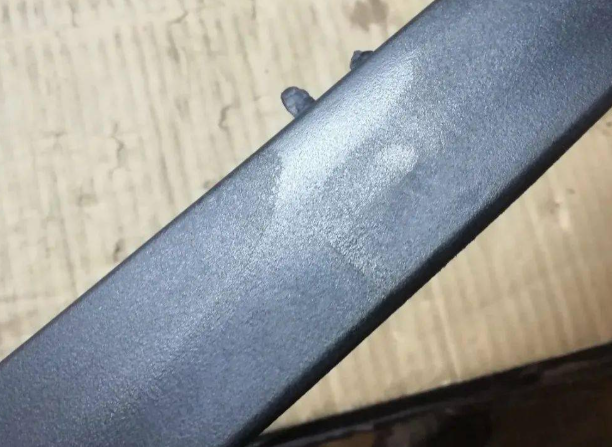
Every additional 5% GF degrades surface finish in a predictable progression. Glass fibers that reach the mold surface create a visible "float fiber" or "silver streak" appearance — short glass fibers poking through the polymer skin.
| GF% | Surface Quality | Paintable Directly? |
|---|---|---|
| 0% | Glossy, smooth | Yes (class A possible) |
| 15% | Slight texture | Yes with primer |
| 20% | Visible matte fiber | Yes with primer + light sand |
| 30% | Clear float-fiber matte | No (cosmetic only) |
| 35% | Pronounced fiber texture | No |
| 50% | Rough, fiber bundles visible | No |
If you need a class-A painted surface at high GF%, three real options exist:
Use a variotherm (hot/cold) mold — cycle a cold mold during fill then a hot mold during hold to thicken the polymer skin;
Specify a cosmetic additive package (Juhai offers PA6 GF30 "CF" cosmetic grades);
Switch to a PA6/PA66 copolymer like ETF02 — the lower-viscosity copolymer wets fibers better and gives a smoother skin at equal GF%.
6. Processing & Tooling Considerations
Melt and mold temperature
All GF% PA6 grades share roughly the same processing window: barrel 240–265°C, mold 60–80°C (80°C recommended for crystallization and surface). Higher GF% may need 5–10°C higher barrel temperature to maintain flow because the melt is more viscous.
Tool wear
Glass fiber is abrasive. Tool steel choice and maintenance cost scale with GF%:
0–10% GF: standard P20 steel acceptable for 100k+ shot life;
30% GF: P20 with hardened inserts in high-flow areas (gate, runner);
35–40% GF: recommend H13 or S7 tool steel with nitrided gate inserts; budget for gate refurbishment every 50–100k shots.
Flow length
Higher GF% shortens maximum flow length. As a rule of thumb at 1 mm wall, max flow length drops from ~150 mm (0% GF) to ~80 mm (30% GF) to ~50 mm (50% GF). Design additional gates or thicker ribs on high-GF% parts to avoid short shots.
Drying
All PA6 GF grades are hygroscopic and require drying at 80°C × 4 h to ≤0.08% moisture in a dehumidifying dryer regardless of GF%. See our complete nylon drying guide.
7. Cost-per-kg vs Stiffness-per-Dollar Optimization
Mid-2026 EXW pricing for Juhai Plastics standard GF PA6 grades, and the resulting stiffness-per-dollar (tensile modulus ÷ price per kg) — the metric that actually matters when you optimize for cost:
| GF% | Juhai Grade | Price USD/kg | Tensile Modulus (MPa) | Stiffness/USD (MPa per $) |
|---|---|---|---|---|
| 0% | — | 1.80 | 2,700 | 1,500 |
| 15% | — | 1.65 | 4,500 | 2,727 |
| 20% | — | 1.60 | 6,000 | 3,750 |
| 30% Premium | PA6 BFE01 | 2.10 | 8,500 | 4,048 |
| 30% Cost-Optimized | PA6 BFE06 | 1.50 | 8,200 | 5,467 |
| 35% Cost-Optimized | PA6 GBA35 | 1.68 | 9,500 | 5,655 |
| 30% Food Grade | PA6 GBC30 | 2.45 | 8,400 | 3,429 |
| 50% High-Modulus | — | 2.55 | 13,000 | 5,098 |
The sweet spot is 30–35% GF cost-optimized — at this loading, stiffness-per-dollar peaks around 5,400–5,700 MPa per USD. Beyond 35%, you pay for glass (and for compounding throughput loss) faster than stiffness grows. The 50% grade makes sense only when you need the absolute modulus number (13 GPa) for a spec, not when you are optimizing cost.
8. Application-Based Selection Reference
| Application | Recommended GF% | Why |
|---|---|---|
| Cosmetic interior housing | 0–5% | Surface finish priority |
| Light-load clip / snap fit | 15–20% | Needs flexibility + slight stiffness |
| Hand tool housing | 20–30% | Balanced impact + stiffness + surface |
| Structural bracket (general) | 30% | Industry workhorse, cost-optimized |
| Bracket displacing PA66 GF30 | 35% | Match PA66 mechanicals at PA6 cost |
| Food-contact component | 30% FDA | Use GBC30 food-grade compound |
| High-creep structural (120°C+) | 30–5% (or ETF02) | Consider copolymer for thermal retention |
| Maximum stiffness part (replace metal) | ||
| 45–50% | Only when 13 GPa modulus is mandatory |
9. 30-Second Decision Checklist
| • Do you need a class-A / cosmetic surface? | YES — 0–30% GF · NO — |
|---|---|
| • Continuous temp > 140°C? | YES — PA66 or ETF02 copolymer (not more GF) · NO — |
| • Is the part a flat plaque / door prone to warpage? | YES — cap at 30% GF, fix warpage with gate + mold T · NO — |
| • Are you displacing PA66 GF30 to save cost? | YES — 35% GF PA6 (GBA35) · NO — |
| • Is absolute modulus > 11 GPa on the drawing? | YES — 45–50% GF · NO — |
| • Default choice | 30% GF cost-optimized (BFE06) — best stiffness-per-dollar |
10. Frequently Asked Questions
11. Summary & Next Steps
In one sentence: For 80% of structural applications, 30% GF cost-optimized PA6 (BFE06) gives the best stiffness-per-dollar; jump to 35% GF (GBA35) only when displacing PA66 GF30; cap at 30% GF for flat or cosmetic parts; go above 35% only when your drawing absolutely requires >11 GPa modulus. Always validate the grade with a 25 kg sample and a single-cavity molding trial before committing to volume.
Not Sure Which GF% Is Right for Your Part?
Send us your part drawing, target mechanical properties, working temperature and annual volume — our R&D engineers will recommend the optimal GF loading and grade, with expected test values and a 25 kg sample within 3–5 working days.
Get a Grade Recommendation →