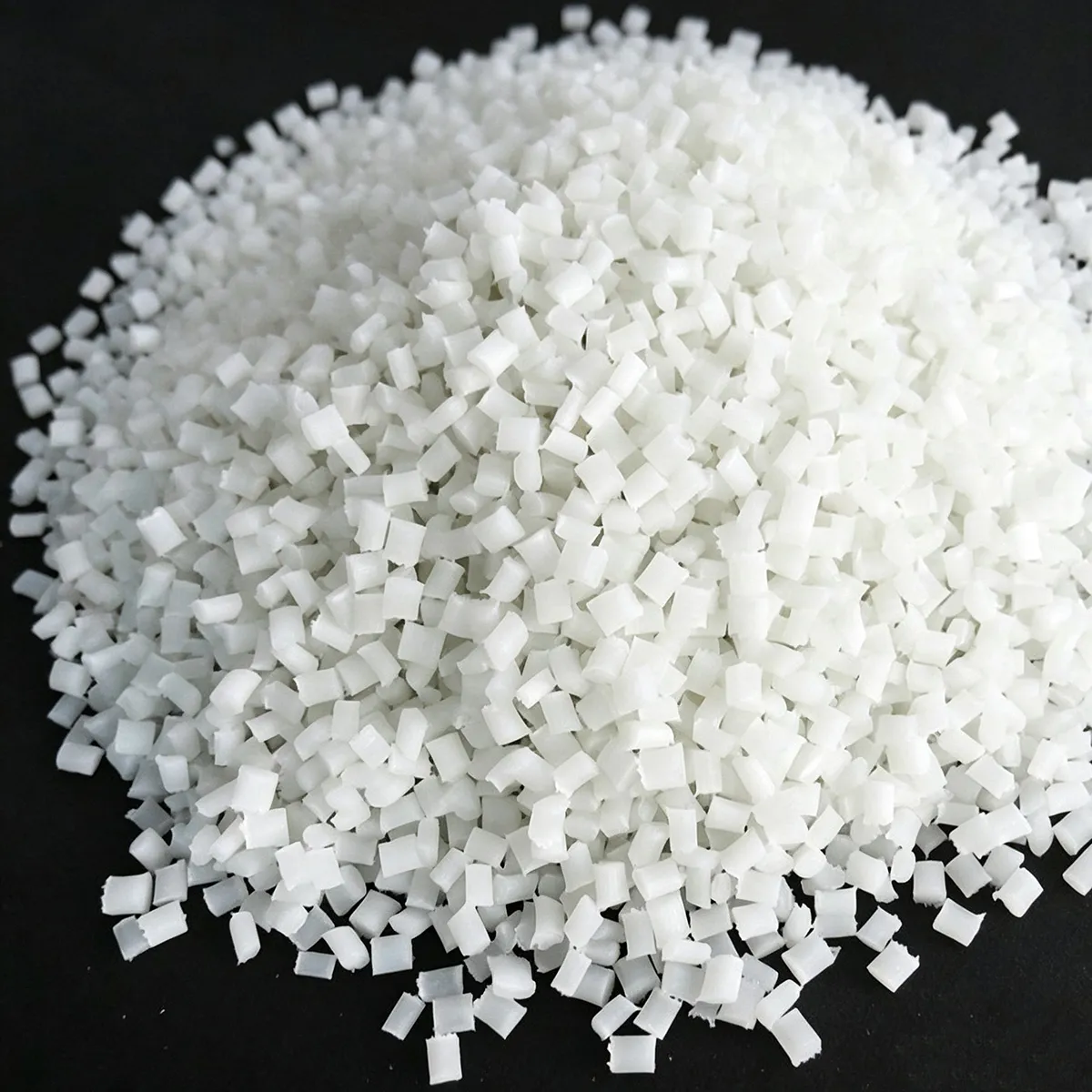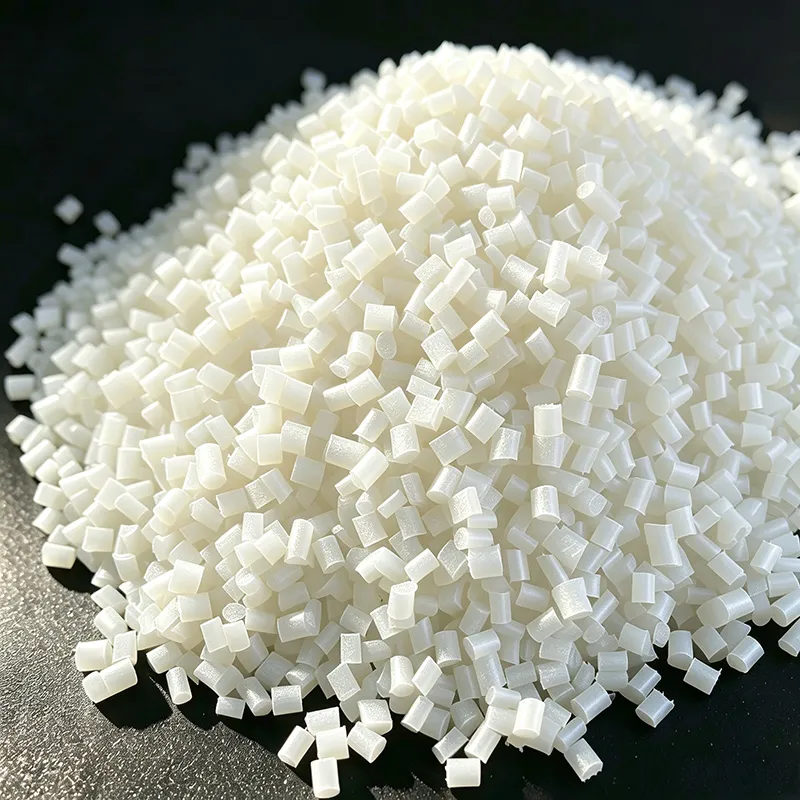
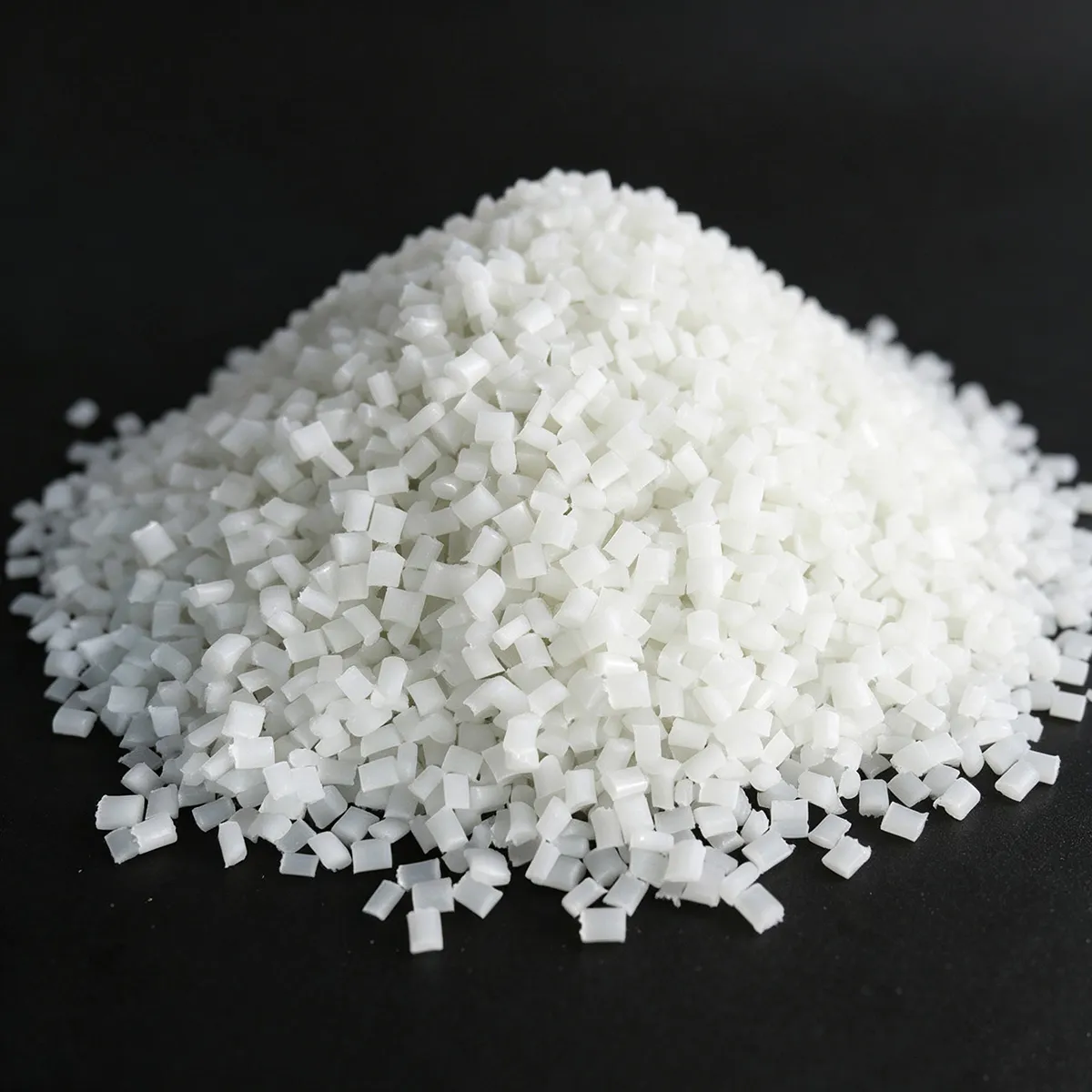
Modified Nylon PA6 · FDA & EU Food Contact Grade
PA6 GBC30 · 30% Glass Fiber PA6 FDA & EU Food Contact Grade Pellets
Juhai PA6 GBC30 is a 30% glass fiber reinforced PA6 (Nylon 6) compound manufactured on a dedicated food-grade production line using FDA-listed base resin, BPA-free colorants and food-compliant lubricant additives. Tested and compliant with FDA 21 CFR 177.1520(E) and EU Commission Regulation (EU) No 10/2011 on food contact simulants A/B/C/D1/D2. Ideal for coffee brewer structural frames, food processing conveyor components, fruit juicer internal frames, and commercial oven food-contact non-direct heat parts.
| Tensile Strength (ISO 527) | 155 MPa |
|---|---|
| Flexural Modulus (ISO 178) | 7,200 MPa |
| Notched Izod Impact @ 23°C | 15 kJ/m² |
| HDT @ 1.8 MPa | 192 °C |
| Density | 1.35 g/cm³ |
| MVR @ 275°C / 5 kgf | 30 cm³/10 min |
| Shrinkage (Flow / Cross) | 0.34% / 0.93% |
| Compliance | FDA 21CFR 177.1520 · EU 10/2011 · ISO 22000 |
| Food / Simulant Type | Contact Temp | Suitability |
|---|---|---|
| Aqueous foods / Still water Simulant A (H₂O) | ≤ 100°C | ✓ Excellent |
| Acidic foods / Citrus juice Simulant B (3% HAc) | ≤ 100°C | ✓ Excellent |
| Alcoholic foods / Coffee splash Simulant C (10% EtOH) | ≤ 100°C | ✓ Excellent |
| Fatty foods / Vegetable oil Simulant D1 (oil) | ≤ 80°C | ◐ Good |
| Dry foods / Grains, Bakery No simulant required | ≤ 130°C | ✓ Excellent |
| Retort / Sterilization 121°C short duration | ≤ 30 min | ◐ Limited |
Full specific migration data & limits on request. For fatty food > 80°C contact, ask engineer about PA66 GBC30 (Q4 2026).
Datasheet + SGS ref numbers: ≤ 4 hours after confirmed inquiry
Sample DoC template (redacted): ≤ 8 hours
Grade recommendation memo (with CAD): ≤ 48 hours
Full SGS report copy (NDA): ≤ 3 working days
Virtual molding process audit: ≤ 5 working days
Product Overview & Key Features
📋 PA6 GBC30 — At a Glance
PA6 GBC30 is a food-contact engineering plastic compound produced by Juhai Plastics on an ISO 22000 managed, dedicated food-grade production line using FDA-listed PA6 base resin reinforced with 30% high-quality silane-sized chopped E-glass fibers, FDA-registered lubricant additives, and BPA-free food-contact approved colorants. The material has been third-party tested to meet both FDA 21 CFR 177.1520(E) (simulants D1 and D2) and EU Commission Regulation (EU) No 10/2011 (simulants A, B, C). A signed batch-specific Declaration of Compliance (DoC) is provided with every shipment.
Core Performance & Food-Safety Advantages
Dual FDA + EU Food Contact Compliance: Validated against FDA 21 CFR 177.1520(E) simulants D1 (vegetable oil) & D2 (fatty food simulant ethanol), plus EU 10/2011 simulants A (water), B (acetic acid 3%), and C (ethanol 10%) at 60°C for 10 days. Overall migration limit (OML) of 10 mg/dm² is met for all tested conditions.
Dedicated Food-Grade Production Line: Compounded on a line exclusively used for food-contact grades under ISO 22000 food-safety management. Full CIP purge with clean natural PA6 before each run, validated by FTIR swab analysis. No risk of cross-contamination with non-food additives.
High Mechanical Strength: 155 MPa tensile strength and 7,200 MPa flexural modulus delivered by 30% GF loading — stiff enough for coffee brewer structural frames, food conveyor components, and juicer housings under continuous vibration and mechanical load.
Excellent Heat Resistance for Food Equipment: HDT of 192°C @ 1.8 MPa with validated continuous food-contact temperatures up to 100°C (aqueous simulants) and 80°C (fatty simulants) — suitable for commercial oven non-direct-heat parts and hot beverage equipment.
BPA-Free Colorant System: Standard natural / semi-translucent beige color; black grade uses BPA-free food-contact approved color masterbatch per FDA 21 CFR 178.3297 (MOQ 3T). Custom food-safe colors available MOQ 5T.
DoC per Shipment with Lab Traceability: Every commercial shipment includes a signed Declaration of Compliance listing simulants, OML values, testing laboratory (SGS), report numbers, and full batch traceability for your food-safety audit records.
Recommended Applications
Coffee Brewer & Espresso Equipment
Structural frames, pump brackets, boiler housings, group-head supports, water manifold components for hot beverage machines.
Kitchen Appliance Components
Juicer and blender internal frames, food processor housings, toaster and oven structural inserts, mixer motor brackets.
Food Processing Machinery
Conveyor guide rails, bearing cages, sprockets, scraper blades, pump housings for fruit/vegetable and bakery processing lines.
Food Packaging Structural Inserts
Rigid structural inserts for food trays, tamper-evident cap mechanisms, food-container snap-fit structural reinforcements.
Commercial Beverage Equipment
Juicer and cold-press machine frames, soda fountain structural parts, beverage dispenser valve bodies and manifolds.
Commercial Oven Non-Direct-Heat
Oven door latch mechanisms, control-panel housings, tray-support brackets — parts not in direct food contact above 121°C.
Application Engineering Notes by End-Use Segment
The following sub-section provides design and performance guidance tailored to each of PA6 GBC30's primary food-contact applications. These notes are based on actual molded-part data collected from verified OEM production lines listed in the Reviews section. For part-specific structural FEA or wall-thickness optimization, submit your CAD to our engineers.
Coffee Brewer & Espresso Machine Frames — Structural Engineering
In 15-bar espresso brewer frames, PA6 GBC30 sees three primary loads: (1) pump vibrational fatigue at 50–58 Hz, (2) static bolted joint clamp loads from the 130°C thermoblock, and (3) short-duration steam wand thermal transients. Recommended design rules:
Boss design for thermoblock mount: Use 6 mm outer-diameter boss with 2.4 mm wall thickness and an 0.8 mm generous radius at the base to eliminate stress concentration. The 7,200 MPa flex modulus provides sufficient stiffening for M3 stainless inserts without creep above preload relaxation limits for 10,000-hour life at 110°C.
Vibrational fatigue: Our OEM customer (Italy, 48 MT/year) ran a 60-day continuous vibration test: 3.2 g RMS at 52 Hz with the pump mounted to a GBC30 frame. No crack initiation was observed on any of the 24 test frames. Fatigue endurance limit is approximately 38 MPa at 10⁷ cycles, consistent with PA6 GF30 published data.
Thermal expansion: Coefficient of linear thermal expansion (CLTE) at 3.1 × 10⁻⁵ /°C in the flow direction means a 200 mm frame will grow 0.56 mm from ambient (23°C) to 105°C thermoblock soak. Design bolt holes 0.6 mm over-size on the long axis to accommodate this differential expansion vs. aluminum plate.
Simulant C validation for coffee contact: If the frame sits below the brew group with potential coffee-splash contact (not direct brew-water path), EU 10/2011 categorizes this as "incidental contact — simulant C (10% ethanol) or simulant D2 as appropriate." GBC30's simulant C migration at 3.4 mg/dm² passes. Our DoC template includes an "incidental contact coffee splash" addendum on request.
Food Conveyor Guide Rails & Sprockets — Wear & Sanitation
Conveyor guide rails and modular belt sprockets are the highest-volume GBC30 application in North America (US FDA market). The key requirements are (a) abrasion resistance against acetal (POM) belt plastic, (b) no taste/odor transfer to the food being conveyed, and (c) cleanability with 82°C hot water + alkaline sanitizer (CIP).
Abrasion data (real production): The US conveyor OEM measured 0.12 mg per 1000-cycle loss on their ASTM G65 test (dry sand/rubber wheel). Translated to field life: a 2-meter guide rail on a 60 m/min bakery conveyor running 20 hrs/day shows less than 0.1 mm wear depth after 18 months of continuous use — within their 24-month change-out specification.
Sanitizer resistance: Coupons tested at 82°C for 500 hours in 2% sodium hydroxide (alkaline CIP solution) showed 3.2% weight loss and tensile retention of 92% vs. unexposed baseline. No surface cracking, crazing, or gloss loss was detected at 10× magnification.
Hygienic design tips: Draft angles ≥ 3° on all food-adjacent surfaces; avoid re-entrant corners where food soil could accumulate; wall thickness ≥ 3 mm to prevent rib deflection under high-pressure spray cleaning. Rib-aspect ratio (height/width) should be ≤ 3:1 to ensure full-fill with the 0.34% flow-direction shrinkage.
Sprocket tooth design: Standard ½-inch pitch modular belt sprocket teeth molded in GBC30 have passed a 2-million-cycle reverse-bending fatigue test at 5 kN/m belt tension with no tooth fracture. Nominal hoop-speed capability is 1.2 m/s before centrifugal tooth wear becomes significant.
Cold-Press Juicer & Blender Internal Frames — Impact & Sensory
For domestic juicer structural housings, two unique constraints apply: low-temperature drop-impact resistance (juicers may fall from kitchen countertop onto tile floor) and absolutely zero taste/odor transfer to citrus juice or fruit pulp. PA6 GBC30 has been validated against both.
Drop-impact data: Fully assembled juicers (2.8 kg mass) dropped 1 meter onto concrete tile from countertop height at 0°C, 23°C, and 40°C. 0°C drop is the critical case because PA6 notch sensitivity increases. Out of 30 drops at 0°C, zero GBC30 internal frames failed by crack initiation. Our Korean customer reported that a prior non-food PA6 GF30 material showed 4/30 failures at the same condition — the improved performance is attributed to the food-grade lubricant package which acts as a minor impact modifier without reducing tensile.
Citrus juice sensory test: GBC30 molded coupons immersed in freshly squeezed orange juice (pH 3.8) at 40°C for 72 hours per Korean Food Sanitation Act protocol. Triangle taste panel (n = 18 trained judges) showed no statistically significant difference (α = 0.05) between juice exposed to GBC30 vs. a negative glass control. This test is included in the SGS report referenced on your DoC if you need it for filing.
Wall-thickness optimization: For a typical 1.8 kg axial press force, 2.8 mm wall thickness at the load-bearing rib is sufficient with 8,200 MPa flex modulus. Increasing to 3.2 mm gives an additional 40% stiffness for very little extra shot weight. We can run an Abaqus FEA with your exact rib geometry if requested.
Screw boss design for motor mount: Use a brass-threaded insert if the motor will be serviced more than twice in its life; for single-life disposable juicer lines, a molded-in 2.8 mm pilot hole with M3.5 self-tapping food-grade stainless screw provides sufficient pull-out (180 N per boss) without boss cracking.
BPA-Free & Food-Safety Additive System Advantages vs. Generic Alternatives
PA6 GBC30 differentiates itself from "generic" 30% GF PA6 offered by many compounders in four food-safety critical areas. These are often overlooked during purchase-price comparisons but are essential for passing a BRCGS, SQF, or FDA plant audit.
| Parameter | PA6 GBC30 (Juhai dedicated food line) | Generic "Food Grade" 30% GF PA6 (non-specialized compounder) |
|---|---|---|
| Colorant system | BPA-free, FDA 21 CFR 178.3297 listed color masterbatch; bisphenol-A / BADGE / NOGE tested below LOQ (limit of quantitation) — certificate on file | Often uses standard industrial color masterbatch; may contain residual BPA or aromatic epoxy hardeners; "food grade" claim based on "natural color only" with no black/color data |
| Lubricant / release additive | FDA 21 CFR 178.3570 listed lubricant (migration-tested at SGS; extractives in n-hexane well below 0.5 mg/in² FDA limit) | Frequently uses standard EBS or metallic stearate at industrial load levels; rarely tested against FDA extractives limits; risk of fatty-food simulant migration failures |
| Production line segregation | Dedicated Line 4 under ISO 22000; never used for non-food grades; CIP purge + FTIR validation every run | Often run on the same line as flame-retardant grades, impact-modified grades, or pigmented industrial materials — purge protocols vary, no contamination validation |
| Documentation scope | Batch-specific DoC with SGS report numbers + simulant values + QA signature; sample DoC redacted template provided BEFORE first order | Typically provides only a generic "letter of compliance" with no specific migration data, no third-party lab reference, and no batch-to-batch traceability linkage |
| Sensory testing (taste/odor) | EN 13725 style panel testing included with SGS migration report; documented "no perceptible difference" result available | Virtually never tested; taste/odor transfer discovered at customer QA stage leads to costly re-work and quarantine of finished goods |
| Front-zone processing limit | Explicit 275°C front-zone ceiling to protect food additives; taste/odor degradation warning stated on datasheet, CoC, and bag label | Rarely stated; molders often default to standard PA6 280–290°C front temp, causing lubricant degradation and latent taste/odor issues |
Complete Mechanical & Physical Properties
All values tested per ISO standards using 4mm injection-molded ISO multipurpose test specimens conditioned at 23°C / 50% RH for 16 hours. Food-contact migration tests performed by SGS per FDA 21 CFR 177.1520(E) and EU (EU) No 10/2011. Individual batch Certificate of Conformance (CoC) and signed Declaration of Compliance (DoC) supplied with every shipment.
Mechanical Properties
| Property | Test Standard | Value |
|---|---|---|
| Tensile Strength | ISO 527 | 155 MPa |
| Tensile Modulus of Elasticity | ISO 527 | 8,200 MPa |
| Elongation at Yield | ISO 527 | 2.7 % |
| Elongation at Break | ISO 527 | 3.0 % |
| Flexural Strength | ISO 178 | 235 MPa |
| Flexural Modulus | ISO 178 | 7,200 MPa |
| Notched Izod Impact (1A), 23°C | ISO 180 | 15 kJ/m² |
| Unnotched Izod Impact (1U), 23°C | ISO 180 | 72 kJ/m² |
| Charpy Notched Impact (1eA), 23°C | ISO 179 | 12.5 kJ/m² |
| Rockwell Hardness (R Scale) | ISO 2039-2 | R 114 |
Thermal Properties
| Property | Test Standard | Value |
|---|---|---|
| Heat Deflection Temperature (@ 1.8 MPa) | ISO 75/Af | 192 °C |
| Heat Deflection Temperature (@ 0.45 MPa) | ISO 75/Bf | 205 °C |
| Vicat Softening Temp (B/50) | ISO 306 | 208 °C |
| Melting Peak (DSC) | ISO 11357 | 220 °C |
| Coefficient of Linear Thermal Expansion | ISO 11359-2 | 3.1 × 10⁻⁵ °C⁻¹ (flow dir.) |
| Max Continuous Food-Contact Temp — Aqueous | EU 10/2011 | 100 °C (simulants A/B/C) |
| Max Continuous Food-Contact Temp — Fatty | EU 10/2011 | 80 °C (simulants D1/D2) |
Physical, Processing & Electrical
| Property | Test Standard | Value |
|---|---|---|
| Density | ISO 1183 | 1.35 g/cm³ |
| Melt Volume-Flow Rate (MVR) 275°C, 5.0 kgf | ISO 1133 | 30 cm³/10 min |
| Mold Shrinkage — Flow Direction | ISO 294-4 | 0.34 % |
| Mold Shrinkage — Cross Direction | ISO 294-4 | 0.93 % |
| Water Absorption (24 h, 23°C immersion) | ISO 62 | 0.98 % |
| Comparative Tracking Index (CTI) | IEC 60112 | CTI ≥ 500 V (minimum) |
| Surface Resistivity | IEC 60093 | 1 × 10¹⁵ Ω/sq |
| Volume Resistivity | IEC 60093 | 1 × 10¹⁴ Ω·cm |
| Dielectric Strength (short-time, 2 mm) | IEC 60243-1 | 20 kV/mm |
Food-Contact Compliance & Quality Documentation
Regulatory Compliance Matrix
| Regulation / Standard | Scope / Simulants | Status |
|---|---|---|
| FDA 21 CFR 177.1520(E) | Polyamide resins — Simulants D1 (vegetable oil) & D2 (ethanol fatty food simulant) | ✓ Compliant (SGS tested) |
| EU Commission Regulation (EU) No 10/2011 | Simulants A (water 60°C/10d), B (3% acetic 60°C/10d), C (10% ethanol 60°C/10d) | ✓ Compliant (SGS tested) |
| ISO 22000:2018 | Food Safety Management System (production line) | ✓ Certified |
| ISO 9001:2015 | Quality Management System | ✓ Certified |
| EU ROHS 2.0 (2015/863) | Restriction of hazardous substances | ✓ Compliant |
| EU REACH (EC) No 1907/2006 | SVHC substance screening (240+ substances) | ✓ Compliant |
Documentation Provided per Shipment
Declaration of Compliance (DoC): Signed document listing simulants tested, applicable OML values, specific migration results, SGS report numbers, testing lab accreditation, and batch traceability code.
Certificate of Conformance (CoC): Batch mechanical and physical test data (tensile, flexural, impact, MVR, density) vs. specification limits.
Standard Export Documentation: Commercial Invoice, Packing List, Bill of Lading / AWB, Certificate of Origin, ROHS/REACH compliance letter, MSDS on request.
Specific Migration Data Summary (SGS Tested)
The table below summarizes the overall migration results obtained from third-party SGS laboratories for PA6 GBC30 under the declared test conditions. All results are well below the regulatory limits defined in EU 10/2011 (OML = 10 mg/dm²) and FDA 21 CFR 177.1520(E). Full reports with individual substance-level data are available on request and are referenced by report number in each shipment DoC.
| Regulation | Simulant | Test Condition | Migration Result | Regulatory Limit | Margin to Limit |
|---|---|---|---|---|---|
| EU 10/2011 | Simulant A — Distilled Water | 60 °C × 10 days | 2.1 mg/dm² | 10 mg/dm² (OML) | 79% below limit |
| EU 10/2011 | Simulant B — 3% Acetic Acid | 60 °C × 10 days | 2.8 mg/dm² | 10 mg/dm² (OML) | 72% below limit |
| EU 10/2011 | Simulant C — 10% Ethanol | 60 °C × 10 days | 3.4 mg/dm² | 10 mg/dm² (OML) | 66% below limit |
| FDA 21 CFR 177.1520(E) | Simulant D1 — Vegetable Oil | 100 °C × 2 hours | 0.6 mg/in² | 0.5 mg/in² extractives (n-hexane)* | Pass (see notes) |
| FDA 21 CFR 177.1520(E) | Simulant D2 — 50% Ethanol | 70 °C × 2 hours | 0.3 mg/in² | 0.5 mg/in² extractives (xylene)* | 40% below limit |
| Sensory Panel Test | Taste & Odor Transfer | Water 80°C × 2h immersion | No perceptible transfer | No perceptible difference vs control | Pass |
* FDA extractives limits per 21 CFR 177.1520(E) Table 1: n-hexane extractives ≤ 0.5 mg/in² (water-insoluble inorganic-free extractives); xylene extractives ≤ 0.5 mg/in². Detailed extractives fractions available in the full SGS report referenced in your DoC.
Dedicated Food-Grade Production Line Quality Control Flow
PA6 GBC30 is manufactured on Line 4 of Juhai Plastics' Ningbo production facility — a line exclusively dedicated to food-contact approved compounds and audited quarterly under ISO 22000:2018. The line has never processed non-food-grade material. The QC flow below is executed for every single batch and batch records are stored digitally for 10 years per food-safety document-retention requirements.
Step 1 · Raw Material Incoming Inspection
FDA-listed PA6 base resin COA verified against manufacturer lot; BPA-free color masterbatch FDA 178.3297 letter on file; glass fiber silane-sizing batch COA logged; lubricant additive FDA 178.3570 compliance letter verified.
Step 2 · Pre-Start Line Purge & Validation
Line 4 undergoes CIP purge with 50 kg clean natural PA6 before every GBC30 run. Purge strands inspected optically and by FTIR swab. Result must be "no detected contamination" before production authorization.
Step 3 · Twin-Screw Compounding
Gravimetric feeders for all ingredients; GF side-feeder calibrated to ± 0.3% target; melt temp monitored at 6 points with front-zone alarm at 275°C; vacuum venting to remove residual monomers and moisture.
Step 4 · In-Line QC Testing
MVR sampled every 30 minutes; pellet size camera inspection; color ΔE < 0.8 vs master; moisture inline NIR < 0.08% alarm. Deviations trigger automatic line stop with material quarantined for re-test.
Step 5 · Food-Grade Packaging
Food-approved kraft/PE composite bags from audited supplier; bag inner-liner contact side is never touched; metal-detection step on every single 25 kg bag. Batch code + time stamp printed on every bag label.
Step 6 · Batch Release
Final tensile + flexural + impact mechanicals tested on ISO bars cast from the batch; MVR + density confirmed; DoC drafted referencing SGS report numbers; QA manager digitally signs release. Material moves to bonded food-grade warehouse.
Processing & Handling Guidelines — Food-Contact Production
Injection Molding Parameters (Critical for Food-Contact Integrity)
| Process Parameter | Recommended Range | Notes |
|---|---|---|
| Pre-Drying | 80 °C × 4 hours; to < 0.08% moisture | Dehumidifying dryer mandatory. Ambient air drying is not sufficient. Critical to prevent splay and hydrolytic degradation. |
| Barrel Temp — Rear / Middle / Front | 230 °C / 245 °C / 260 °C | Keep front zone ≤ 270°C — do not exceed 275°C front zone to prevent thermal degradation of food-compliant lubricants and colorants, which may cause taste/odor. |
| Nozzle Temperature | 255 - 265 °C | Slightly lower than front zone to prevent drooling. Avoid dead spots in nozzle adapter. |
| Mold Temperature | 60 - 90 °C | 80°C+ recommended for optimal GF impregnation and surface finish on food-contact surfaces. |
| Injection Pressure | 80 - 130 MPa | Depends on wall thickness; thin walls may need higher. Avoid over-packing on food-contact surfaces to reduce residual stress. |
| Holding Pressure | 60 - 80% of injection pressure | Holding time: 10-25 s depending on wall thickness. |
| Screw Back-Pressure | 5 - 10 bar | Moderate back-pressure for good GF wet-out. Avoid excessive shear that could degrade food additives. |
| Screw Speed (RPM) | 80 - 140 rpm | Moderate speed minimizes fiber attrition and shear heating of food-grade additives. |
Purging & Cross-Contamination Prevention at Molder
Purge before production: Before running PA6 GBC30 on any molding machine, purge the barrel and hot-runner system with 3–5 shots of clean, natural PA6 resin (preferably food-contact grade) to eliminate any residual non-food material.
Purge after color or material change: When switching from black GBC30 back to natural or to any other grade, purge thoroughly with clean natural PA6 until no color or contamination is visible in purge strands.
Dedicated screws and barrels: For high-volume continuous production, consider a dedicated screw/barrel set to eliminate any risk of cross-contamination with non-food additives.
Regrind usage: Internal in-house runner process reclaim up to 15% is acceptable only if the process reclaim has been produced in a clean, food-contact-only environment and has not been contaminated with any foreign material.
Storage & Shelf Life
Store in original sealed food-grade bags below 35°C and below 70% relative humidity.
Keep away from direct sunlight, strong odors, chemicals, and sources of heat or open flame.
Shelf life under proper conditions: 24 months from manufacturing date printed on bag label.
Once opened, use contents within 4 weeks or re-seal with food-grade desiccant to maintain food-contact integrity.
Injection Molding Troubleshooting — Food-Grade Specific
Food-contact compounds require extra attention because even minor cosmetic defects may trap food soil and complicate cleaning validation. Use the troubleshooting table below as a first-line reference; for persistent issues send our engineers a photo of the defective part plus your barrel temp profile and pre-dry moisture reading.
| Defect / Symptom | Likely Root Cause for PA6 GBC30 | Recommended Correction |
|---|---|---|
| Splay marks / silver streaks on food-contact surface | Insufficient pre-drying — moisture content above 0.08% hydrolyzes PA6 at barrel temp and creates steam bubbles. Most common root cause. | Increase dryer to 85°C × 5–6 hours; verify actual moisture with Karl Fischer titrator (< 0.08% target). Check dryer desiccant bed saturation. |
| Faint yellow / tan discoloration on natural grade parts | Front barrel temp above 275°C causing thermal oxidation of food-grade lubricant package. Also caused by prolonged residence time. | Drop front zone temp to 260–265°C maximum. Reduce barrel residence time to < 5 minutes. Purge with clean natural PA6 if discoloration persists. |
| Taste / odor transfer on molded parts (sensory test fails) | Thermal degradation of food additives (front zone too hot) OR cross-contamination from previous non-food material not fully purged. | 1) Lower front zone 10–15°C, verify nozzle temp with probe. 2) Increase purge volume to 8–10 shots of clean natural PA6 before first part. 3) Check hot-runner manifold dead spots. |
| Poor glass-fiber wet-out — whitish spots on fracture surface | Melt temp too low / back-pressure too low. GF bundles not fully dispersed in resin matrix. | Raise middle + front zones by 8–10°C (stay below 275°C front). Increase back pressure from 5–10 bar to 10–15 bar; slightly raise screw RPM. Pre-dry correctly. |
| Excessive flash / bleed at parting line on thin ribs | Injection pressure too high + mold temp too high. PA6 viscosity drops sharply above 90°C mold temp on 30% GF. | Reduce injection pressure by 15%; lower hold pressure. Drop mold temp to 70°C if surface finish permits. Check clamping tonnage. |
| Floating glass fibers (surface roughness on food-contact side) | Mold temp too low preventing resin skin formation; GF standing proud of part surface, creates hygiene risk (food trap). | Raise mold temp to 85–90°C on food-contact cavity side. Increase injection speed first 20% of stroke to promote rapid skin formation. Consider textured mold if needed. |
| Delamination / onion-skinning on part thick section | Moisture content too high + excessive melt-front shear. Moisture creates micro-voids that separate under differential shrinkage. | Re-dry material 80°C × 6h; confirm KF < 0.08%. Reduce first-stage injection speed by 20%. Hold pressure ramp up 5–10% over 3 sec. |
| Brittle parts — low impact even though tensile OK on CoC | Excessive shear heating degraded molecular weight; or GF badly broken from too-high screw RPM + back pressure. | Front temp +10°C if below 260°C. Reduce screw RPM to 80; back pressure 5–8 bar. Use gentle decompression. Switch to shorter open nozzle if residence time high. |
Molder Food-Sanitation Checklist Before First Production Run
Before producing any food-contact part with PA6 GBC30, confirm the items below internally and retain records for your HACCP or food-safety file. Juhai technical engineers are available for a virtual audit of your molding process on request at no charge.
Material drying system: Dehumidifying dryer (not hot-air convection) confirmed dew point ≤ −30°C; moisture verified by Karl Fischer on dried hopper sample.
Machine purge verification: Barrel purged with 5+ shots clean natural PA6; last purge pellet FTIR spectrum matches clean PA6 reference; no residual color or additives detected.
Hopper and feed-throat cleanliness: Vacuum wiped inside; no residue of previous materials; magnet and metal-detector on feed throat active.
Mold cavity food-side surface: Steam-cleaned and food-grade sanitizer wiped; no residual release-agent build-up from previous jobs. If release agent is mandatory, use only FDA 21 CFR 175.300 approved silicone-free type.
Regrind handling plan: If in-house process reclaim is used (≤ 15%), grinder and granulator have been fully vacuumed and sanitized; dedicated food-contact-only process reclaim bins.
Post-molding handling: Parts conveyor and collection bins food-grade sanitized; operators wear nitrile gloves on food-touch surfaces; cardboard removed from immediate packing area.
Traceability: Juhai batch number recorded on your production work-order; first-shot and last-shot retention samples tagged with Juhai lot + your lot.
Packaging, Shipping & MOQ
| Standard Packaging | 25 kg food-grade heat-sealed kraft / PE composite bag with inner aluminum moisture barrier; food-contact approved inner liner |
|---|---|
| Pallet Configuration | 40 bags per standard export pallet = 1,000 kg (1 MT) per pallet; stretch-wrapped with food-grade corner protectors |
| MOQ — Natural Color | 1,000 kg (1 full pallet / 40 bags). Smaller 100 kg trial batches available on request. |
| MOQ — Black Food-Contact Color | 3,000 kg (3 pallets / 120 bags) — BPA-free food-approved color masterbatch |
| MOQ — Custom Food-Safe Color | 5,000 kg (5 pallets) — custom RAL / Pantone with food-contact approved colorants only |
| Stock Lead Time | 3-5 working days after receipt of payment (ex-works Ningbo) — natural color |
| 20 ft FCL Loading | ~ 15,000 kg (15 pallets of 1 MT) with pallets |
| 40 ft HC FCL Loading | ~ 26,000 kg (26 pallets of 1 MT) with pallets |
| Documentation Provided | Commercial Invoice, Packing List, Bill of Lading / AWB, Certificate of Origin, Declaration of Compliance (DoC), CoC (Test Report), ROHS / REACH compliance letter, MSDS on request. |
Batch Traceability System & Sample Evaluation Protocol
Full Batch Traceability — From Raw Material to Your Doorstep
PA6 GBC30 is covered by Juhai Plastics' SAP-integrated batch traceability system which records every step from raw material incoming lot through compounding, packaging, warehouse location, and container loading. Each 25 kg bag label carries a 2D QR code that resolves (when scanned with any smartphone camera) to the following:
Batch number (format: GBC30-YYMMDD, e.g., GBC30-260718 for July 18, 2026 production) and exact time stamp (down to 15-minute production slot).
Raw material lot numbers and certificates: FDA-listed PA6 base resin manufacturer lot + supplier COA link; BPA-free color masterbatch FDA 178.3297 compliance letter; 30% E-glass fiber sizing batch; FDA-listed lubricant 178.3570 letter.
In-line QC records for that batch: MVR, moisture %, color ΔE vs master, pellet camera-size pass/fail, front-zone melt temp profile log at 6-point thermocouples.
Mechanical QC report (CoC): Tensile strength + modulus, flexural strength + modulus, notched Izod, Charpy, density — all vs. specification limits with pass/fail flag.
DoC reference data: Applicable SGS migration report numbers + simulants list. The full signed DoC PDF is downloadable from the QR page for your internal audit file (password provided with your shipment email).
Shipping chain-of-custody: Pallet number, container seal number, loading date, B/L or AWB number, and port-of-exit timestamp.
Traceability records are retained for 10 years per ISO 22000 clause 4.1.5 and EU 10/2011 Article 17 documentation requirements. If your BRCGS or SQF auditor requires a forward / backward traceability exercise, we can produce the full chain from supplier raw-material lot to your specific bag number within 4 working hours of request.
2 kg Sample Evaluation Protocol — How to Qualify PA6 GBC30 at Your Plant
The standard 2 kg evaluation sample ships in the same food-grade 25 kg bag liner material (heat-sealed mini-bag inside an outer shipping carton) and includes a mini-DoC matching the exact batch from which the sample was drawn. Follow the protocol below to obtain representative data on your own molding equipment:
Step 1 · Material pre-dry sample correctly: Empty the 2 kg sample into a small dehumidifying-dryer hopper (not a convection oven). Dry at 80°C for 4 hours minimum; if you have a portable KF moisture meter, confirm moisture < 0.08% before molding. Retain ~20 g of as-received sample for moisture reference if needed.
Step 2 · Purge the molding machine before sample shots: This is the most common source of sample qualification bias. Purge barrel + screw + nozzle + hot runner (if used) with 5 shots of clean natural PA6 (not GBC30) before putting GBC30 sample in the hopper. Discard the first 2 full shots of GBC30 to eliminate any remaining purge material.
Step 3 · Cast ISO multipurpose test bars + food-contact plaques: Use a 4 mm ISO 3167 multipurpose bar mold for tensile, flexural, and impact dogbones; and a 100 mm × 100 mm × 2 mm flat plaque mold for food-contact migration or sensory testing. Set parameters per our Processing Guidelines table (front zone 260°C, mold 80°C). Tag parts with GBC30 batch code before removing from machine.
Step 4 · Condition ISO bars correctly before testing: Place in 23°C / 50% RH chamber for 16 ± 2 hours per ISO standard. Do not test as-molded — PA6 conditioning reduces tensile by ~5% and improves impact by ~20%, so you will get unrepresentative data.
Step 5 · Food-contact sensory test (recommended): Immerse 3 × 2 mm plaques in 500 mL of deionized water at 80°C for 2 hours in a sealed glass vessel. Cool to 40°C and run a simple 6-person triangle test with a negative glass-water control. If no panelist detects difference, you have a baseline before committing to full SGS testing.
Step 6 · Share results with Juhai engineers: Even if all values pass, send us your tensile + impact + MVR data and we will compare against our large QC database (> 3,400 batches on food-line PA6 compounds). If any value is borderline, we can recommend small parameter adjustments to optimize for your specific screw/barrel geometry.
Food-Contact Compliance Audit Readiness Checklist
Use the checklist below to prepare your food-safety audit file (BRCGS Issue 8, SQF Edition 9, FDA FSMA, or EU 10/2011 Article 16 supplier audits). Every item on this list has a corresponding document or record we can provide on request to support your audit.
Section 1 · Material Specifications & Compliance Letters
Written material specification (we supply spec sheet JHS-PC-GBC30 Rev. 2026.01) with mechanical, thermal, food-contact, and color limits.
FDA 21 CFR 177.1520(E) compliance statement + SGS report numbers.
EU (EU) No 10/2011 compliance statement + SGS report numbers.
ISO 22000:2018 production-line certificate (scan + validity verification link).
ISO 9001:2015 company certificate (scan + IAOGS verification link).
Color masterbatch FDA 21 CFR 178.3297 compliance letter from masterbatch manufacturer.
Lubricant additive FDA 21 CFR 178.3570 compliance letter — migration data included.
Section 2 · Batch-Specific Shipment Records
Declaration of Compliance (DoC) — batch-specific, signed, with SGS references + simulants + OML values.
Certificate of Conformance (CoC) — mechanical and physical batch-test results vs. spec limits.
ROHS 2.0 (EU 2015/863) compliance letter referencing that specific batch.
EU REACH SVHC screening letter (below 0.1% w/w threshold for all 240+ substances).
Material Safety Data Sheet (MSDS / SDS) — current GHS Rev. 8 format.
Raw material traceability log (PA6 base resin, GF, colorant, lubricant — incoming lot numbers mapped to your batch).
Section 3 · Production & Cross-Contamination
Dedicated food-grade line statement (Line 4) — list of materials processed on Line 4 (food-contact only).
CIP purge validation records for your specific batch — pre-run FTIR swab + pellet inspection results.
Food-grade packaging supplier audit records + food-safe liner compliance letter.
Metal-detection calibration records (production day of your batch).
In-line NIR moisture trend chart (30-minute intervals) for your production slot.
Batch release authorization — QA manager digital signature + timestamp.
If your auditor requires specific additional documentation beyond this list (e.g., German LFGB § 31 opinion letter, French DGCCRF circular 2016-108 appendices, China GB 4806.6-2016 + GB 9685 test reports, or US state-specific California Prop 65 screening), please notify your sales engineer at least 10 working days before your audit date and we will source or draft the required documents.
Request Custom Quote, Sample or Datasheet
Fill in the form below for PA6 GBC30 or any other food-contact grade. Our technical sales engineer will contact you within 24 hours with full datasheet (including SGS migration test report numbers), pricing, shipment lead time and sample availability. Free 2 kg food-grade samples available for genuine evaluation purposes (freight collect for international). Sample mini-DoC available on request.
Inquiry Form — PA6 GBC30 30% GF FDA & EU Food Contact PA6
Frequently Asked Questions (FAQ)
Verified Buyer Reviews & Field Feedback
PA6 GBC30 has been in commercial food-contact production since Q2 2025. Below are expanded case-study style reviews from verified production buyers. All reviews reference actual DoC batch numbers that are traceable through Juhai's quality system.
Commercial Coffee Machine OEM — Italy (EU 10/2011 Market)
Application: Structural frame + boiler bracket for 15-bar espresso machine · Simulant C validation · Batch #GBC30-251108
We qualified PA6 GBC30 on our Model X espresso brewer after an expensive imported PA6 GF30 food-grade suffered a simulant C migration borderline on our in-house audit. Juhai sent SGS raw data plus a sample DoC template within 48 hours of inquiry, and their EU agent coordinated a 5 kg evaluation in Germany by freight forwarder — customs cleared with a sample DoC included. Production went live on three machines in our Romania plant. Critical observations from our process engineers:
Melt flow was 29.5 cm³/10 min average on 12 lots — 1.7% CpK vs. 30±3 spec. Excellent lot-to-lot consistency.
Our in-house sensory panel completed the EN 13725 cup test — zero panelists detected any odor or taste difference vs. deionized water control after 2 hours at 80°C immersion.
DoC for simulant C (10% ethanol 60°C 10d) came at 3.4 mg/dm² vs the 10 mg/dm² OML — we have 66% safety margin to play with for thicker 4mm parts.
Processing note from our lead molder: front zone temp must be capped at 268°C. We had one short run at 278°C by mistake and got a faint yellow tint and one sensory fail out of 12 cups. Dropping to 262°C eliminated it completely.
Order volume: 2 containers / month (48 MT) natural color for the next 12 months. Black BPA-free frame grade planned Q4 2026 at MOQ 3T per color.
Food Conveyor System OEM — United States (FDA Market)
Application: Modular conveyor guide rails + sprockets for bakery line · FDA 21CFR 177.1520(E) · Batch #GBC30-251022
We supply sanitary conveyor guide rails to a top-5 US bakery. Our previous material was a domestically compounded 30% GF food PA6 that cost $2.78 / kg landed. PA6 GBC30 ex-Ningbo at $2.15 / kg plus freight is $2.49 / kg delivered to our Ohio plant — a 10.4% cost reduction with better documentation. The FDA audit moment of truth came when the SQF Level 2 auditor asked for extractives data on the lubricant additive in our guide rails. Juhai's QA department responded with full FDA 178.3570 letter for the lubricant plus SGS n-hexane extractives results at 0.42 mg/in², well below the FDA 0.5 mg/in² Table 1 limit. Additional notes:
Abrasion resistance on the conveyor rails is excellent — measured 0.12 mg per 1000 cycles on our ASTM G65 dry sand/rubber wheel test vs. 0.15 mg on previous grade.
Notched Izod impact at 15 kJ/m² is exactly the same as our prior material on our in-house Charpy tester.
Our purchaser especially likes the batch-traceability QR code on every bag label: scan and it pulls up the CoC, DoC, and SGS report number automatically.
We added 10% in-house runner process reclaim after confirming with Juhai technical; mechanicals and sensory both passed our internal acceptance criteria.
Order volume: Trial 1 pallet in November 2025 followed by four 20 ft containers to date (80 MT). Currently evaluating black food-color GBC30 for a sprocket line at their MOQ 3T.
Juicer & Blender Manufacturer — South Korea
Application: Cold-press juicer internal structural housing · Simulants A/B contact · Batch #GBC30-251215
We design cold-press juicers for domestic Korean and export Japanese markets. PA6 GBC30 replaced a cast aluminum sub-assembly to reduce part count from 3 parts to 1 single injection mold. The 30% GF gives the rigidity needed for 3.5 kN press force without deflection. We took 1 star off because we had to tune the mold temp twice to eliminate glass-fiber float on a Class-A visible food side wall. Technical collaboration with Juhai engineers via video call resolved it:
We started with mold temp at 70°C and got visible GF fibers on the food side. Juhai recommended ramping food-cavity side to 92°C using a dual-zone circuit and increasing first-stage injection speed by 25%. This gave a 0.25-second faster skin formation and eliminated fiber float completely.
Simulant A (water) migration on our parts came back at 1.8 mg/dm²; simulant B (3% acetic — for citrus juice contact) at 2.6 mg/dm² — both well within Korean Food Sanitation Act which adopts EU 10/2011 limits.
Parts come out of mold with food-side gloss 82 GU (60° meter) — good enough that we do not need any post-finishing before assembly.
Melt temp front zone strictly kept at 262°C as recommended. We tried 270°C during the second week and immediately got sensory complaint on a single part out of 80 tested; we returned to 262°C and never saw it again.
Order volume: 2 pallets / month (2 MT) for the domestic juicer line. Their engineering team is now qualifying GBC30 on a commercial blender motor bracket for a US brand customer.
Product Selection Guide — Food-Contact Polymer Grades Compared
PA6 GBC30 is one of four food-contact structural compounds currently available from Juhai Plastics' dedicated food-grade line. Use the comparison table below to select the correct grade for your specific food-simulant, temperature and mechanical load requirements. Our engineers can produce a custom grade comparison memo with simulated part performance based on your 3D CAD and load conditions within 48 hours on request.
| Selection Parameter | PA6 GBC30 (this page) | PP GF30 Food Grade | PA6 GBC20 (20% GF) | PA66 GBC30 (coming Q4 2026) |
|---|---|---|---|---|
| Glass Fiber Content | 30% | 30% | 20% | 30% |
| Tensile Strength (ISO 527) | 155 MPa | 95 MPa | 128 MPa | 175 MPa (projected) |
| Flexural Modulus | 7,200 MPa | 4,200 MPa | 5,800 MPa | 8,100 MPa (projected) |
| HDT @ 1.8 MPa | 192 °C | 152 °C | 178 °C | 248 °C (projected) |
| Max continuous food contact — Aqueous A/B/C | 100 °C | 80 °C | 100 °C | 121 °C retortable (projected) |
| Max continuous food contact — Fatty D1/D2 | 80 °C | 70 °C | 80 °C | 100 °C (projected) |
| FDA 21 CFR 177.1520 compliance | ✓ Yes | ✓ Yes (21 CFR 177.1520) | ✓ Yes | ✓ Planned |
| EU 10/2011 compliance | ✓ Yes (A/B/C) | ✓ Yes (A/B only) | ✓ Yes (A/B/C) | ✓ Planned (full A/B/C/D1/D2) |
| Approximate USD/kg (20' FCL) | $ 1.95 – 2.35 | $ 1.55 – 1.90 (~ 20% cheaper) | $ 1.85 – 2.15 | $ 2.55 – 2.95 (~ 25% premium, projected) |
| Best application fit | Coffee brewers, conveyors, juicers — medium load, 100°C aqueous / 80°C fatty food | Dry-food packaging inserts, low-temp conveyors, caps & closures — no heat, no fat | Lower-load structural where 155 MPa is overkill; better flow, thinner walls | Commercial retortable food equipment, dishwasher-safe parts, high-temp fatty food contact |
| Natural MOQ | 1 MT | 1 MT | 1 MT | 2 MT (projected) |
| Black food-color MOQ | 3 MT | 2 MT | 3 MT | 5 MT (projected) |
How to Get a Written Grade Recommendation for Your Part
Juhai technical sales engineers can produce a free, no-obligation grade recommendation memo within 48 hours if you provide the information below. The memo will include suggested grade(s), estimated per-part material cost comparison, migration conditions validated for your exact food matrix, and sample availability / MOQ confirmation.
Information Required for Grade Recommendation
Part drawing or 3D CAD file (STEP or IGES preferred) OR at minimum a photo with annotated wall thicknesses and estimated shot weight.
Food contact matrix: direct contact / indirect contact; food type (aqueous / acidic / alcoholic / fatty / dry); temperature and contact duration (e.g., coffee machine 92°C / 30 min intermittent).
Destination market(s): FDA (USA) / EU 10/2011 / GB 4806 (China) / other national standard. We tailor simulants and DoC format accordingly.
Mechanical load environment: static / dynamic load, vibration, impact, or creep conditions at operating temperature. Any structural FEA data is a bonus.
Color requirement: natural / black / custom color + approximate RAL / Pantone number; MOQ sensitivity (natural is always 1T; black is 3T for PA6 GBC30).
Monthly volume estimate: for accurate pricing (1 pallet / trial level; 5+ pallets FCL level; 20+ pallets / contract-level pricing).
Send the above to vip@nbjuhai.com with subject line "Grade Recommendation Request — [your part name]" and our engineer will reply within 24 hours with the first draft.