Material Comparison Guide · Updated August 15, 2026 · Juhai R&D Center
PA6 vs PA66 Nylon — The Complete 2026 Material Comparison Guide (With ISO Test Data)
PA6 and PA66 are the two most common nylons in engineering plastics — but do you really know the practical, measurable differences when selecting a grade for your part? This side-by-side guide compares chemistry, mechanicals, HDT, moisture absorption, cost and 15 real-world case studies so you can select the right polyamide on data, not guesswork.

Table of Contents
2. Full Side-by-Side Property Comparison Table (Unreinforced & 30% GF)
4. Thermal Performance: HDT, Melting Point and Continuous Use
1. The Core Chemical Difference (Why It Matters)
Both PA6 and PA66 are polyamides — long-chain polymers with repeating amide (-CONH-) groups. But the length of the aliphatic carbon chain between those amide groups, and how regularly the hydrogen bonds align, produces all the measurable differences in mechanical and thermal behavior:
PA6 (Nylon 6, Polycaprolactam, CAS 25038-54-4)
Polymerized by ring-opening of caprolactam monomer (6 carbon atoms).
Amide groups spaced every 6 carbons along the chain — slightly less dense hydrogen bonding per unit length.
Lower crystallinity (~30-40%). Lower melting point (Tm ~ 220°C).
Lower melt viscosity at equal temperature → better flow and surface finish in molding.
PA66 (Nylon 66, Polyhexamethylene Adipamide, CAS 32131-17-2)
Condensation polymer of hexamethylenediamine (6C diamine) + adipic acid (6C diacid) — hence "6,6".
More symmetric and tighter chain packing → denser, more regular hydrogen bonding.
Higher crystallinity (~45-50%). Higher melting point (Tm ~ 260°C).
Superior crystal structure gives higher tensile, higher stiffness and especially 50–60°C higher HDT at equal glass fiber load.
.selectTdClass{background-color:#edf5fa !important}table.noBorderTable td,table.noBorderTable th,table.noBorderTable caption{border:1px dashed #ddd !important}table{margin-bottom:10px;border-collapse:collapse;display:table;}td,th{padding: 5px 10px;border: 1px solid #DDD;}caption{border:1px dashed #DDD;border-bottom:0;padding:3px;text-align:center;}th{border-top:1px solid #BBB;background-color:#F7F7F7;}table tr.firstRow th{border-top-width:2px;}.ue-table-interlace-color-single{ background-color: #fcfcfc; } .ue-table-interlace-color-double{ background-color: #f7faff; }td p{margin:0;padding:0;}
All values below are Juhai Plastics production-typical tested values on ISO specimens (dry-as-molded, 23°C, 50% RH). Always request a CoC for exact lot data, or contact our R&D for custom test certificates.
| Property | Test Standard | PA6 Unreinforced | PA66 Unreinforced | PA6 + 30% GF | PA66 + 30% GF |
|---|---|---|---|---|---|
| Tensile Strength (MPa) | ISO 527 | 78 | 85 (+9%) | 162 | 190 (+17%) |
| Tensile Modulus (MPa) | ISO 527 | 2,700 | 3,100 (+15%) | 8,500 | 9,600 (+13%) |
| Elongation at Break (%) | ISO 527 | 120 | 60 (-50%) | 2.5 | 2.3 (-8%) |
| Notched Izod Impact kJ/m² 23°C | ISO 180/1A | 4.5 | 5.5 (+22%) | 12 | 14 (+17%) |
| Flexural Strength (MPa) | ISO 178 | 110 | 120 (+9%) | 245 | 275 (+12%) |
| Flexural Modulus (MPa) | ISO 178 | 2,500 | 2,900 (+16%) | 7,600 | 8,800 (+16%) |
| HDT @ 1.82 MPa (°C) | ISO 75/Af | 65 | 90 (+38%) | 190 | 250 (+32%) |
| Vicat B/50 (°C) | ISO 306 | 175 | 205 (+17%) | 208 | 243 (+17%) |
| Melting Point Peak °C | DSC | 220–222 | 260–265 | 222 | 263 |
| Shrinkage Flow / Cross % | ISO 294-4 | 1.2 / 1.4 | 1.4 / 1.6 | 0.35 / 0.95 | 0.30 / 0.90 |
| Density g/cm³ | ISO 1183 | 1.13 | 1.14 | 1.35 | 1.37 |
| Water Absorption 24 h % | ISO 62 | 1.9 | 1.6 (-16%) | 1.0 | 0.9 |
| Surface Hardness Rockwell R | ISO 2039-2 | R 118 | R 120 | R 119 | R 121 |
| Approx. Premium Price USD/kg | 2026 Mid-Year | $ 2.25 | $ 2.80 (+24%) | $ 2.10 | $ 2.65 (+26%) |
| Cost-Optimized-GF Price USD/kg (Juhai) | 2026 Mid-Year | $ 1.60 | $ 2.00 | $ 1.50 (BFE06) | $ 1.95 |
3. Mechanical Performance
In the unreinforced state, PA66 is roughly 10–15% stronger than PA6 in every mechanical category — tensile, flexural and impact. Once you add glass fiber (the form you will actually specify 90% of the time for structural parts), the gap narrows to ~12–17 % depending on the property. But there is a critical pattern:
Key Observation: PA6 + 35% GF ≈ PA66 + 30% GF on most mechanicals
This is the single most under-appreciated fact in nylon grade selection. If your drawing currently says "PA66 GF30, tensile ≥ 180 MPa", you can usually match that by going to PA6 GF35 at a 20–25% lower per-kilogram cost. At Juhai, this is exactly how our PA6 GBA35 (35% GF Cost-Optimized) grade often displaces premium PA66 GF30 at medium-load structural bracket customers.
4. Thermal Performance
Thermal performance is where PA66 earns its premium. The difference in HDT (heat deflection temperature) is ~50°C at 1.82 MPa even at equal GF loading. Translated to product reliability:
PA6 GF30 is safe for continuous 100–120°C, short peak up to 190°C. Covers the vast majority of appliance, power tool, general electronic and industrial bracket heat requirements.
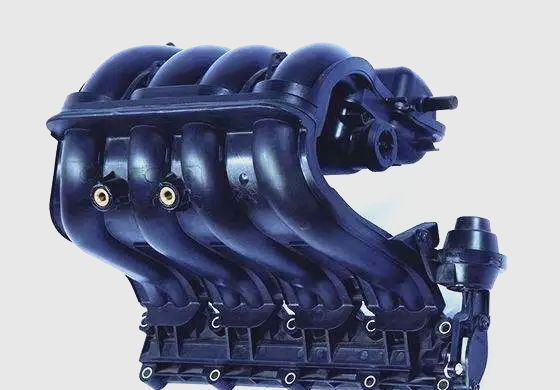
PA66 GF30 is required for continuous 140–170°C, short peak up to 250°C. Automotive under-hood (intake manifolds, engine covers), high-power relay bobbins, near-motor components, industrial cookware structural parts.
Quick Thermal Litmus Test
If you cannot hold your gloved hand on the hottest exposed location of the working part for 3 seconds (> 60°C surface), but boiling water poured on it does NOT deform it (≤ 100°C continuous) → PA6 is sufficient. If boiling water or a 150°C oven heat test shows deflection → PA66 or PA6/66 blend.
5. Chemical Resistance & Moisture Absorption
Both PA6 and PA66 have excellent resistance to:
Hydrocarbons (gasoline, diesel, motor oil, gear oil, hydraulic fluid)
Most alcohols, weak acids and weak alkalis at room temperature
Chlorinated solvents, refrigerant gases, ester-based lubricants
Both degrade in:
Strong mineral acids (H₂SO₄, HCl) and strong alkalis (NaOH 50% at elevated T)
Phenolic compounds and calcium chloride solutions at > 60°C (stress cracking)
Bleaching solutions containing active chlorine
The main practical difference is moisture absorption: PA6 absorbs marginally more moisture than PA66 (see table above). After 500 hours at 85°C/85% RH, PA6 GF30 tensile drops ~8 % vs PA66 GF30 which drops ~5 %. If your application is a high-humidity tropical outdoor environment with close tolerance snap fits, a small PA66 advantage justifies evaluation. For typical < 60 % RH indoor use the effect is negligible.
6. Dimensional Stability & Shrinkage
Unreinforced PA66 actually shrinks MORE than unreinforced PA6 — a persistent myth that the "higher performance" PA66 should shrink less. This reverses once you add glass fiber: GF-filled PA66 has slightly LESS flow-direction shrinkage (0.30 vs 0.35 %). But both materials' real dimensional issue is ANISOTROPIC shrinkage — cross-direction shrinkage is 2.5-3× the flow-direction shrinkage. This is the #1 cause of warpage in GF-nylon parts. Our defects troubleshooting guide covers this in depth with mold temperature and gate fixes.
7. Injection Molding Processing Parameters Compared
| Barrel Temp | PA6 = 240–265°C, PA66 = 270–295°C | PA66 is ~30°C hotter across the barrel profile |
|---|---|---|
| Mold Temp | PA6 = 60–90°C, PA66 = 80–110°C | PA66 mold hotter for good surface and crystallization |
| Drying | Both identical: 80°C × 4h to ≤ 0.08 % moisture (dehumidifying dryer mandatory) | |
| Cycle Time | ~10–15% longer for PA66 because hotter melt takes longer to cool to ejection temperature | |
| Melt Decomposition | Keep barrel residence time ≤ 6 min for both; 5 min at top of range for PA66 to avoid discoloration | |
Processing cost: PA66 will cost you ~3-5 % more per shot in higher electricity consumption (higher barrel temps) and longer cycle time. For a 500-Ton press running 24/7, this is a non-trivial 4- to 5-figure annual cost on top of the raw-material premium.
8. Cost-Performance Analysis
Scenario: a medium-volume automotive bracket project, 50,000 parts / year, 85 grams each, 30% GF required:
| Annual resin (kg) | 50,000 × 0.085 = 4,250 kg |
|---|---|
| Option A — Premium PA66 GF30 | 4,250 × $ 2.65 = $ 11,263 / year |
| Option B — Premium PA6 GF30 | 4,250 × $ 2.10 = $ 8,925 / year (saves $ 2,338) |
| Option C — Juhai Cost-Optimized PA6 GF35 | 4,250 × $ 1.68 = $ 7,140 / year (saves $ 4,123 vs PA66) |
On this typical 4-ton-per-year bracket project, PA6 is over USD 2,300 per year cheaper, and Juhai's 35% GF cost-optimized PA6 grade saves over $ 4,100 per year with mechanicals that exceed PA66 GF30's tensile (138 MPa for our PA6 GBA35 vs 190 MPa for premium PA66 GF30 — we do transparently publish the spec, so please check if PA6 GF35 meets your actual load; we will tell you honestly if it doesn't.)
9. 15 Real-World Application Case Studies
Applications where PA6 is the BETTER choice (9 of 15):
Consumer-grade power tool gearbox housing (class B surface, 110°C HDT sufficient)
Office furniture height-adjustment mechanism bracket
Reel and spool components for fishing tackle (impact > 12 kJ/m² is enough)
Domestic washing machine detergent dispenser drawer housing
Electric bicycle battery lower case structural frame (room temp)
Industrial conveyor belt idler pulley (PA6 GF35 matches competitor PA66 GF30 in testing)
Light-duty cable cleat and ladder tray fastener
Kitchen blender drive shaft coupler (low heat, snap-fit critical)
Automotive secondary interior dashboard mounting bracket (hidden, 80°C max)
Applications where PA66 is the CORRECT choice (6 of 15):
Automotive intake manifold — direct contact 140°C coolant lines and vibration creep
Terminal block and relay base with 125°C continuous operating temp per IEC standard
Heavy-duty industrial ratchet wrench gear cage (max fatigue strength)
Industrial cooker deep-fryer structural bracket (150°C continuous use)
2.5 kV high-voltage bushing and insulator requiring UL 746B 130°C RTI
Automotive door check strap / hinge bearing washer (high creep load + winter -40°C)
10. 30-Second Decision Checklist: PA6 or PA66?
| ⓵ Continuous use temp > 140°C? | YES → PA66 · NO → go to ⓶ |
|---|---|
| ⓶ Sustained structural load > 80 MPa? | YES → PA66 · NO → go to ⓷ |
| ⓷ Customer spec explicitly requires PA66? | YES → PA66 · NO → go to ⓸ |
| ⓸ Can you accept 5 % lower tensile for 25 % lower cost? | YES → PA6 (or PA6 GF35 ≈ PA66 GF30 for same price) |
| ⓹ Still unsure? | → Send part drawing + load case to Juhai R&D for free simulation-based grade recommendation within 24h. |
11. 8 Most Frequently Asked Questions
Jump directly to the full plastic material FAQ section on the blog home page, or read the expanded 8 PA6-vs-PA66 specific FAQs (with structured data for Google People Also Ask).
12. Summary & Next Steps
In one sentence: If your application can live within PA6's HDT and you're optimizing total cost, PA6 (especially 35% GF cost-optimized) is almost always the rational engineering choice. If you need every last degree of heat resistance and creep stiffness — or an existing standard locks you in — PA66 GF is worth every penny of its premium. Not sure where your part falls? Juhai's R&D engineers will read your drawing, review your spec, and recommend a grade with actual expected performance numbers and sample test results — all free of charge, within 24 hours of you contacting us.
Free Grade Recommendation for Your Part
Send us your part drawing, load condition, temperature range and annual volume — our R&D engineers will recommend either PA6, PA66 or a copolymer blend, with expected mechanicals and two pricing options (premium and cost-optimized grades).
Contact Juhai R&D →